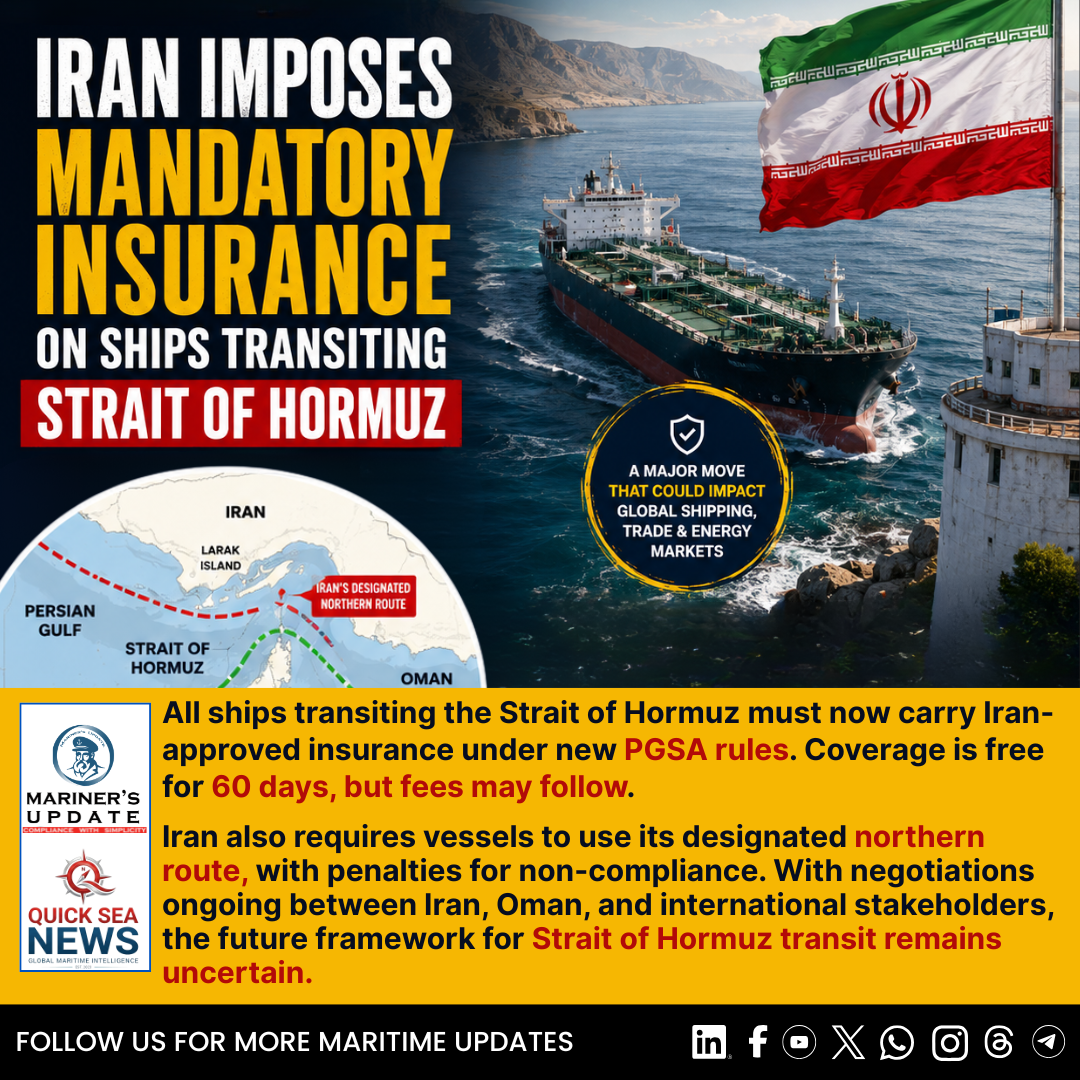
Iran has introduced a new regulatory framework for vessels transiting the Strait of Hormuz, requiring all ships to obtain insurance approved by Tehran’s newly established Persian Gulf Strait Authority (PGSA). The move represents Iran’s strongest attempt yet to exert greater control over one of the world’s most strategically important maritime chokepoints.
Under the new rules, all vessels passing through the Strait of Hormuz must carry PGSA-approved insurance coverage. Iran has stated that the insurance will be provided free of charge for an initial 60-day period, with all costs covered by the Iranian government. However, authorities have also confirmed that insurance fees may be introduced once the temporary period expires, requiring shipowners to purchase and renew the coverage.
The requirement comes despite the recently signed US-Iran Memorandum of Understanding (MoU), which guarantees safe and toll-free passage for commercial vessels through the strait for 60 days. While Iran argues that the insurance requirement does not violate the agreement because no fees are currently being charged, industry stakeholders view the measure as a potential precursor to future transit-related costs.
In addition to the insurance mandate, Iran is insisting that vessels use its designated northern transit route near Larak Island. The PGSA has warned that ships deviating from the approved route could face penalties, revocation of passage permissions, or other legal actions. This position directly challenges the growing use of the US-protected southern corridor near the Omani coast by many commercial vessels.
The PGSA has also declared itself the sole authority responsible for processing transit applications and issuing passage permits for vessels navigating the Strait of Hormuz. The new terms have been circulated throughout the shipping industry and submitted to the International Maritime Organization (IMO) for review.
Shipowners, tanker operators, Middle East Gulf states, and major oil companies have expressed concern over the development. Many argue that introducing mandatory insurance schemes and potential future fees could undermine long-standing principles of freedom of navigation and create uncertainty for global shipping markets.
IMO Secretary-General Arsenio Dominguez has reportedly cautioned that allowing transit fees in strategic waterways could establish a dangerous precedent for other international shipping routes. Discussions involving Iran, Oman, and international stakeholders are ongoing to develop a long-term framework that aligns with international maritime law.
Meanwhile, US officials continue to emphasize that international waterways should remain free from tolls and additional charges. While Washington’s immediate priority remains keeping the Strait of Hormuz open and secure, negotiations are expected to continue regarding the future governance and security arrangements for the vital maritime corridor.
The latest development highlights the growing geopolitical and operational challenges facing shipowners trading through the region. With approximately one-fifth of global oil supplies passing through the Strait of Hormuz, any changes to transit regulations could have significant implications for shipping costs, energy markets, and global trade flows.