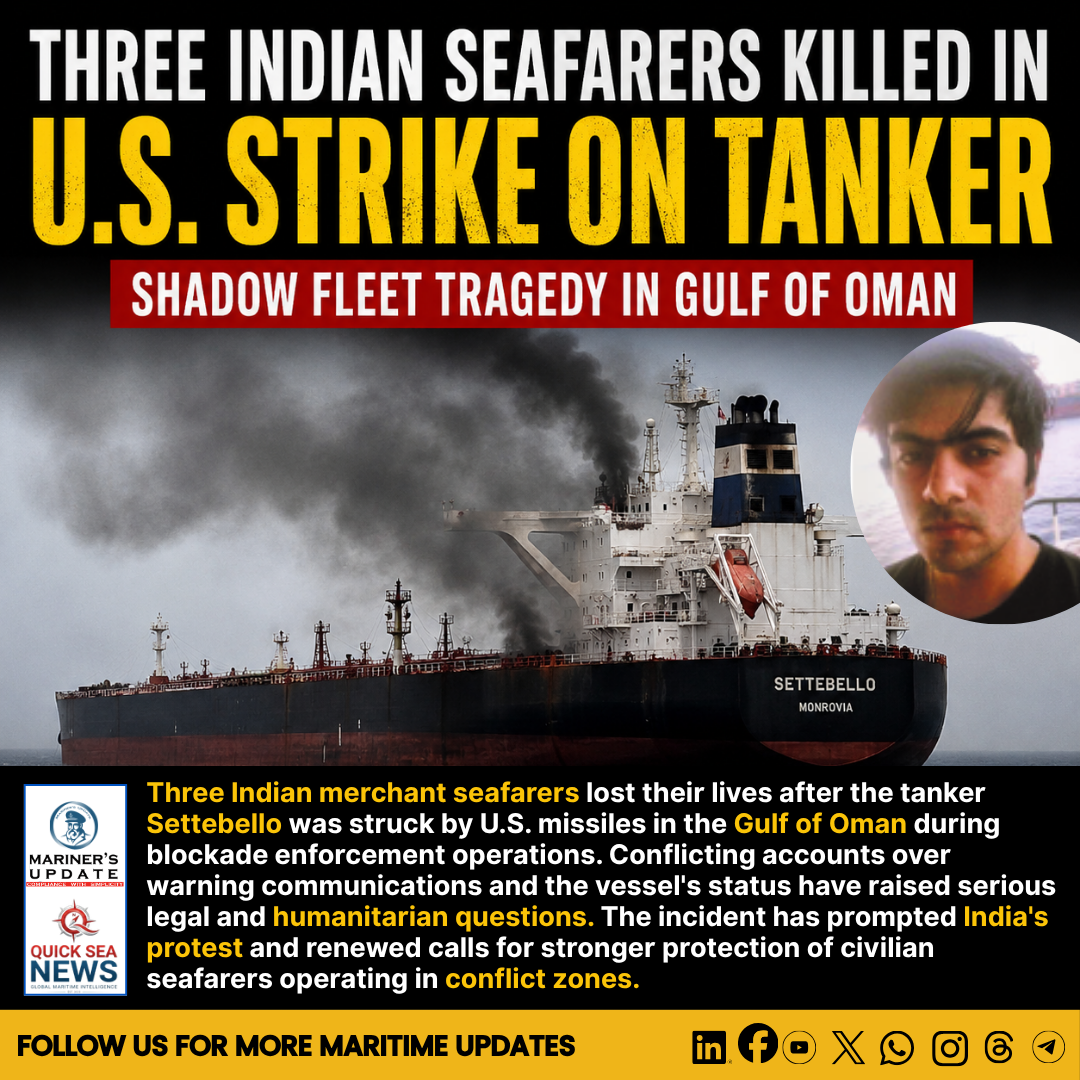
Three Indian seafarers lost their lives after a U.S. missile strike targeted the shadow fleet tanker Settebello, raising serious questions over maritime safety, blockade enforcement, and the protection of civilian merchant crews.
Civilian Seafarers Become Victims as Shadow Fleet Tanker Settebello is Struck in Gulf of Oman
The deaths of three Indian merchant seafarers aboard the tanker Settebello have brought renewed global attention to the growing dangers faced by commercial shipping in conflict zones. The incident, which occurred in the Gulf of Oman during heightened tensions between the United States and Iran, has sparked debate over the legality of the military strike, the responsibilities of ship operators, and the protection of civilian crews working aboard sanctioned trade routes.
A Routine Contract Turns Into a Deadly Mission
For the 28-member crew—most of them Indian nationals—the voyage initially appeared to be another commercial assignment. However, the vessel they had joined was allegedly part of the so-called “shadow fleet,” a network of tankers accused of transporting Iranian oil while evading U.S. sanctions through practices such as disabling tracking systems and conducting ship-to-ship transfers.
According to maritime intelligence, Settebello had reportedly been involved in transporting Iranian oil for nearly five years despite not being directly sanctioned by the United States.
The tanker departed from Lianyungang, China, in late April before proceeding toward the Gulf of Oman.
Operations in a High-Risk Zone
During the first week of June, the vessel remained near Oman’s territorial waters before a new master assumed command on June 2.
Crew members later stated that the tanker carried out multiple ship-to-ship oil transfers at sea. While the crew was never officially informed about the cargo’s origin, some believed it was Iranian oil. U.S. Central Command later confirmed that its intelligence assessed the cargo to be Iranian.
The vessel eventually loaded approximately 26,000 metric tonnes of bitumen, a petroleum product commonly used in road construction.
Conflicting Accounts Before the Strike
The United States maintains that the tanker repeatedly ignored its blockade enforcement measures.
According to U.S. Central Command:
- Nearly 60 radio warnings were issued.
- The vessel allegedly ignored at least eight military demonstrations, including fighter jet flyovers and warning flares.
- Two final warnings were reportedly transmitted before the strike, including one instructing the crew to evacuate the engine room within 15 minutes.
However, these claims have been strongly disputed.
The Forward Seamen’s Union of India stated that senior crew members and the bridge cadet denied receiving any vessel-specific warnings. They claimed only general navigation broadcasts regarding restricted areas had been heard and insisted the crew never responded aggressively to U.S. communications.
This contradiction remains one of the central issues surrounding the incident.
Missile Strike Claims Three Lives
On the morning of 10 June, while much of the crew was asleep, U.S. missiles struck the engine room of Settebello.
The attack killed:
- Chief Engineer Suresh Patnala
- Fitter Shivanand Chaurasia
- Trainee Cadet Aditya Sharma
The strike marked the first reported civilian fatalities directly linked to the U.S. blockade operations against Iranian maritime trade during the conflict.
Questions Over Use of Force
One of the most controversial aspects of the incident concerns the vessel’s condition at the time of the strike.
Several crew members stated that the tanker had shut down its engines and had been drifting in the Gulf of Oman after a planned ship-to-ship transfer failed to take place.
Independent maritime experts reviewing released footage also suggested there was no visible indication that the vessel was underway.
If the vessel was indeed stationary, legal experts argue it raises important questions regarding whether disabling force against the engine room was necessary or proportionate under international maritime law.
Experts noted that blockade enforcement generally requires the least destructive means possible before resorting to military action.
The U.S. military has declined to comment on whether the vessel was drifting but defended the operation, stating that disabling a non-compliant vessel was safer than attempting a physical boarding.
India Seeks Accountability
The incident prompted diplomatic protests from India, one of the world’s largest suppliers of merchant seafarers.
The Forward Seamen’s Union of India has demanded:
- Compensation for the victims’ families.
- An independent international investigation.
- Accountability for the deaths of civilian seafarers.
Union representatives stressed that merchant mariners are civilians performing commercial duties and should never become casualties of armed conflict.
Growing Risks for Merchant Shipping
The Settebello tragedy highlights the increasingly dangerous environment facing commercial vessels operating around the Strait of Hormuz and the Gulf of Oman.
As geopolitical tensions continue to escalate, merchant ships—particularly those suspected of involvement in sanctioned trade—face significantly higher operational risks. The incident also raises broader concerns regarding employer responsibility, voyage risk assessments, crew awareness, and the protection of civilian mariners navigating conflict zones.
For the families of those who lost their lives, however, the legal debate offers little comfort. They continue to seek answers over why civilian sailors carrying out their duties became victims of a conflict they were never part of.