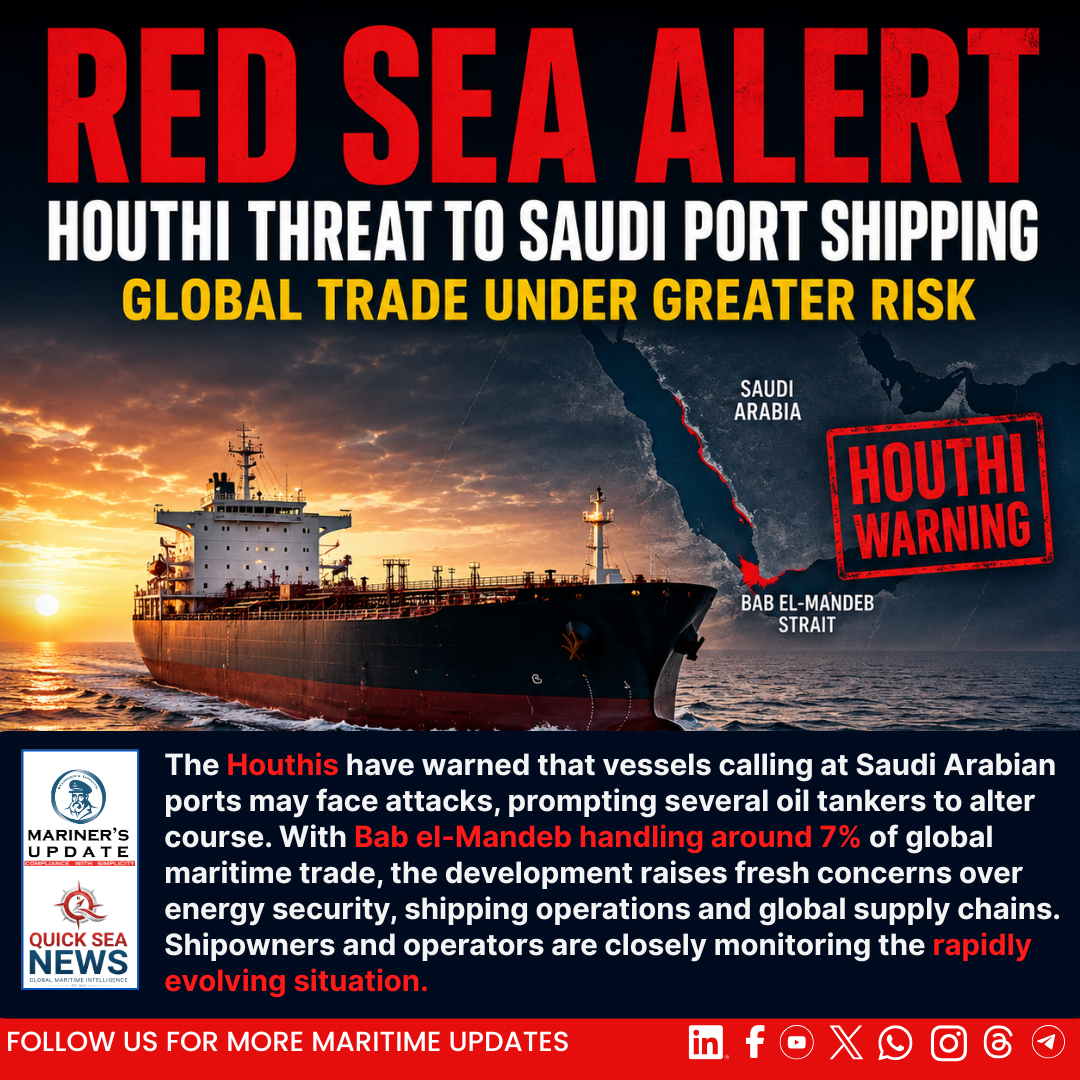
The maritime industry is facing another major security challenge as Yemen’s Houthi movement has issued a direct warning to international shipping companies, stating that vessels calling at Saudi Arabian ports could become legitimate targets. The development significantly raises the risk profile for commercial shipping in the Red Sea and comes at a time when concerns are already mounting over the security of the Strait of Hormuz.
The warning follows the Houthis’ announcement of what they describe as a naval blockade against Saudi Arabia. Shipping companies reportedly received emails advising them not to load or discharge cargo at Saudi ports, warning that vessels engaged in such operations could be targeted “at any location” within the group’s operational reach.
Immediate Market Reaction
The threat triggered an immediate response across the shipping industry. Several crude oil tankers that had already loaded Saudi Arabian crude destined for China and India altered their routes, turning away from the Bab el-Mandeb area and heading toward the Suez Canal. According to Houthi statements, six vessels reportedly changed course following the warning.
This rapid rerouting demonstrates the seriousness with which shipowners and operators are treating the evolving security situation.
A New Layer of Risk for Global Shipping
The latest warning expands the maritime security crisis beyond previous attacks that primarily focused on vessels linked to Israel or Western interests.
Industry experts believe the new warning potentially places:
- Saudi crude oil exports at greater risk.
- Tankers calling at Saudi Arabian ports under increased threat.
- Shipping companies in a difficult position when planning voyage routes.
- Marine insurers and charterers under pressure to reassess operational risks.
- Freight markets facing additional uncertainty.
Strategic Importance of Bab el-Mandeb
The Bab el-Mandeb Strait is one of the world’s most critical maritime chokepoints, connecting the Red Sea with the Gulf of Aden and ultimately linking the Suez Canal to the Indian Ocean.
Approximately 7% of global maritime trade passes through this corridor, making any disruption capable of affecting:
- Global energy supplies
- International container shipping
- Bulk cargo movements
- Supply chain reliability
- Freight costs worldwide
Combined with the Strait of Hormuz, nearly 25% of global oil and gas shipments transit these two strategic waterways, highlighting the broader implications of any prolonged disruption.
Experts Warn of Wider Consequences
Security analysts suggest that while the Houthis have not officially announced the closure of the Bab el-Mandeb Strait, the warning against vessels using Saudi ports creates significant uncertainty for commercial operators.
Analysts also note that vessels carrying Saudi crude could become particularly vulnerable, although the Houthis have not publicly clarified the exact criteria they intend to use for selecting targets.
Some observers believe that shipping companies transporting Saudi energy cargoes may face increased operational risks regardless of vessel nationality.
A Pattern of Maritime Attacks
The latest warning follows an extended period of attacks in the Red Sea between 2023 and 2025, during which the Houthis reportedly used:
- Armed drones
- Anti-ship missiles
- Fast attack boats
- Unmanned surface threats
More than 100 commercial vessels were targeted during previous campaigns, leading many shipping companies to divert around the Cape of Good Hope instead of using the Red Sea.
Regional Conflict Continues to Intensify
The maritime security situation is unfolding alongside continued military operations across the Middle East.
The United States has stated that it remains prepared to respond should threats against international shipping continue. At the same time, Washington indicated it remains open to meaningful diplomatic negotiations with Iran.
Meanwhile, reports suggest ongoing military strikes involving Iran, while several regional countries, including Jordan and Kuwait, have also reported missile and drone incidents affecting their territories and infrastructure.
Diplomatic efforts continue behind the scenes, with discussions reportedly exploring options for a temporary ceasefire aimed at creating space for renewed negotiations.
Operational Impact for the Maritime Industry
Shipowners, operators, charterers and masters should closely monitor developments as the evolving security environment may lead to:
- Voyage rerouting decisions.
- Increased war risk insurance premiums.
- Enhanced security measures onboard.
- Higher freight and bunker costs.
- Delays in crude oil and cargo deliveries.
- Greater operational uncertainty across Red Sea trade routes.
Continuous voyage risk assessments, compliance with company security procedures, close monitoring of naval advisories, and timely intelligence updates remain essential for vessels operating in or near the Red Sea and Gulf region.