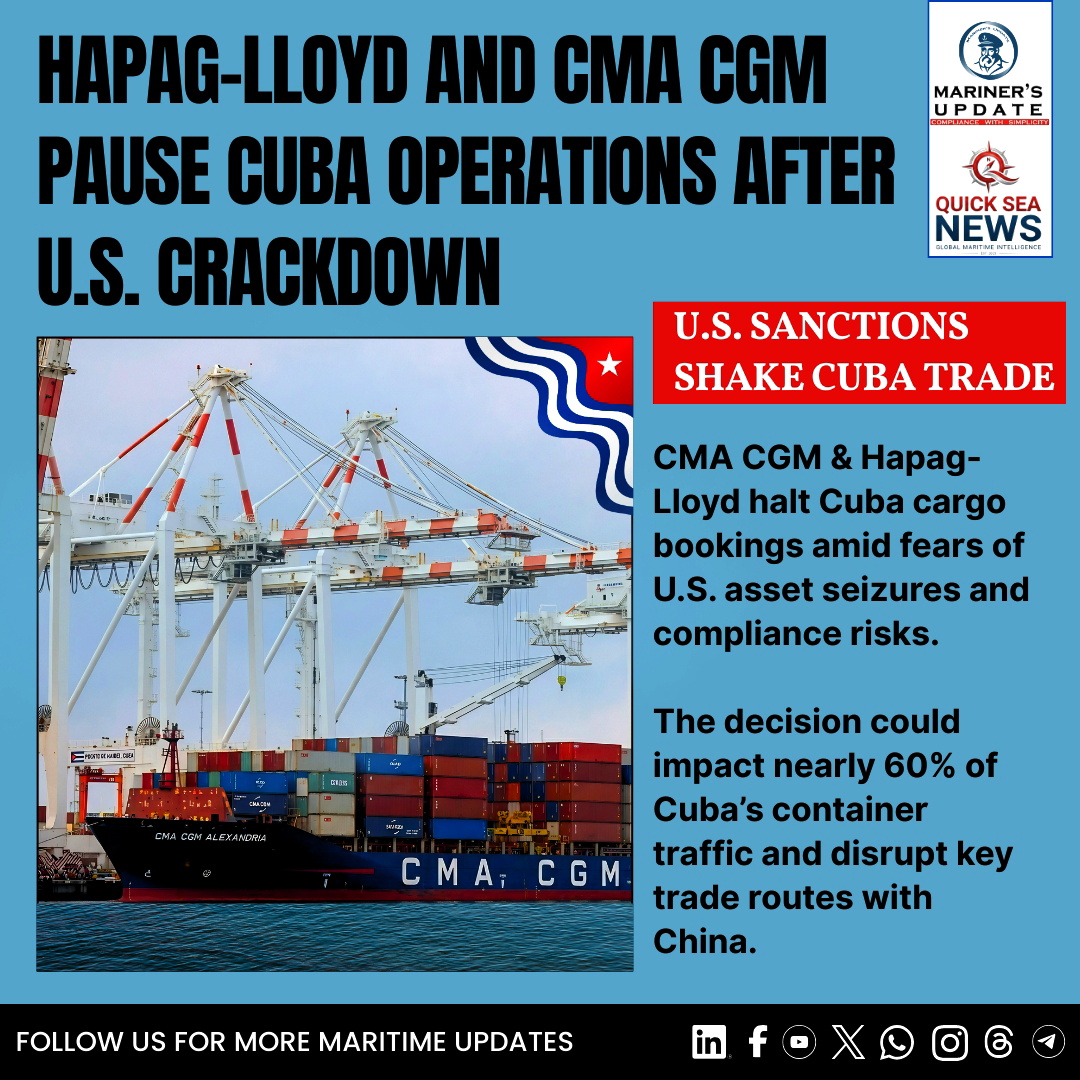
Global shipping lines are beginning to distance themselves from Cuba after the United States introduced a sweeping new sanctions framework targeting entities connected to the Cuban economy. Two of the world’s largest container carriers, CMA CGM and Hapag-Lloyd, have now suspended cargo bookings to and from Cuba due to growing concerns over exposure to U.S. penalties and potential asset seizures.
The move follows a new executive order issued by the Trump administration on May 1, aimed at tightening economic restrictions on the Cuban government. The order authorizes the freezing of assets belonging to foreign companies or organizations that conduct business with sectors linked to the Cuban state. These sectors include energy, defense, mining, metals, financial services, security operations, and potentially any other area tied to the Cuban economy.
Although shipping was not directly named in the sanctions list, the broad wording of the order has created major compliance concerns across the maritime industry. Since a large portion of Cuba’s economy remains state-controlled, shipping companies face significant challenges in ensuring that cargo movements are not indirectly supporting government-linked activities.
Industry analysts believe the latest restrictions could severely disrupt Cuba’s international trade network. Sources within the shipping sector estimate that the suspension by CMA CGM and Hapag-Lloyd alone may impact nearly 60 percent of the island’s containerized cargo traffic. Trade routes involving China are expected to be among the hardest hit, given their importance to Cuban imports and exports.
The executive order also extends beyond corporate entities. It specifically targets senior executives of companies found to be in violation of the sanctions regime, while also threatening financial institutions that facilitate transactions connected to Cuba. This broader enforcement mechanism has intensified concerns among international carriers, banks, and logistics providers, many of whom may now choose to avoid Cuban trade altogether rather than risk U.S. penalties.
According to compliance experts, the new measures are likely to deepen Cuba’s economic isolation. However, analysts also note that despite years of sanctions and economic pressure, the Cuban government has continued to maintain its political control. Some observers argue that international firms may increasingly “over-comply” with U.S. sanctions rules to minimize legal and financial risk, further limiting Cuba’s access to global trade and investment.
The suspension of services by major carriers marks another significant escalation in the long-running geopolitical and economic tensions between the United States and Cuba. For the maritime sector, it also highlights how rapidly evolving sanctions policies can reshape global shipping patterns and commercial risk assessments almost overnight.