Ch 2.4.1
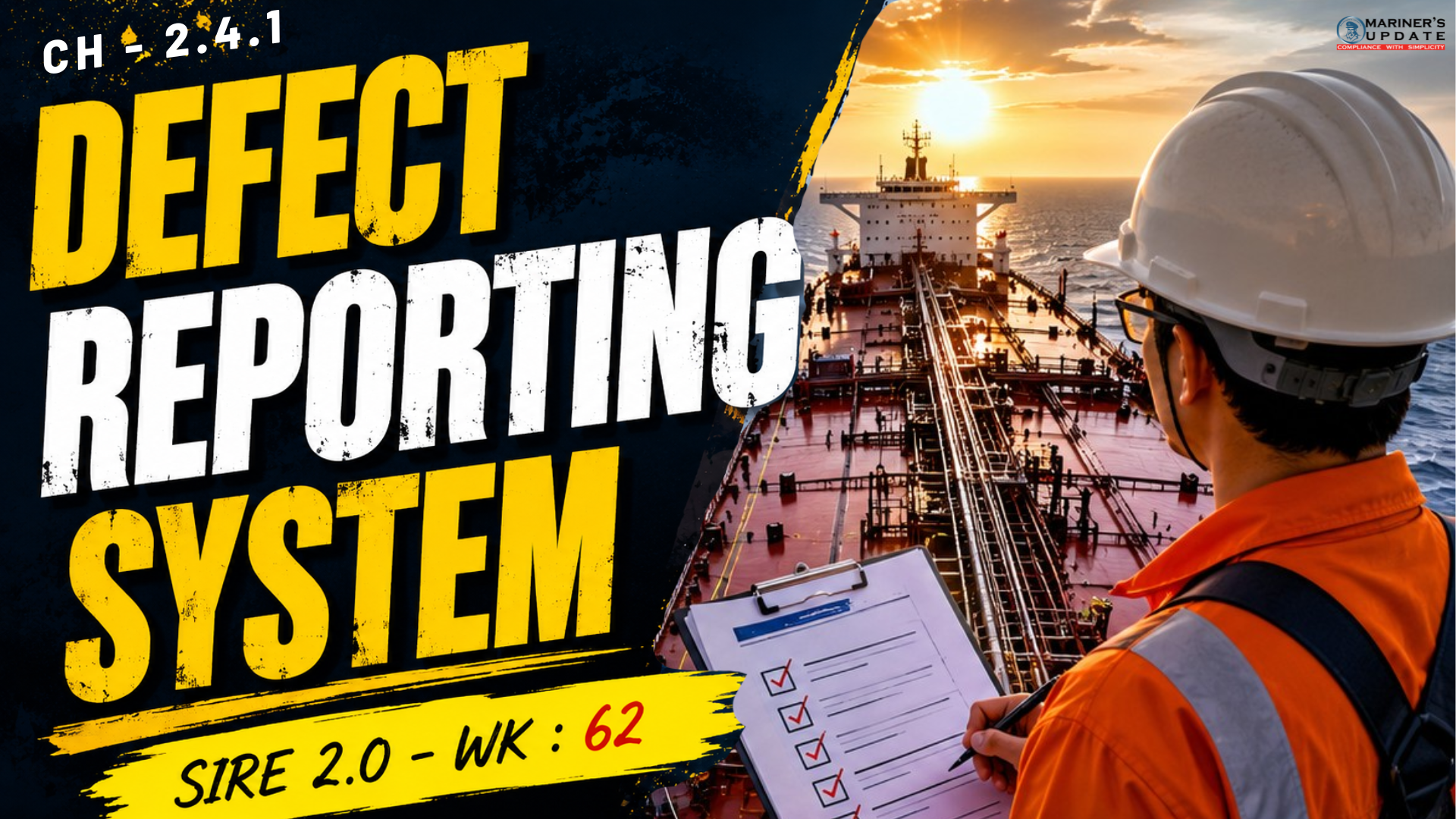
Were the senior officers familiar with the company procedure for reporting defects to vessel structure, machinery and equipment to shore-based management through the company defect reporting system and was evidence available to demonstrate that all defects had been reported accordingly?
Applies to: OIL TANKER / CHEMICAL TANKER / LNG / LPG
Potential Ground for Negative Observation (OBS)
- There was no defect reporting system.
- There was no company procedure for managing defects to vessel structure, machinery and equipment through the defect reporting system.
- The accompanying senior officer was unfamiliar with the company defect reporting procedure.
- Defects entered in the defect reporting system had not been acknowledged by shore management.
- Defects were evident onboard the vessel during the inspection that were required to be entered in the defect reporting system but were not. In such cases identify the defective equipment in the negative observation module of the Hardware response tool. Such observation should be limited to items listed on the supplements to the statutory certification or subject to class survey.
- Defects which had either caused an incident or were caused by an incident that had not been reported through the company incident reporting system for further investigation.
Where defects were properly recorded in the defect reporting system and acknowledged by shore management, such defects should not result in a negative observation under this question.
Checklist for You
1. Are all senior officers familiar with the definition of defect as outlined in company procedure and company defect reporting procedure?
2. Have all defects been reported in accordance with the company defect reporting system?
3. Are there any defects on board which have not been reported into the defect reporting system?
4. Have any defects which had caused an incident or were caused by an incident been reported through the system for further investigation?
5. Have all defects entered in the defect reporting system been acknowledged by shore management?
Guidelines
HUMAN
The accompanying Senior Officer must be familiar with the company defect reporting procedure.
PROCESS
The vessel operator must have a defect reporting system available, which may be incorporated within the Safety Management System (SMS). The Inspector will verify the procedure, ensuring it defines the following:
What constitutes a defect to structure, machinery, and equipment that must be reported through the defect reporting system. This should include:
- Navigation equipment
- Engine machinery
- Deck machinery
- Cargo-handling machinery/equipment
- Hull structure
- Electronic equipment
The procedure should also define:
- The process for entering defects into the defect reporting system.
- The timeline for entering a defect into the defect reporting system and then transmitting the report to shore-based management.
- The process for shore-based management to acknowledge a defect and assign a timeline for corrective action.
- The process for establishing mitigating actions where the reported defect adversely affects the safe operation of the vessel.
- The requirement to submit an incident report where a defect resulted in or was the cause of an incident, as defined in company procedures.
This system should ensure clear procedures for managing defects, tracking their resolution, and ensuring the safety and efficiency of operations.
HARDWARE
The Inspector will also observe any visibly defective structure, machinery, or equipment that is not covered by any defect report.
In addition, if the defects were caused by an incident, or if the defects themselves had caused an incident, the Inspector will verify whether an investigation has taken place.
This ensures that any serious issues are properly addressed, investigated, and corrected, with a focus on maintaining safety and operational standards.
References
TMSA
KPI 4.1.2 requires that a defect reporting system is in place for each vessel within the fleet. The defect reporting system covers all onboard equipment and includes Conditions of Class.
IMO
ISM Code – Section 10.1
IACS Information Paper
Classification Societies – What, Why and How?
Section B1
The effectiveness of classification depends upon the shipbuilder, during construction, and the shipowner, once the vessel enters service, cooperating with the Class Society in an open and transparent manner on all issues which may affect its class status.
For the shipowner, this particularly requires acting in good faith by disclosing to the Class Society any damage or deterioration that may affect the vessel’s classification status.
If there is the least question, the owner should notify Class and schedule a survey to determine if the vessel is in compliance with the relevant Class standard.
IACS
Recommendation 2001/Rev.2 (2018)
A Guide to Managing Maintenance in Accordance with the Requirements of the ISM Code