
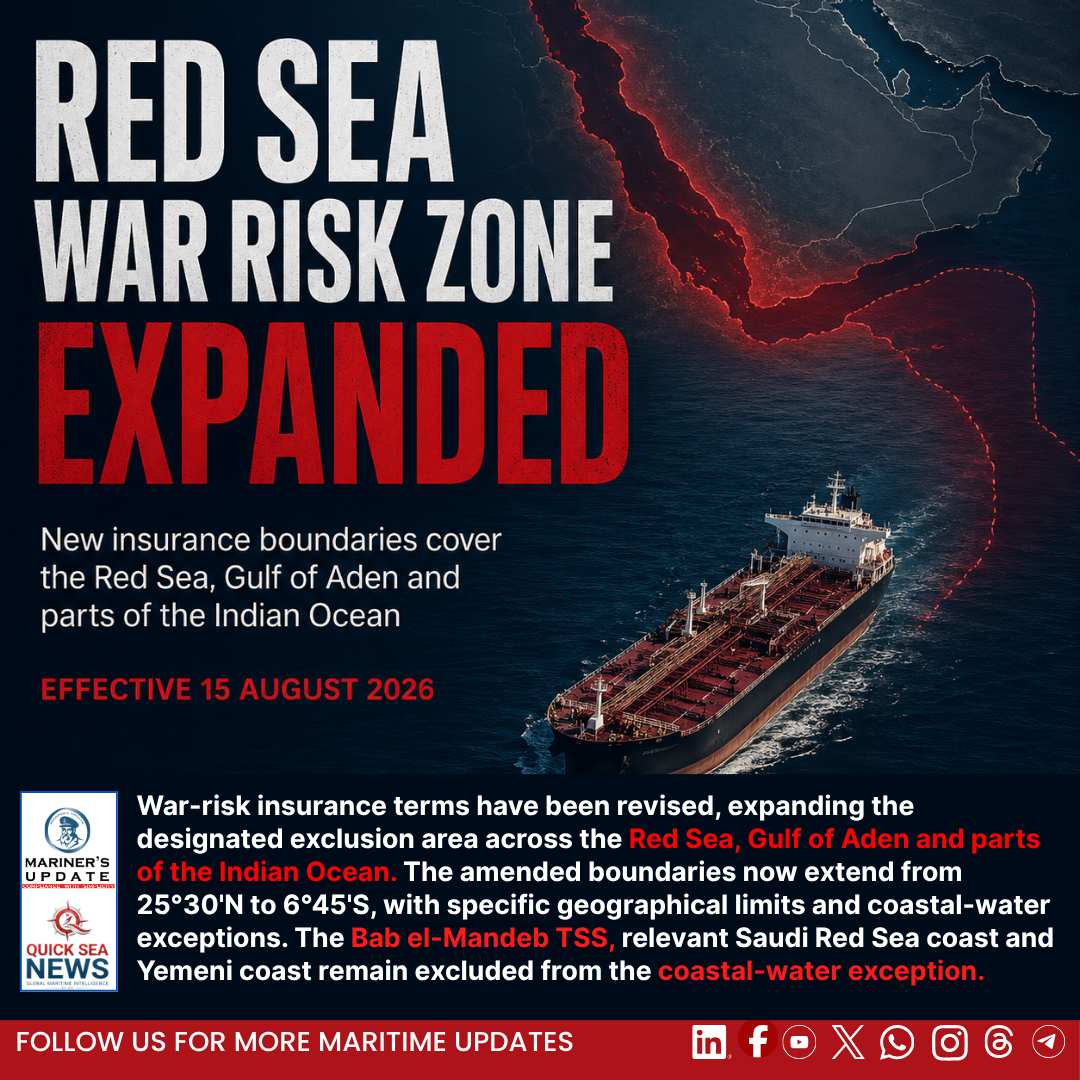
Red Sea War Risk Coverage Area Expanded Under Revised P&I Clause
A significant change to war risk insurance coverage in the Red Sea and surrounding waters has been announced following a notice received by the Association from its reinsurers. The change expands the geographical area covered by the designated Red Sea war-risk exclusion under the applicable “P&I War Risks Clause for Special Cover.”
The revised terms are particularly important for shipowners, charterers, operators and other maritime interests whose insurance arrangements fall within the scope of this clause.
What is changing?
The Association has issued a circular confirming that the designated war-risk area will be expanded. The amendment affects Clause 4(4) of the “P&I War Risks Clause for Special Cover.”
The revised provision applies to war-risk coverage under:
- Charterers’ entries
- Fixed-premium P&I entries
- Additional insurance covers, including additional covers attached to mutual P&I entries, where the “P&I War Risks Clause for Special Cover” applies
However, the change does not apply to:
- Mutual P&I entries
- Excess War P&I cover
- FD&D cover
When does the change take effect?
The notice was given effective from 24:00 hours GMT on 12 August 2026.
Following the specified 72-hour notice period, the amendment to Clause 4(4) takes effect at 24:00 hours GMT on 15 August 2026.
This means vessels and maritime interests operating within the newly defined area need to carefully review their applicable insurance terms and voyage risk assessments.
Expanded designated area
Under the amended clause, war-risk coverage excludes losses, damages, liabilities, costs or expenses occurring within the designated area covering parts of the Indian Ocean, Gulf of Aden and Southern Red Sea.
The revised boundaries are defined geographically as follows:
Northwest:
The Red Sea south of Latitude 25°30’N.
Northeast:
A line extending from the Yemen border at 16°38.5’N, 53°6.5’E to the high-seas point at 14°55’N, 53°50’E.
East:
From the high-seas point at 14°55’N, 53°50’E, extending to 10°48’N, 60°15’E, and then to 6°45’S, 48°45’E.
Southwest:
From the Somalia border at 1°40’S, 41°34’E to the high-seas point at 6°45’S, 48°45’E.
Important coastal-water exceptions
The revised wording also provides an exception for coastal waters extending up to 12 nautical miles offshore of territories that are wholly or partly located within the defined boundaries.
However, this exception does not apply to three specifically identified areas:
- The Bab el-Mandeb Traffic Separation Scheme
- The Red Sea coast of Saudi Arabia that falls within the defined boundaries
- The Yemeni coast
These exclusions are particularly important because they mean that the coastal-water exception cannot automatically be relied upon when assessing war-risk exposure in these areas.
What does this mean for the maritime industry?
The change highlights the continuing insurance implications of security risks across the Red Sea, Gulf of Aden and surrounding waters.
For vessels operating or planning voyages through the affected region, operators and charterers should carefully examine:
- The vessel’s planned route and trading area
- Applicable war-risk insurance terms
- Whether the vessel’s entry falls within the scope of the amended clause
- Additional insurance requirements
- Voyage-specific risk assessments
- The treatment of coastal waters and the specifically excluded areas
- Any contractual obligations relating to war-risk coverage
The geographical coordinates in the amended clause are especially important because the revised exclusion area extends well beyond a narrowly defined Red Sea zone.
Other insurance terms remain unchanged
The Association has also made clear that the amendment does not alter the position of any other areas that are already restricted or excluded under the respective entries.
All other terms and conditions of cover remain unchanged.
For maritime operators, the key takeaway is therefore not simply that the Red Sea exclusion has changed, but that the precise geographical boundaries and exceptions now need to be considered when evaluating war-risk insurance exposure.
This development reinforces the importance of checking insurance conditions before entering or transiting areas affected by changing security and war-risk conditions.