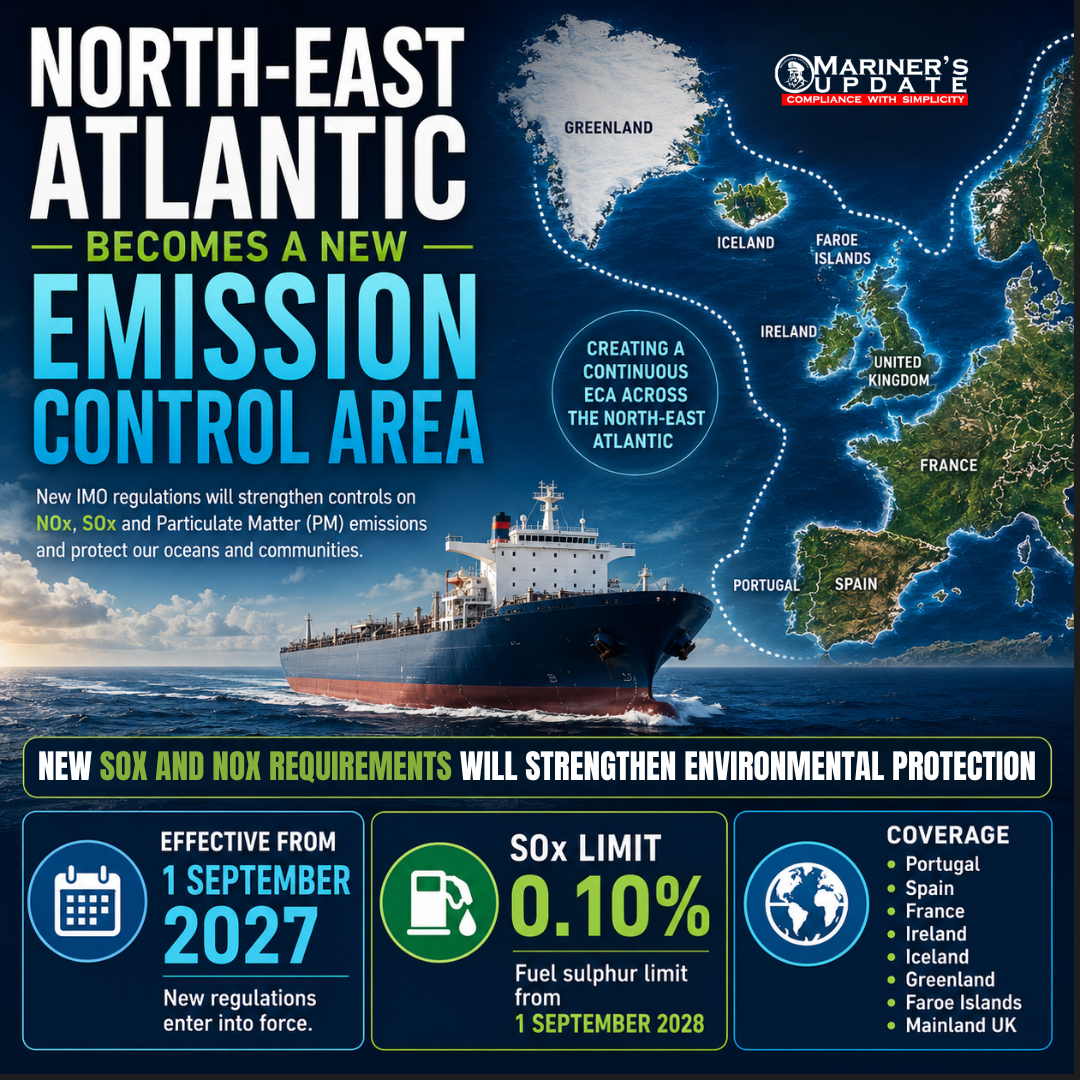
The global maritime industry is set to enter a new phase of environmental compliance following the adoption of amendments to MARPOL Annex VI at MEPC 84, which officially designate the North-East Atlantic as a new Emission Control Area (ECA) for nitrogen oxides (NOx), sulphur oxides (SOx), and particulate matter (PM).
The new regulations will enter into force on 1 September 2027 and represent another significant step in the International Maritime Organization’s efforts to reduce air pollution from ships and protect both marine ecosystems and coastal communities.
Expanding the Global ECA Network
The North-East Atlantic ECA will cover the Exclusive Economic Zones (EEZs) and territorial waters of Portugal, Spain, France, Ireland, Iceland, the Faroe Islands, Greenland, and mainland United Kingdom that are not already included within existing ECAs.
However, the EEZs surrounding Madeira, the Azores, and the Canary Islands will remain outside the new ECA boundaries.
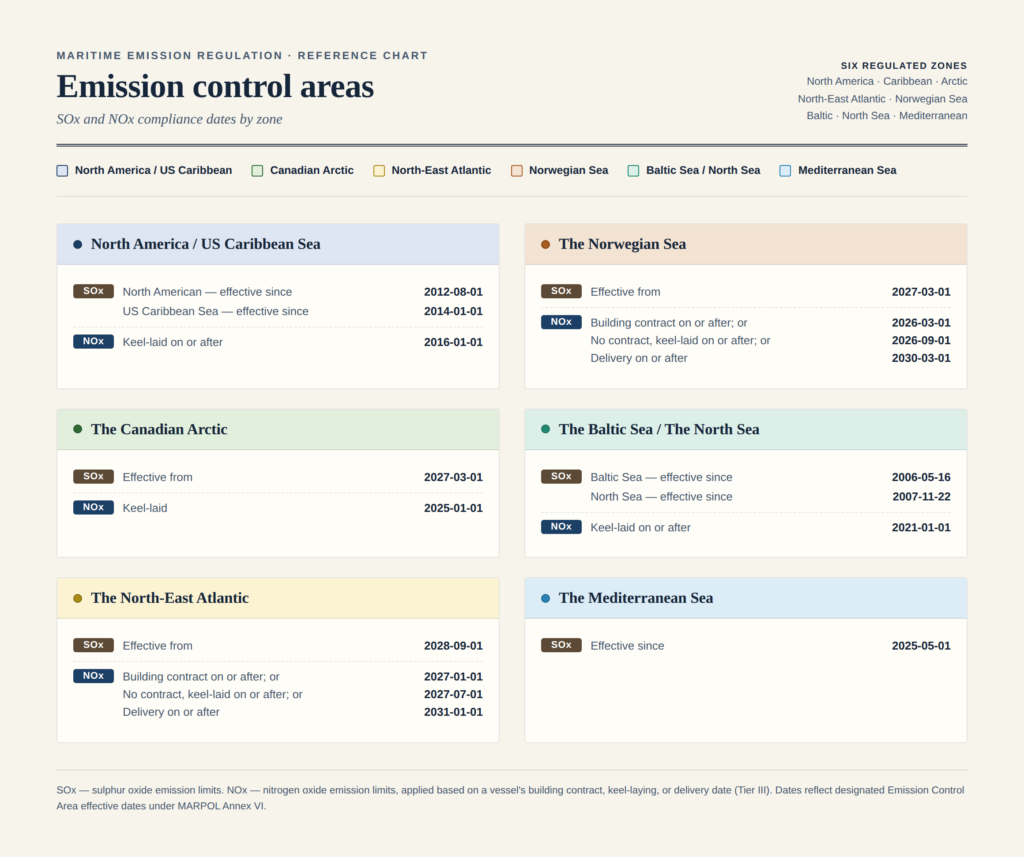
With this designation, a continuous chain of emission-controlled waters will be created, effectively connecting the Canadian Arctic, Norwegian Sea, North Sea, Mediterranean Sea, and North-East Atlantic ECAs into one of the world’s largest interconnected emission-regulated maritime regions.
Why the New ECA Matters
Emission Control Areas are designed to reduce harmful air pollutants generated by ships, particularly:
• Nitrogen Oxides (NOx)
• Sulphur Oxides (SOx)
• Particulate Matter (PM)
These pollutants contribute to environmental degradation, acid rain, respiratory illnesses, and reduced air quality in coastal regions. The new ECA is expected to deliver significant environmental and public health benefits across the North Atlantic region.
SOx Compliance Requirements
The sulphur-related requirements will become effective on 1 September 2028, twelve months after the amendments enter into force.
From this date, vessels operating within the North-East Atlantic ECA must use fuel with a sulphur content not exceeding 0.10%.
Operators may alternatively use approved Exhaust Gas Cleaning Systems (EGCS) while burning higher-sulphur fuels. However, growing restrictions on open-loop scrubber operations across Northern European waters under OSPAR regulations are increasingly limiting the practical use of this compliance option.
NOx Compliance Requirements
The NOx requirements will apply to new ships constructed on or after 1 January 2027 under the IMO’s “three-date” principle.
A vessel will be subject to Tier III NOx standards if:
• The building contract is placed on or after 1 January 2027; or
• The keel is laid on or after 1 July 2027 if no building contract exists; or
• The vessel is delivered on or after 1 January 2031.
Ships meeting any of these conditions and operating diesel engines above 130 kW within the ECA must comply with Tier III NOx emission standards.
The same requirements will also apply to additional engines installed on existing vessels and non-identical replacement engines.
Exemptions
Certain vessels and engines will remain exempt, including:
• Recreational vessels under 24 metres in length used solely for leisure purposes.
• Ships with a combined propulsion power below 750 kW where Tier III compliance is proven technically infeasible.
• Ships undergoing repairs, conversions, or construction within an NOx ECA, provided they meet Tier II requirements and travel directly to or from the repair facility without conducting cargo operations within the ECA.
What Shipowners and Managers Should Do Now
With the implementation timeline already defined, shipowners, managers, shipyards, and flag administrations should begin evaluating their long-term compliance strategies.
Key considerations include:
• Fuel procurement and future fuel strategies.
• Engine certification and Tier III compliance requirements.
• Newbuilding specifications.
• Retrofit planning for existing fleets.
• Assessment of regional restrictions affecting scrubber operations.
Early planning will help operators avoid costly modifications and ensure seamless compliance as the North-East Atlantic joins the rapidly expanding global network of Emission Control Areas.
The new designation marks another milestone in maritime decarbonisation and environmental protection, reinforcing the industry’s transition toward cleaner and more sustainable shipping operations.