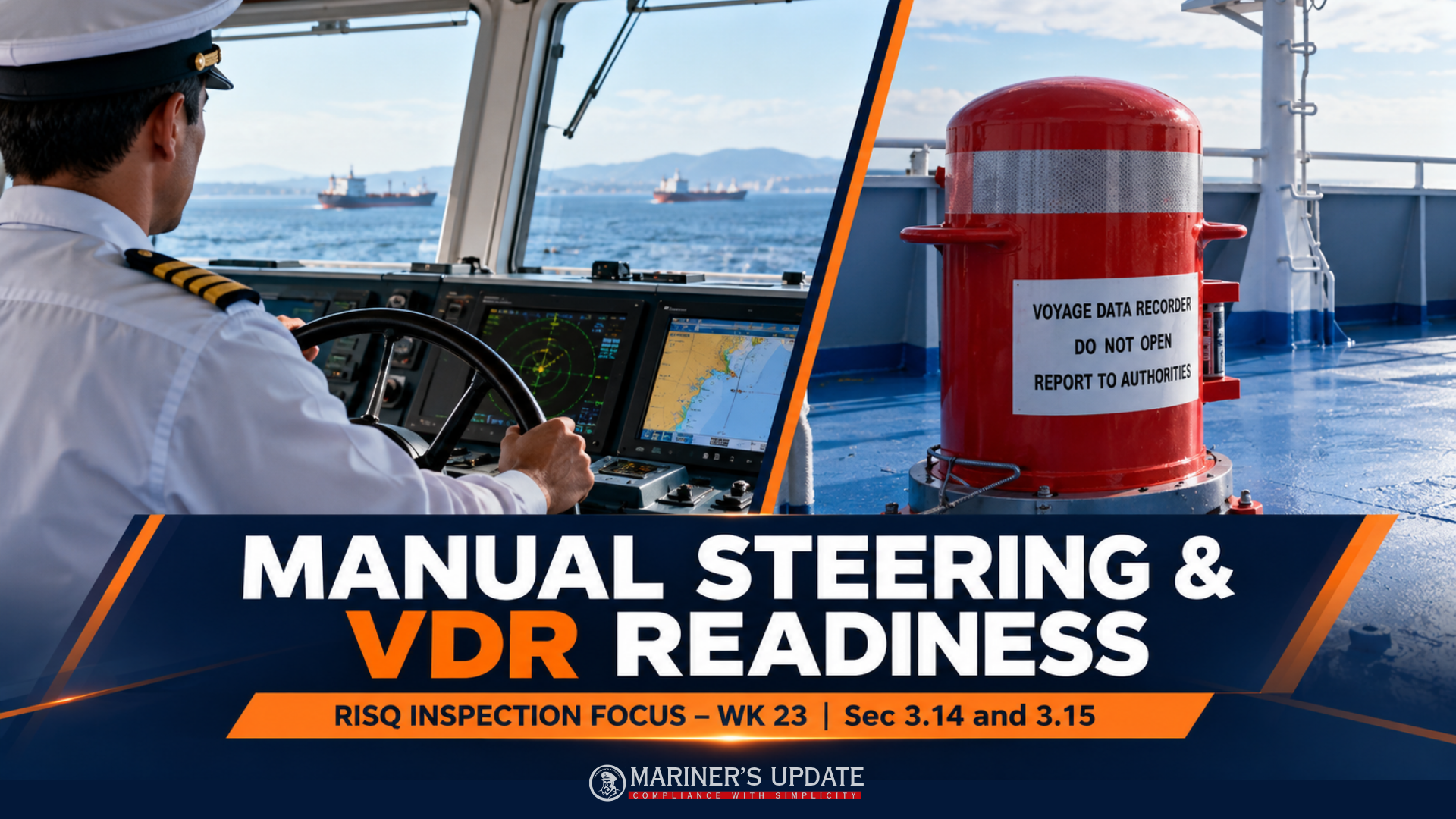
Two small bridge practices that make a big difference when things go wrong.
On a busy bridge, knowing when to take the helm by hand and being ready to protect the Voyage Data Recorder (VDR) record after an incident are habits that protect the ship, the crew and the learning that follows. This week’s focus looks at both.
3.14 | MANUAL STEERING: TAKE CONTROL BEFORE YOU NEED IT
Automatic steering performs well on open water, but it cannot read a crowded sea lane or anticipate a developing situation. That is why manual steering should be used whenever it is appropriate, and not only when something has already gone wrong.
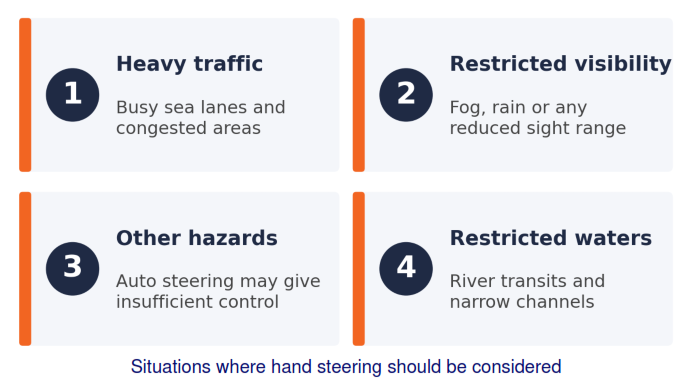
When should hand steering be considered?
- Areas of high traffic density – where frequent, quick helm responses are needed
- Conditions of restricted visibility – when the bridge team needs maximum control and awareness
- Any other potentially hazardous situation – particularly where an automatic steering system may provide insufficient control
- River transits and navigation through restricted waters – where tight margins leave little room for delay
Record Every Change-over
The time and location of engaging hand steering should be recorded in the deck logbook or bell book. The same applies when changing back from manual to automatic steering. A clear, timely entry shows that the change was a deliberate decision made by the bridge team, and it gives a reliable record to refer back to later.
Test Once Every Watch
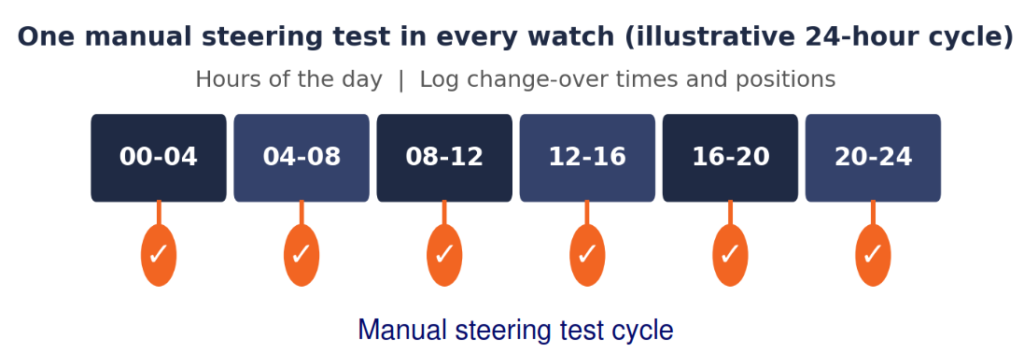
Manual steering should be tested once per watch, using the bridge procedures checklist. Regular testing proves that the helm is responsive and ready, so that the change-over is smooth on the day it is really needed.
3.15 | VDR DATA: PRESERVE IT, UNDERSTAND IT, LEARN FROM IT
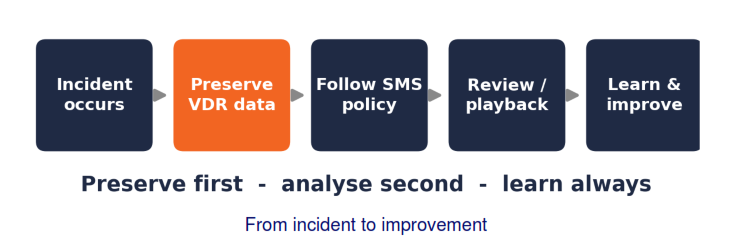
Watchkeeping officers should be familiar with the procedures for preserving VDR data if an incident occurs. The company’s Safety Management System (SMS) should also contain a clear policy on the playback of VDR data.
Know the Preservation Procedure
Every officer on watch should understand the SMS procedures for preserving records. In the moments after an incident there is no time to search for the steps. The data must be secured quickly and correctly, so that nothing valuable is lost.
Playback as a Learning Tool
VDR playback can be a useful tool for analysing the performance of the Bridge Team. A mistake, as long as it is not intentional or caused by carelessness, should normally be treated as a learning opportunity rather than a reason for blame.
A “just” culture gives people the confidence to admit mistakes and near misses. When people speak up, the lessons are shared, and that leads to a safer working environment on board.
Keep the VDR Test-ready
Testing is required annually. It must also always be carried out after repair or maintenance work on the VDR itself, or on any source that provides data to the VDR. This helps confirm that the recorder is capturing the information it is meant to capture.
When is VDR testing required?
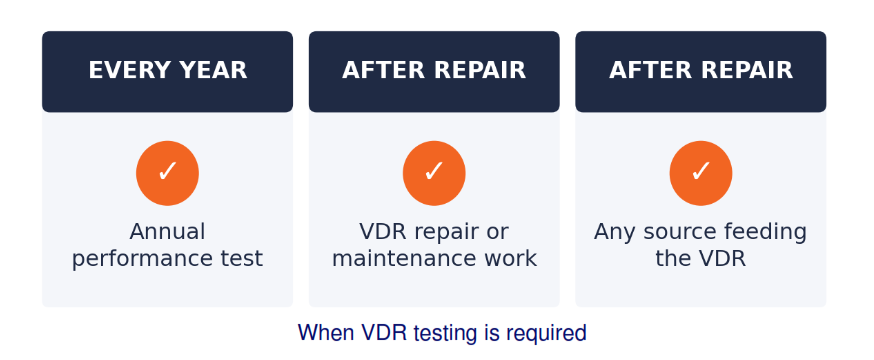
- Every year – the annual test
- After any repair or maintenance work on the VDR
- After any repair or maintenance work on a source that feeds data to the VDR
KEY TAKEAWAYS
- Use manual steering in heavy traffic, restricted visibility, rivers, restricted waters and other hazardous situations.
- Log the time and location of every change-over, in both directions.
- Test manual steering once per watch.
- Know your SMS steps for preserving VDR data after an incident.
- Treat honest mistakes as lessons – a just culture makes ships safer.
- Test the VDR annually and after any related repair or maintenance.