Iran reports an oil tanker fire near the Strait of Hormuz as the sinking of Singapore-flagged GFS PRIDE and a separate bulk carrier incident intensify concerns over commercial shipping security.
Oil Tanker Fire Reported Near the Strait of Hormuz
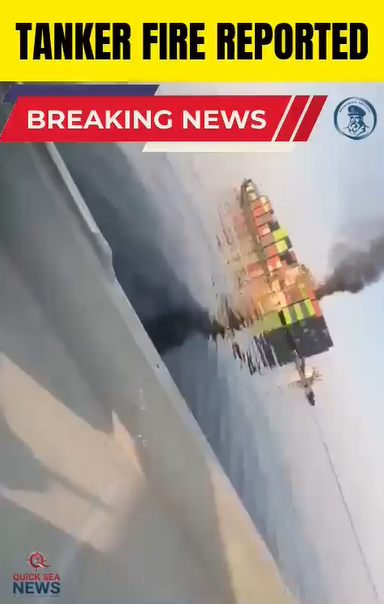
A fresh maritime security alert has emerged in the Gulf region after Iran’s army reported that an oil tanker caught fire near the eastern Strait of Hormuz. According to Iranian reports, the vessel was allegedly attempting to transit a restricted area in the Gulf of Oman.
Iranian military officials described the tanker as a “rogue” vessel and claimed that it had disabled its tracking systems while attempting to pass through the restricted area. However, these allegations have not been independently verified in the available report. The tanker’s identity, the extent of the damage and the condition of its crew were not confirmed in the information available.
The reported fire adds to growing concerns over the safety of commercial vessels navigating the region, where heightened geopolitical tensions have increased uncertainty surrounding maritime movements.
GFS PRIDE Sinks in the Strait of Hormuz
The tanker fire report follows the sinking of GFS PRIDE, a Singapore-flagged container ship involved in a serious incident in the Strait of Hormuz on 14 October 2026.
The vessel reportedly had a capacity of approximately 2,824 twenty-foot equivalent units (TEU) and was carrying more than 2,500 containers at the time of the incident.
Iran’s Revolutionary Guards Navy claimed that the vessel struck a naval mine and caught fire while navigating what it described as an unauthorised and dangerous route. Separately, the United Kingdom Maritime Trade Operations (UKMTO) received a report of a container ship being struck by an unknown projectile. It remains unclear whether these accounts refer to the same circumstances.
Despite the loss of the vessel, all 21 crew members were safely evacuated, with no injuries reported, according to Singapore’s Maritime and Port Authority (MPA).
The incident highlights the serious risks facing merchant vessels operating in the region and the potential consequences of maritime security incidents for ships, cargo and seafarers.
Singapore Condemns Attacks on Commercial Shipping
Singapore’s Maritime and Port Authority expressed concern over attacks on commercial vessels transiting the Strait of Hormuz and condemned such incidents as unprovoked and unjustifiable, describing them as violations of international law.
The safe evacuation of all 21 crew members aboard GFS PRIDE was a positive outcome amid the serious circumstances surrounding the vessel’s loss.
The incident also reinforces the importance of effective emergency preparedness, crew evacuation procedures and timely communication between vessels and relevant authorities when a maritime emergency occurs.
Strait of Hormuz Disruption Raises Global Shipping Concerns
The Strait of Hormuz is a strategically important maritime corridor connecting the Persian Gulf with the Gulf of Oman and the wider Arabian Sea. It is a critical route for international oil and gas shipments, as well as other commercial maritime traffic.
Before the conflict began on 28 February 2026, approximately 125–140 large commercial vessels reportedly transited the waterway each day, including oil tankers, gas carriers, bunker vessels and container ships.
The report noted that oil prices remained above US$100 per barrel amid geopolitical uncertainty and efforts by US President Donald Trump to secure diesel imports through a new arrangement with Russia.
Shipping through the waterway had been severely disrupted following coordinated US and Israeli airstrikes against Iran on 28 February. Although traffic had shown signs of recovery at certain points, further incidents have renewed concerns about the safety and reliability of commercial transits.
Any prolonged disruption to this vital route could affect vessel schedules, cargo deliveries, freight costs and global energy supplies.
Implications for Shipowners, Operators and Seafarers
The reported tanker fire and the sinking of GFS PRIDE highlight the importance of continuous maritime risk assessment when operating in conflict-affected waters.
Shipowners, ship managers, charterers and masters should remain alert to official navigational warnings, maritime security advisories and instructions issued by the relevant authorities. Voyage planning and operational decisions should take account of the latest available information and applicable company procedures.
Effective bridge-team communication, emergency preparedness, crew safety measures and compliance with relevant security requirements remain essential when navigating high-risk areas.
With uncertainty continuing around the security of the Strait of Hormuz, further escalation could have serious implications for seafarer safety, commercial shipping operations and international trade.