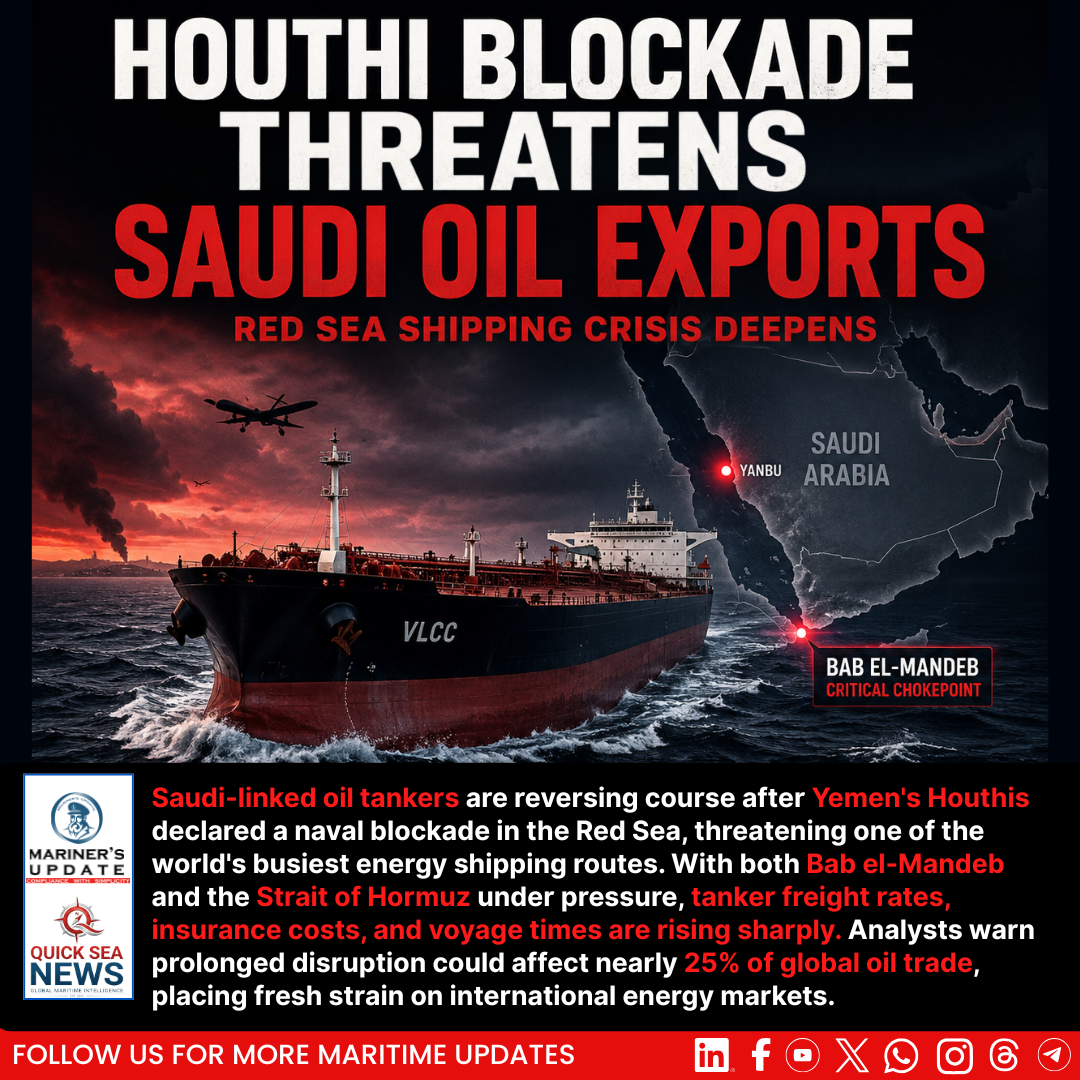
The global shipping and energy markets are facing renewed uncertainty after Yemen’s Houthi movement declared a naval blockade targeting Saudi-linked shipping in the Red Sea. The latest threat is already disrupting commercial traffic, forcing oil tankers and cargo vessels to alter their voyages while raising fears of another major shock to global energy supply chains.
Within the last 24 hours, multiple tankers carrying Saudi crude oil, along with a Chinese car carrier, reportedly turned back while transiting the Red Sea following the Houthi announcement. The development directly threatens Saudi Arabia’s alternative export corridor through the Red Sea—a route that became increasingly important after escalating security concerns in the Strait of Hormuz.
Saudi Arabia’s Alternative Export Route Faces New Risks
As tensions around the Strait of Hormuz intensified, Saudi Arabia shifted a significant portion of its oil exports to its Red Sea terminal at Yanbu, allowing cargoes to bypass the Gulf.
However, the Bab el-Mandeb Strait now faces similar security threats.
During the previous month, Saudi crude oil and petroleum product shipments moving through Bab el-Mandeb exceeded 4 million barrels per day, making the corridor one of the world’s most important energy transit routes.
The Houthi blockade now places this crucial export route under direct pressure, creating uncertainty for oil producers, refiners, shipowners, and charterers alike.
Asian Buyers Forced to Seek Longer Routes
Asian refiners have already begun adjusting their logistics.
South Korea’s Hyundai Oilbank has reportedly started seeking Very Large Crude Carriers (VLCCs) capable of loading crude at Yanbu while retaining the flexibility to route cargo through the Suez Canal and Egypt’s SUMED Pipeline before continuing toward Asia.
The alternative route significantly increases voyage duration and costs.
A voyage from Yanbu to South Korea through Suez and around the Cape of Good Hope may extend transit time by nearly four weeks, while additional bunker fuel expenses alone could increase transportation costs by approximately US$1.63 per barrel.
Because fully loaded VLCCs cannot transit the Suez Canal, operators typically discharge part of the cargo at the Red Sea end of the SUMED Pipeline before reloading it onto another tanker in the Mediterranean.
Global Oil Supply Faces Growing Pressure
According to market intelligence firm Kpler, simultaneous disruption of both the Strait of Hormuz and Bab el-Mandeb could affect shipping routes responsible for transporting roughly 25% of global oil supply.
Recent shipping data already reflects the impact.
- Bab el-Mandeb vessel crossings averaged only 41 ships per day between July 15 and July 20.
- Traffic remains 43% below 2023 peak levels.
- Saudi oil shipments through the strait have declined 34% within just two weeks.
- Strait of Hormuz traffic has fallen sharply from nearly 55 daily crossings in late June to approximately 12.5 vessels per day.
Most remaining traffic through Hormuz is reportedly using Iranian-controlled routing schemes or operating through less transparent “dark” routes.
Kpler warns that if Saudi-linked vessels become primary targets, compliant commercial shipping could fall by another 40–50%, significantly tightening available tanker capacity.
Freight Rates and War Risk Costs Continue Rising
The tightening security environment is rapidly impacting tanker markets.
Brokerage Braemar reports that VLCC earnings for Middle East Gulf-to-China voyages have surged by nearly US$85,000 per day since early July, reaching approximately US$379,000 per day.
The premium over Gulf of Oman loadings has widened to nearly US$255,000.
At the same time:
- Only 25 compliant VLCCs remain inside the Gulf compared to more than 60 vessels earlier this year.
- Atlantic Basin tanker availability is becoming increasingly constrained as Asian buyers compete for alternative crude supplies.
- Freight markets are once again witnessing what brokers describe as an “urgency premium,” reflecting increased demand for available vessels.
Major Container Shipping Also Faces Uncertainty
Container shipping may also be affected if security conditions deteriorate further.
Analysts suggest that carriers including Maersk and Hapag-Lloyd, which recently resumed limited Red Sea transits, could once again suspend voyages should the security situation worsen.
The scheduled Red Sea transit of the 19,000 TEU Majestic Maersk is being closely watched as an indicator of shipping industry confidence.
Yanbu Terminal Near Operational Limits
Shipping analysts from SEB note that Yanbu is currently handling nearly 4 million barrels per day, compared with less than 1 million barrels daily a year ago.
The export terminal now has very limited spare capacity to absorb additional disruptions.
Routing cargo north through Suez instead of Bab el-Mandeb more than doubles sailing time from approximately 21 days to 49 days on voyages to China’s Ningbo.
Analysts believe that insurance availability, rather than physical shipping capacity, may become the biggest limiting factor if attacks continue.
Limited Alternatives for Asian Importers
Shipbroker Arrow estimates that around 2.9 million barrels per day transported via Bab el-Mandeb are now exposed to disruption.
Countries heavily dependent on Saudi crude may face particular challenges.
Since March:
- South Korea has sourced roughly 30% of its Yanbu crude imports through this corridor.
- Japan has sourced approximately 27%.
While some Saudi crude could move toward Europe through Egypt’s SUMED Pipeline, the pipeline is already operating close to its 2.5 million barrels-per-day capacity, leaving little room for additional exports.
Sending cargo around the Cape of Good Hope is considered commercially unattractive due to substantially higher voyage costs.
Market Outlook
The latest Houthi blockade highlights how quickly geopolitical tensions can threaten critical maritime chokepoints.
With both the Strait of Hormuz and Bab el-Mandeb under pressure, global tanker availability, freight rates, insurance premiums, and crude supply chains are expected to remain highly volatile.
If attacks continue or expand to Saudi-linked shipping, the maritime industry could face one of its most significant energy transport disruptions in recent years.