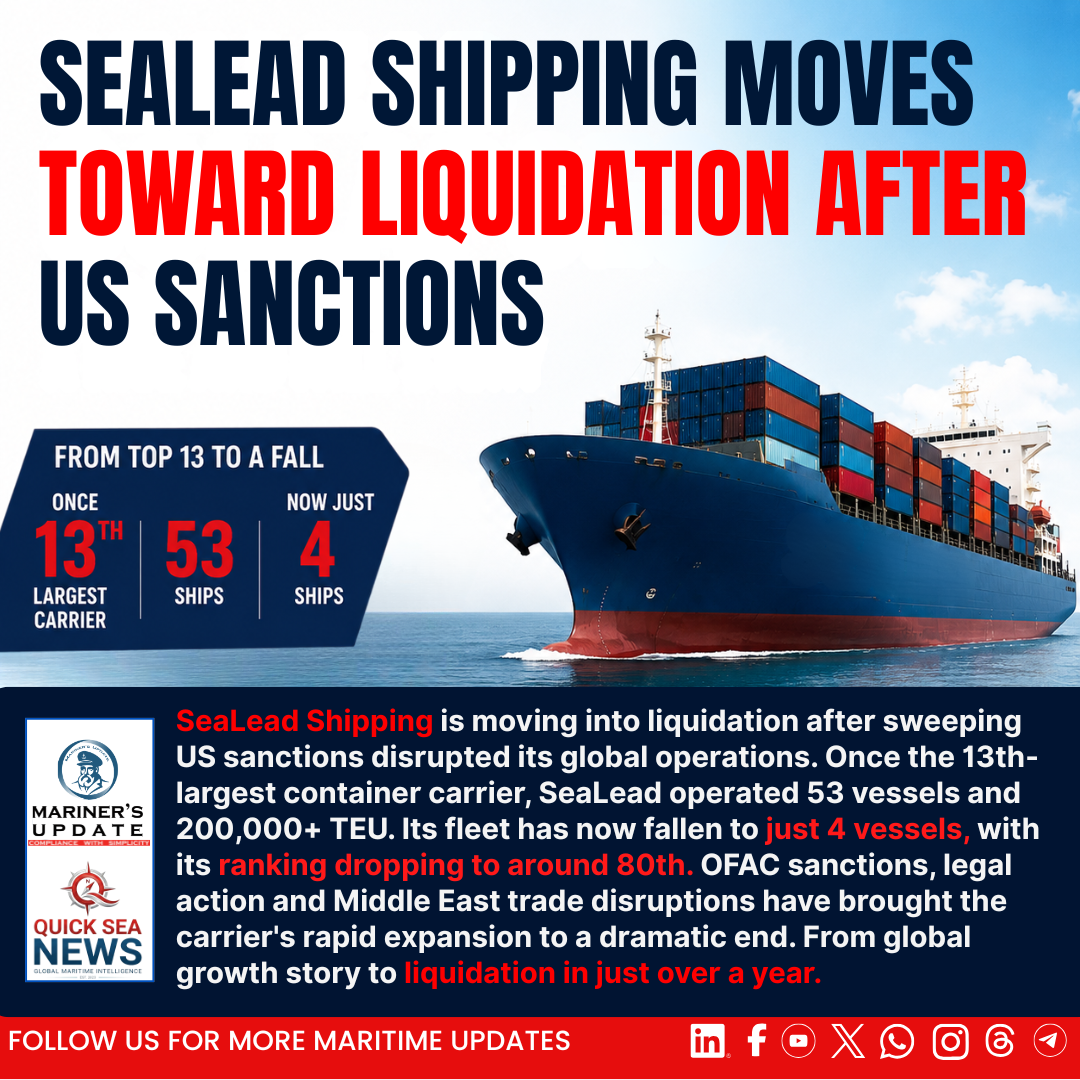
SeaLead Shipping, once one of the world’s fastest-growing container carriers, is heading into liquidation following a series of US sanctions that severely disrupted its global operations.
The Singapore-headquartered liner operator has reportedly moved into liquidation after the US Treasury’s Office of Foreign Assets Control (OFAC) imposed sweeping sanctions in July, effectively cutting the company off from much of the international shipping and financial system.
The collapse represents a dramatic reversal for a company founded only in 2017. Just over a year ago, SeaLead ranked as the 13th-largest container carrier globally, operating 53 vessels with more than 200,000 TEU of capacity. By late July 2026, its fleet had fallen to just four vessels, pushing the company down to around 80th place globally.
US Sanctions Deliver the Decisive Blow
The latest and most significant action came on 14 July 2026, when OFAC designated Sea Lead Shipping Pte Ltd, together with affiliated entities in Dubai, the Marshall Islands and India.
The sanctions formed part of a broader US action targeting the shipping and trading network associated with Mohammad Hossein Shamkhani, the son of senior Iranian political figure Ali Shamkhani.
According to the US Treasury, SeaLead was a significant container-shipping business within the network and was involved in moving both legitimate and illicit cargoes, including cargoes allegedly connected with Iran-backed Houthi interests in Yemen.
OFAC also blocked three SeaLead-linked containerships:
- Paya Lebar
- Shenton Way
- Tanjong Pagar 1
The designation effectively placed major restrictions on SeaLead’s ability to conduct normal international business.
A Much Bigger Impact Than the 2025 Sanctions
The latest sanctions were not SeaLead’s first major encounter with US enforcement action.
In July 2025, the US blacklisted 16 vessels chartered by SeaLead over alleged links to the Shamkhani network. SeaLead responded by immediately terminating those charter arrangements and repeatedly denied having links to the Iranian regime.
The company also maintained that it had stringent sanctions-screening and due-diligence procedures in place.
Despite those efforts, the sanctions caused significant damage to its operations.
The company subsequently reduced its fleet, closed offices and off-hired vessels, while disruption caused by the Iran conflict placed additional pressure on its important Middle East trades.
Legal Pressure Intensifies
The pressure increased further in March 2026, when the US Department of Justice filed a civil forfeiture complaint seeking $2.4 million allegedly intended for SeaLead and its Indian affiliate.
US prosecutors alleged that the companies were intended to provide shipping services to the Shamkhani network.
Together, the sanctions, legal action, operational disruption and loss of access to normal international business created mounting pressure on the carrier.
Limited Wind-Down Period Granted
OFAC has issued General License Z, allowing certain limited wind-down activities involving SeaLead and the three blocked vessels until 12 September 2026.
The authorization allows activities necessary to safely wind down operations, including:
- Cargo discharge
- Crewing activities
- Bunkering
- Insurance-related activities
- Safe port calls
However, the authorization does not allow new commercial contracts involving blocked persons outside the permitted wind-down activities.
This means the remaining operations are focused primarily on safely concluding existing business rather than rebuilding SeaLead’s commercial network.
From Fast-Growing Challenger to Liquidation
SeaLead’s story highlights how quickly geopolitical sanctions can transform the fortunes of a shipping company.
Founded in 2017, the carrier expanded rapidly and emerged as a major challenger in the container shipping market. At its peak, it operated more than 200,000 TEU of capacity and ranked among the world’s top 15 container carriers.
Within little more than a year, however, its fleet had effectively collapsed.
53 vessels → 4 vessels
13th-largest carrier → around 80th
And now, the company is moving into liquidation.
SeaLead’s collapse demonstrates that sanctions exposure can extend far beyond the targeted cargo or vessel. Once a shipping company becomes subject to extensive restrictions, the consequences can spread across chartering, banking, insurance, vessel operations, ports, suppliers and customers.
For the wider container shipping industry, the SeaLead case is a significant reminder that sanctions compliance, beneficial-ownership screening and counterparty due diligence are no longer peripheral risks — they can determine whether a carrier can continue operating at all.