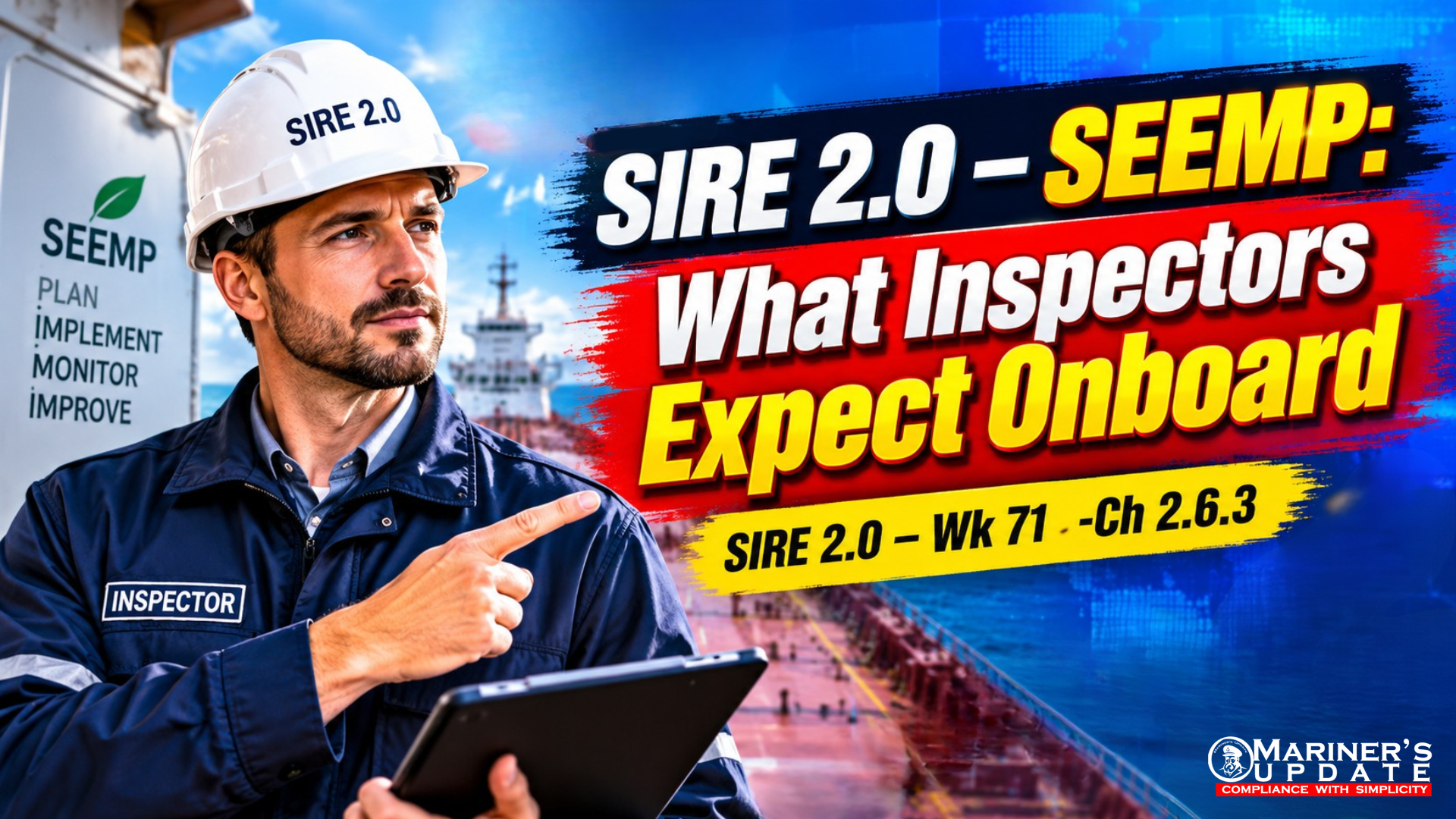
Chapter 2.6.3
Were the Master and senior officers familiar with the contents and requirements of the Ship Energy Efficiency Management Plan (SEEMP) and had these been fully implemented?
Applies to: Oil Tanker | Chemical Tanker | LNG | LPG
Potential Ground for Negative Observation (OBS)
• The Master and/or the Chief Engineer were not familiar with the contents and requirements of the Ship Energy Efficiency Management Plan (SEEMP).
• The SEEMP Part I did not contain a package of measures to improve the ship’s energy efficiency, and details for their implementation, such as:
o Improved voyage planning. o Weather routeing. o Just in time arrival. o Speed optimization. o Optimum trim. o Optimum use of rudder and heading. control systems (autopilots). o Hull maintenance.
• The package of measures listed in the SEEMP Part I to improve the ship’s energy efficiency was not ship specific.
• There was no evidence that the package of measures listed in the SEEMP Part I to improve the ship’s energy efficiency had been implemented and/or monitored.
• On a ship of 5,000 gross tonnage or above:
o The SEEMP Part II did not include a description of the ship-specific method to collect, aggregate, and report ship data with regard to annual fuel oil consumption, distance travelled, hours underway and other data required by regulation 22A of MARPOL Annex VI to be reported to the flag administration.
o A Statement of Compliance – Fuel Oil Consumption Reporting had not been issued.
o There were no records of the collection, aggregation, and/or reporting of ship data with regard to annual fuel oil consumption, distance travelled, hours underway and other data required by regulation 22A of MARPOL Annex VI to the flag administration.
o Records of fuel consumptions did not include all the fuel oil consumed on board, regardless of whether the ship was underway or not:
▪ By the main engines, auxiliary engines, gas turbines, boilers and inert gas generator, if fitted, and any other fuel consumer. ▪ For each type of fuel oil consumed e.g. HFO, DO, LNG etc.
Checklist for You
1. Is SEEMP manual available on board?
2. Does Ship specific SEEMP part 1 manual onboard contain package of measures to improve the ship’s energy efficiency, and details for their implementation such as:
- Improved voyage planning.
- Weather routeing.
- Just in time arrival.
- Speed optimization.
- Optimum trim.
- Optimum use of rudder and heading. control systems (autopilots).
- Hull maintenance?
3. Are package of measures listed in the SEEMP Part I to improve the ship’s energy efficiency been implemented and/or monitored?
4. Do SEEMP Part II include a description of the ship-specific method to collect, aggregate, and report ship data with regard to annual fuel oil consumption, distance travelled, hours underway and other data required by regulation 22A of MARPOL Annex VI to be reported to the flag administration?
5. Has a Statement of Compliance – Fuel Oil Consumption Reporting been issued?
6. Are records of the collection, aggregation, and/or reporting of ship data with regard to annual fuel oil consumption, distance travelled, hours underway and other data required by regulation 22A of MARPOL Annex VI to the flag administration been maintained?
7. Do Records of fuel consumptions include all the fuel oil consumed on board, regardless of whether the ship was underway or not:
- By the main engines, auxiliary engines, gas turbines, boilers and inert gas generator, if fitted, and any other fuel consumer.
- For each type of fuel oil consumed e.g. HFO, DO, LNG etc.
8. Are master and Chief Engineer familiar with the contents and requirements of the Ship Energy Efficiency Management Plan (SEEMP)?
Guidelines
HUMAN
The Inspector will interview the Master and/or the Chief Engineer to verify their familiarity with the contents and requirements of the SEEMP.
PROCESS
1. Ship-Specific and Approved SEEMP
The SEEMP must:
- Be specific to your ship.
- Be approved by the Flag Administration or a Recognised Organisation.
- Be part of the vessel’s Safety Management System (SMS).
2. Implementation of SEEMP Part I
Show evidence of energy-saving measures implemented, such as:
- Better voyage planning.
- Weather routing.
- Just-in-time arrival.
- Speed and trim optimization.
- Proper use of auto-pilot and rudder systems.
- Hull maintenance.
3. Requirements for Ships 5,000 GT and Above
SEEMP Part II must include:
- Methods to collect, aggregate, and report data on fuel oil consumption, distance traveled, and hours underway.
- Compliance with MARPOL Annex VI Regulation 22A.
4. Fuel Oil Consumption Records
Keep detailed records of fuel consumption from all onboard systems, including:
- Main engines, auxiliary engines, boilers, gas turbines, and inert gas generators (if fitted).
- Fuel types used (e.g., HFO, DO, LNG).
- Consumption whether the ship is moving or stationary.
5. Inspector’s Review
Provide:
- Records of data collection, aggregation, and reporting for fuel oil usage.
- Statement of compliance for fuel oil consumption reporting issued by the Flag Administration.
- SEEMP and all supporting documentation.
Maintain accurate and updated records to demonstrate compliance and support efficient inspections.ate training, records, and procedures to ensure smooth inspections and compliance.
Reference
TMSA KPI 10.1.1
The environmental management plan may include:
• Energy management and efficiency.
IMO: ISM Code/7.
IMO: MARPOL/Annex VI/Chapter 4 Regulation 6, Regulation 22/Ship Energy Efficiency Management Plan (SEEMP)/Regulation 22A
IMO: Resolution MEPC.282(70) 2016 Guidelines for the development of a Ship Energy Efficiency Management Plan (SEEMP)