
INTRODUCTION
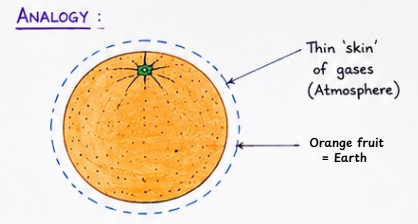
The Earth with its atmosphere can be compared to a giant fruit covered by a very thin invisible layer. This invisible layer is called the atmosphere and is held around the Earth by gravitational force.
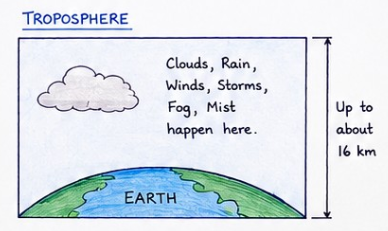
In meteorology, the most important part of the atmosphere is the lower layer known as the troposphere. This layer extends up to about 16 km above the Earth’s surface and is the region where almost all weather phenomena occur.
Clouds, rain, storms, fog, mist, winds, and other weather conditions are all formed within this layer of the atmosphere.
THE TROPOSPHERE
The troposphere is the lowest layer of the atmosphere and the most active weather region.
Important features of the troposphere:
- Extends up to approximately 16 km
- Contains most of the atmosphere’s moisture
- Responsible for weather formation
- Clouds and precipitation develop here
- Strong vertical air movement occurs in this layer
COMPOSITION OF THE ATMOSPHERE
Dry air is composed of a mixture of gases. The major gases present in the atmosphere are:
Nitrogen – 78%
Oxygen – 21%
Other Gases – 1%
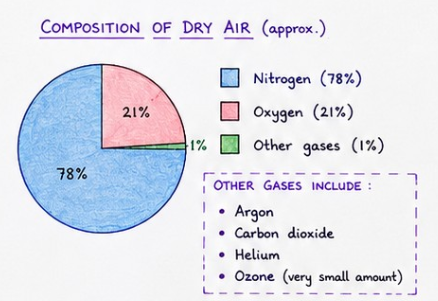
The remaining small percentage includes:
- Argon
- Carbon dioxide
- Helium
- Ozone
Although these gases are essential for life, meteorology mainly focuses on water vapour because it plays a major role in weather formation.
THE IMPORTANCE OF WATER VAPOUR
Water vapour is the invisible moisture present in the atmosphere.
Even though it exists in small quantities, it is extremely important because it controls many weather processes such as:
- Cloud formation
- Rainfall
- Snowfall
- Fog and mist
- Humidity
- Thunderstorm development
The quantity of water vapour constantly changes due to:
- Evaporation from oceans, rivers, and lakes
- Temperature variations
- Condensation processes
- Precipitation
HOW WATER VAPOUR ENTERS THE ATMOSPHERE
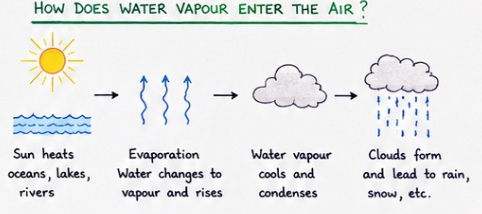
The Sun heats oceans, seas, lakes, and rivers causing water to evaporate.
This water changes into invisible water vapour and rises into the atmosphere. As the air cools, the vapour condenses to form clouds which may later produce precipitation.
DUST AND SALT PARTICLES
Tiny particles present in the atmosphere are also very important in meteorology.
These particles include:
- Sea salt
- Dust
- Smoke particles
They act as nuclei around which water vapour condenses to form cloud droplets.
Without these particles, cloud formation becomes much more difficult.
SUMMARY
- The atmosphere is a thin layer of gases surrounding the Earth.
- The troposphere is the main weather-producing layer.
- Nitrogen and oxygen are the major gases in the atmosphere.
- Water vapour is the key element responsible for weather changes.
- Dust and salt particles assist in cloud formation.