For years, the global shipping industry has celebrated a steady decline in total vessel losses and an overall improvement in maritime safety. While these achievements deserve recognition, a far more persistent challenge continues to threaten vessels worldwide—machinery failure.
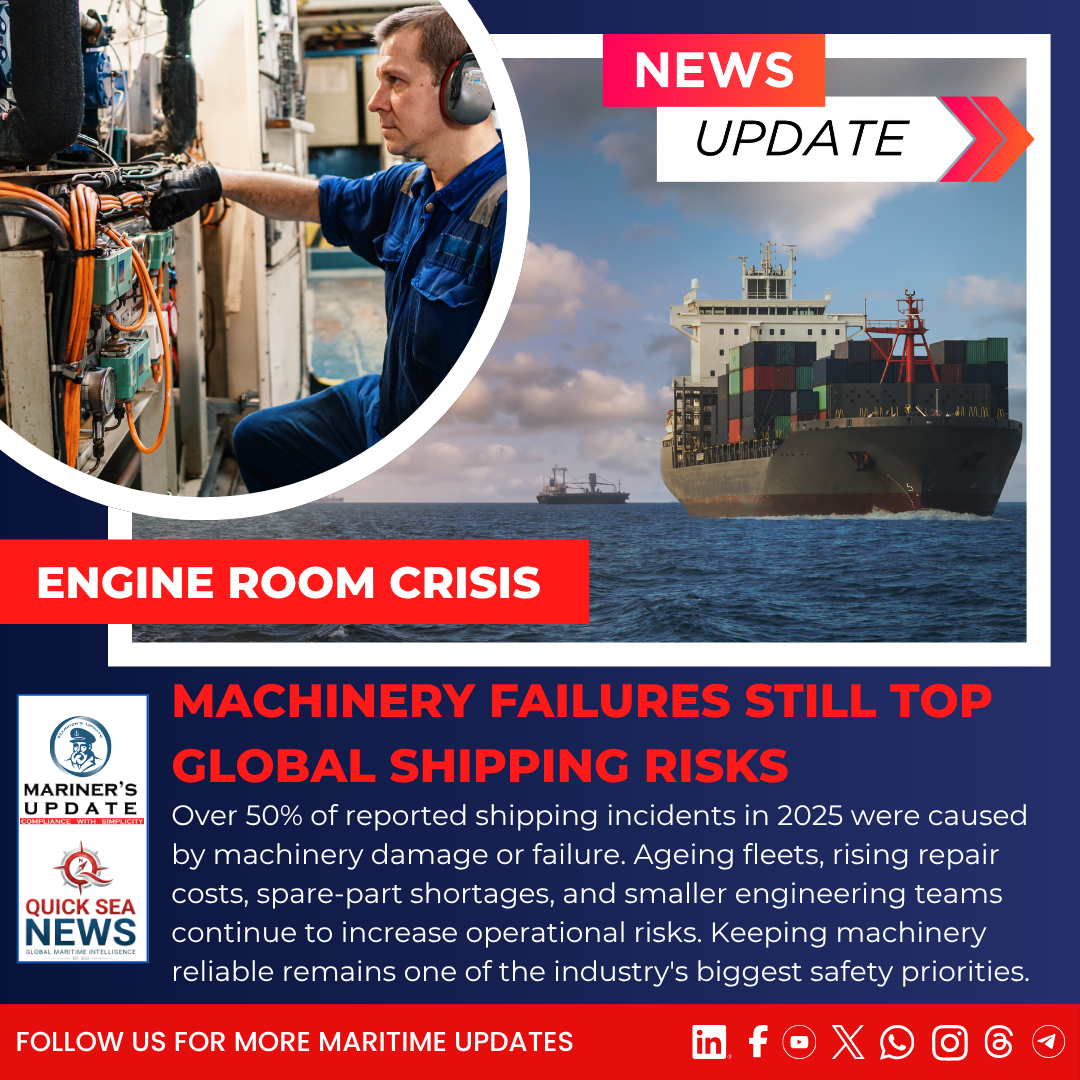
Recent industry data reveals that machinery damage and equipment failure remain the single largest cause of shipping incidents globally, accounting for more than half of all reported maritime casualties in 2025. Despite advances in technology, automation, and safety management, the engine room continues to be the industry’s most vulnerable area.
Machinery Failure Dominates Global Shipping Incidents
Out of more than 2,800 reported shipping incidents involving vessels over 100 GT during 2025, over 1,500 were directly linked to machinery damage or failure—representing approximately 53% of all recorded incidents.
Looking at the broader picture, machinery-related failures have consistently remained the leading cause of maritime incidents over the past decade, far exceeding collisions, groundings, fires, and explosions combined. The trend highlights that while catastrophic accidents often capture headlines, everyday mechanical failures continue to pose the greatest operational risk to commercial shipping.
Rising Repair Costs Add Financial Pressure
The impact of machinery failures extends far beyond operational delays.
Repair costs have remained significantly higher than pre-pandemic levels due to increasing labor expenses, rising material costs, extended spare-part delivery times, and limited shipyard availability. Industry forecasts indicate that hull and machinery repair expenses are expected to continue climbing over the coming years, placing additional financial pressure on shipowners and operators.
As vessels become more technologically advanced, repairs are also becoming more specialized, requiring skilled engineers and sophisticated diagnostic capabilities.
Shortage of Marine Engineers Becoming a Critical Challenge
One of the major factors contributing to machinery reliability concerns is the global shortage of experienced marine engineers and technical specialists.
Many operators are struggling to recruit and retain qualified engineering personnel while maintenance workloads continue to increase. Smaller onboard engineering teams are often required to manage increasingly complex propulsion systems, automation equipment, and environmental technologies with limited resources.
Although automation has improved operational efficiency, it has not eliminated the need for skilled engineers capable of maintaining critical machinery and responding effectively during emergencies.
Supply Chain Disruptions Delay Essential Maintenance
Extended lead times for major engine components, including bearings, crankshafts, fuel injection systems, and other critical spare parts, continue to challenge vessel maintenance schedules.
Limited shipyard capacity and growing demand for repairs and retrofitting projects further delay maintenance opportunities. These disruptions increase the likelihood that vessels continue operating with deferred maintenance, raising the probability of unexpected equipment failures at sea.
Ageing Fleet Increases Mechanical Risk
The average age of the global commercial fleet has continued to rise, with many vessels now operating well beyond 20 years of service.
Older ships naturally experience increased wear and fatigue across engines, propulsion systems, electrical equipment, and structural components. At the same time, sourcing original replacement parts for aging machinery becomes increasingly difficult, often forcing operators to extend maintenance intervals or seek alternative replacement components.
Industry statistics indicate that vessels over 20 years old account for more than half of all reported maritime safety incidents, highlighting the strong relationship between fleet ageing and machinery reliability.
Alternative Fuels Bring New Engineering Challenges
The shipping industry’s transition toward cleaner fuels and dual-fuel propulsion systems introduces an entirely new layer of operational complexity.
Modern engines capable of operating on multiple fuel types require additional maintenance procedures, specialized crew training, and more advanced troubleshooting techniques. Engineers must now manage unfamiliar systems while adapting to evolving environmental regulations.
Alternative fuels also introduce unique maintenance concerns, including fuel stability, component compatibility, corrosion risks, and limited spare-part availability in certain trading regions.
Non-Original Components Raise Reliability Concerns
Growing supply chain constraints and higher equipment costs have encouraged some operators to use non-original replacement components when genuine parts are unavailable.
While this may reduce short-term maintenance costs or minimize downtime, improperly matched or lower-quality components can compromise equipment reliability and increase the likelihood of electrical failures, propulsion loss, and unexpected machinery breakdowns.
The decision to use alternative replacement parts requires careful engineering assessment, as failures involving critical systems can have serious operational and financial consequences.
Operational Pressure Is Stretching Engineering Departments
Today’s engineering teams are managing more responsibilities than ever before.
Longer voyages, rerouted shipping lanes, geopolitical disruptions, stricter environmental compliance requirements, and reduced crew sizes have significantly increased workloads inside the engine room.
Planned maintenance schedules are becoming increasingly difficult to maintain, while unexpected repairs must often be completed with limited manpower and constrained resources.
The result is a growing strain on engineering departments that directly impacts vessel reliability and operational safety.
The Industry’s Most Persistent Risk
While global shipping continues to demonstrate encouraging improvements in overall safety performance, machinery failure remains the industry’s most significant operational challenge.
An ageing fleet, rising repair costs, skilled labor shortages, delayed spare parts, increasingly complex propulsion technologies, and mounting operational pressures are combining to create an environment where machinery reliability is under greater strain than ever before.
Strengthening preventive maintenance, investing in engineering talent, ensuring timely access to quality spare parts, and supporting crews with adequate resources will remain essential if the industry hopes to reduce its most common—and most expensive—cause of maritime incidents.