Machinery upkeep is back in the spotlight. Port State Control Officers worldwide are aligning on a sharper, more consistent approach to checking engine rooms — moving beyond a quick walk-through to verifying real operational readiness. Here’s what’s changing and what it means for your ship.
FIRST LOOK: WHAT INSPECTORS SCAN FOR
Before any deep dive, PSCOs form a quick impression of the engine room’s overall health. A clean, well-run space is the strongest first impression a crew can make.
- Bilges, drip trays and lagging free of oil — no hidden save-alls or oily rags
- Ventilation and lighting fully working in all machinery areas
- Electrical panels clean, no earth faults, insulation readings normal
- Piping, valves and joints in good condition, no leaks
- Alarm panel clear of unexplained faults; escape routes unobstructed
- Gauges accurate; boiler water levels and start-air pressure normal
RED FLAGS THAT TRIGGER A DEEPER DIVE
Certain conditions give PSCOs “clear grounds” to escalate into a full More Detailed Inspection (MDI):
- Propulsion failure or generators unable to share load
- Excessive oil leakage or accumulation in bilges
- Crew unfamiliar with testing equipment per manufacturer instructions
- Multiple alarms inhibited, off-scan or manually suppressed
- Low start-air pressure or insufficient compressors running
- Large earth faults on 220V, or any fault on 440V systems
- Cluttered engine room with loose parts or rubbish
- Signs of a rushed, recent emergency repair
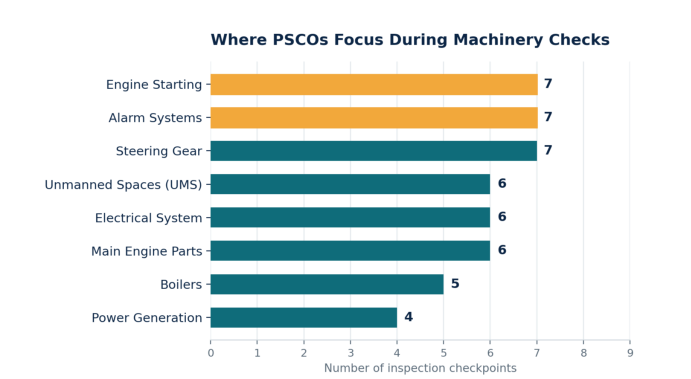
Where PSCOs focus most: steering gear, alarm systems and engine-starting systems carry the highest number of inspection checkpoints under the current machinery guidance.
WHERE DETENTION RISK RUNS HIGHEST
Not all defects are equal. These are the failure points most likely to keep a ship in port:
- Electrical — loss of main power, dead emergency generator, or crew using jumper cables to bypass faulty sensors
- Steering gear — slow rudder response, alarm failures, or unresolved leakage
- Main engine — unable to start, reverse or stop; cracked cylinder liners
- Critical piping — leaks in fuel, cooling or hydraulic lines feeding main systems
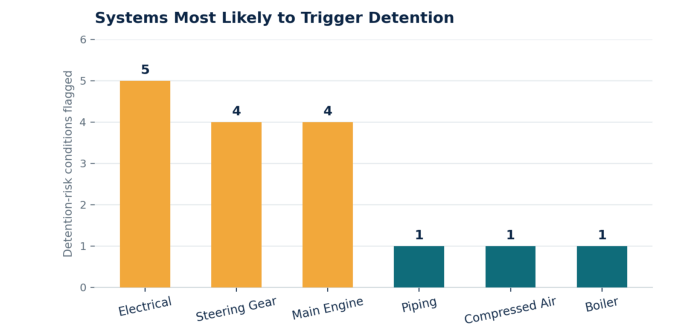
Electrical faults and steering gear failures top the list of conditions PSCOs treat as detention-worthy.
BOTTOM LINE FOR CREWS
- Keep maintenance records current, complete and matched to logbook entries
- Make sure crew can demonstrate — not just describe — system testing and emergency drills
- Fix small leaks and alarm faults early; they’re the fastest route to a clear grounds finding
- A tidy, well-documented engine room remains the best defence against an MDI