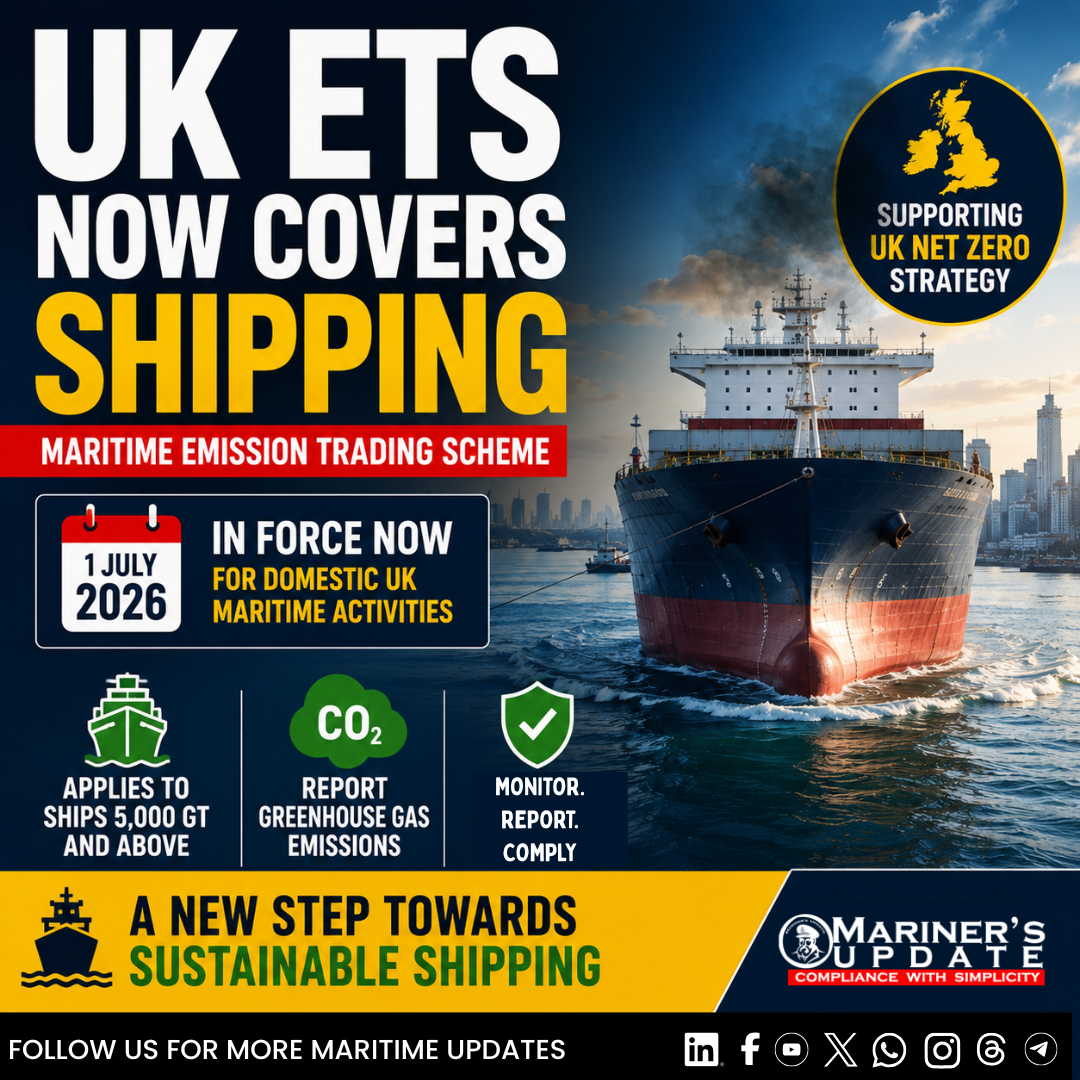
New carbon reporting rules are now in force for large ships operating on UK domestic voyages, marking a major step in the UK’s maritime decarbonisation strategy.
UK Launches Maritime Emissions Trading Scheme to Accelerate Shipping Decarbonisation
The United Kingdom has officially expanded its Emissions Trading Scheme (UK ETS) to the maritime sector, introducing mandatory greenhouse gas (GHG) emissions reporting for qualifying vessels from 1 July 2026.
The move forms a key part of the UK’s Net Zero Strategy and aligns with global efforts to reduce shipping emissions, following the introduction of similar measures under the European Union’s Emissions Trading System (EU ETS).
Initially, the UK ETS applies to ships of 5,000 gross tonnage (GT) and above engaged in domestic UK maritime activities. From 1 January 2027, the scheme will also cover offshore vessels of the same size, including offshore construction, offshore support and offshore supply vessels.
Which Emissions Are Covered?
Under the new regulations, ship operators must monitor and report greenhouse gas emissions generated during UK maritime operations. The reporting requirements include emissions of:
- Carbon dioxide (CO₂)
- Methane (CH₄)
- Nitrous oxide (N₂O)
These emissions are calculated on a tank-to-wake basis and include emissions produced during voyages as well as while vessels are alongside or at anchor in UK ports.
Scope of the Scheme
The UK ETS currently focuses on domestic maritime operations and applies to:
- 100% of emissions from voyages between ports within Great Britain.
- 50% of emissions from voyages between Great Britain and Northern Ireland.
- 100% of emissions generated while vessels are in UK ports.
At present, international voyages to or from UK ports are not included within the scheme, although future expansion remains under consideration.
Ships Exempt from the Scheme
Several vessel categories remain outside the reporting requirements, including naval vessels, coastguard ships, search and rescue units, fishing vessels, government service ships, medical response vessels, certain research ships, wooden ships of primitive build, Scottish ferry services and offshore vessels until the end of 2026.
Compliance Responsibilities
Responsibility for compliance generally rests with the vessel’s registered owner. However, where an ISM Company has formally accepted responsibility through a legally binding agreement, it may become the designated Maritime Operator under the UK ETS.
Operators are required to submit an Emissions Monitoring Plan, annual verified emissions reports and other regulatory documentation through the UK’s dedicated reporting platform.
In addition, one UK Emission Allowance must be surrendered for every tonne of carbon dioxide equivalent emitted under the scheme. The first surrender deadline for emissions reported during the 2026 and 2027 reporting periods is 30 April 2028.
Looking Ahead
The introduction of the UK ETS represents another major milestone in the shipping industry’s transition towards lower emissions and greater environmental accountability.
With both the UK ETS and EU ETS now applying to maritime transport under different frameworks, shipowners, managers and operators will need to ensure robust emissions monitoring, reporting systems and compliance procedures to avoid regulatory and financial risks.
The UK and European Union are also exploring the possibility of linking both emissions trading systems in the future, which could further streamline compliance for operators trading across both regions.