
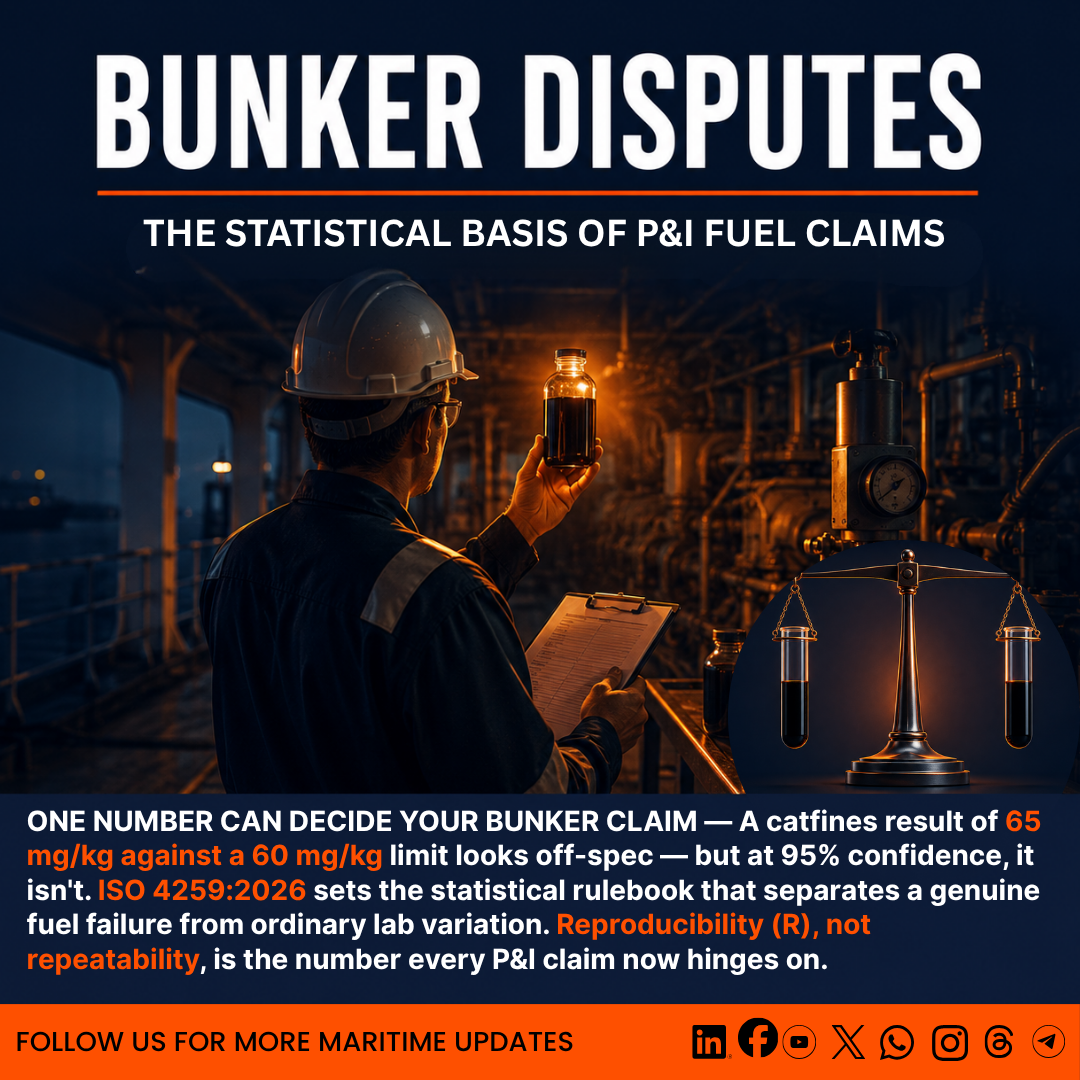
Why Precision Data Matters: ISO 4259:2026 and the Statistical Backbone of Every Bunker Claim
When a bunker dispute reaches a P&I Club’s desk, the real question is rarely whether a fuel sample tested off-spec. It’s how far off-spec — and whether that gap can actually stand up to scrutiny. That answer doesn’t come from ISO 8217. It comes from ISO 4259, the standard that governs how test method precision is measured and applied across petroleum testing.
The newly updated 2026 edition modernises the statistical framework first built under ISO 4259:2006 and ISO 4259:2017. But for marine fuel users, the practical takeaway hasn’t changed: every routine compliance call made under ISO 8217 still rests on published precision data and the 95% confidence approach set out in ISO 4259-2.
The Problem ISO 4259 Was Built to Solve
Here’s the uncomfortable truth of analytical chemistry: two labs testing the same fuel sample — or even the same lab testing it twice — will almost never return identical numbers. That’s not a flaw in the system. It’s statistical reality. ISO 4259 exists to answer the question this creates: when does a difference between two results stop being normal variation and become a genuine, provable failure?
The standard’s foundation is that precision must be proven empirically, never assumed. This happens through round robin testing — a single prepared fuel sample is sent to multiple accredited labs, each testing it independently with the same method. The spread of results is then analysed to generate a reproducibility (R) value for that method at that concentration. This R value is what underpins the 95% confidence failure limits used across ISO 8217 disputes. And none of it means anything unless the testing lab holds ISO 17025 certification.
Repeatability vs. Reproducibility — The Distinction That Decides Cases
These two terms get used interchangeably far too often, but in a real dispute, the difference is everything.
- Repeatability (r): Same operator, same equipment, same lab, same sample, short interval. It’s an internal quality-control check — it tells you if a method is consistent within one lab.
- Reproducibility (R): Different operators, different equipment, different labs, same sample. This is the true test of independent verification — and it’s the number that actually matters in a vessel-vs-supplier dispute.
A lab can have excellent repeatability while still being consistently biased. Repeatability tells you nothing about accuracy, and it doesn’t address the situation most bunker disputes actually involve: two different labs analysing retained samples and reporting two different numbers. That’s a reproducibility problem, not a repeatability one — and treating it otherwise means arguing from the wrong statistical ground entirely.
The 95% Confidence Limit, In Practice
The formula behind it all is simple: 95% confidence failure limit = specification limit ± (0.59 × R). A result has to cross this adjusted threshold — not just the raw spec limit — before it can be called a definitive failure.
Applied to a typical RMG 380 grade, this widens the practical thresholds considerably:
- Viscosity: a 380 cSt spec only fails above 396.6 cSt or below 361 cSt
- Density: a 991.0 kg/m³ limit fails only above 991.9 kg/m³
- Flash point: a 60°C limit fails only below 56.5°C
- Aluminium + Silicon (catfines): a 60 mg/kg limit fails only above 72 mg/kg
That catfines example is worth pausing on. A result of 65 mg/kg looks off-spec against a 60 mg/kg limit — but statistically, at 95% confidence, it isn’t. Only a reading above 72 mg/kg is genuinely certain to represent real failure rather than normal interlab variation. In catfine damage claims, that 60–72 mg/kg gap is almost always where the argument lives.
CIMAC WG7: The Practical Rulebook
ISO 4259 lays out the theory — CIMAC Working Group 7 (“Fuels”) turns it into something a claims handler can actually use. Its guideline, developed alongside the ISO 8217 working group, spells out exactly how the 0.59R boundary should be applied from each side of a bunker transaction:
- Supplier side (max limits): fuel is compliant if the result doesn’t exceed spec limit + 0.59R
- Supplier side (min limits): fuel is compliant if the result isn’t below spec limit − 0.59R
- Recipient side (max limits): non-compliance only holds if the result exceeds spec limit + 0.59R
- Recipient side (min limits): non-compliance only holds if the result falls below spec limit − 0.59R
In short: a recipient sample coming back slightly over the headline limit is not, on its own, proof of a valid off-spec claim. The boundary reflects genuine test variability — not a negotiating margin.
CIMAC WG7 also covers duplicate testing. When a lab reports the average of two results, a modified reproducibility term (R1) applies — narrowing the confidence boundary only slightly, never eliminating it. Where parties still can’t agree, the formal dispute mechanism in ISO 4259-2 remains the fallback. In practice, WG7’s guideline works as a ready-reference lookup table, saving users from recalculating 0.59R from scratch every time.
Where This Actually Shows Up in P&I and Insurance Claims
| Scenario | Why It Matters |
|---|---|
| Fuel quality dispute (supplier vs. vessel) | Without the 95% confidence framework, neither side can definitively prove off-spec — the statistical threshold is the only defensible basis for assessment. |
| Port State Control inspections | Authorities may weigh results against confidence limits; a marginal flash point reading needs to be read in light of applicable reproducibility data. |
| MARPOL Annex VI compliance | Sulphur limits rely on reproducibility data; if a result is challenged, the retained MARPOL sample — tested at an independent accredited lab — is the definitive reference. |
| Catfine damage claims | The 60–72 mg/kg gap between spec and statistical failure threshold is often exactly where the dispute is fought. |
| Insurance & P&I Club claims | Clubs increasingly demand certified results from recognised ISO, ASTM or IP methods — anything less risks being challenged as evidence. |
As evidentiary standards get stricter, a result’s pedigree matters just as much as the number itself. A test that can’t be traced to a recognised method, or wasn’t run by an ISO 17025-accredited lab, is at real risk of being dismissed the moment a claim is contested.
The Practical Takeaway
ISO 4259 is what gives ISO 8217 limits their statistical teeth. Without it, a specification number is just a number — with no way to separate a real failure from ordinary lab-to-lab variation. Round robin testing supplies the empirical backbone: R values built from real data, not theoretical guesswork.
For anyone assessing a marine fuel dispute, the operational checklist is simple:
- Insist on accredited testing — ISO 17025 labs, recognised ISO/ASTM/IP methods only
- Use the confidence limit, not the raw spec number — always assess against the 95% failure threshold
- Focus on reproducibility (R), not repeatability (r) — R is the relevant metric in any two-party dispute
- Start with CIMAC WG7’s tables — check the published recipient/supplier limits before escalating
The commercial logic here is hard to argue with: a full ISO 8217 analysis typically costs less than 0.038% of the value of a 1,000 MT bunker stem — yet it can catch issues that carry real operational, regulatory, and financial weight, from crew safety risks and SOLAS non-compliance to engine damage, deposit formation, and fuel instability.
The bigger point, though, is this: ISO 4259:2026 doesn’t just tighten a formula — it makes sure test results are read correctly in the first place, giving every party a genuinely defensible basis for technical decisions, commercial negotiation, and dispute resolution.