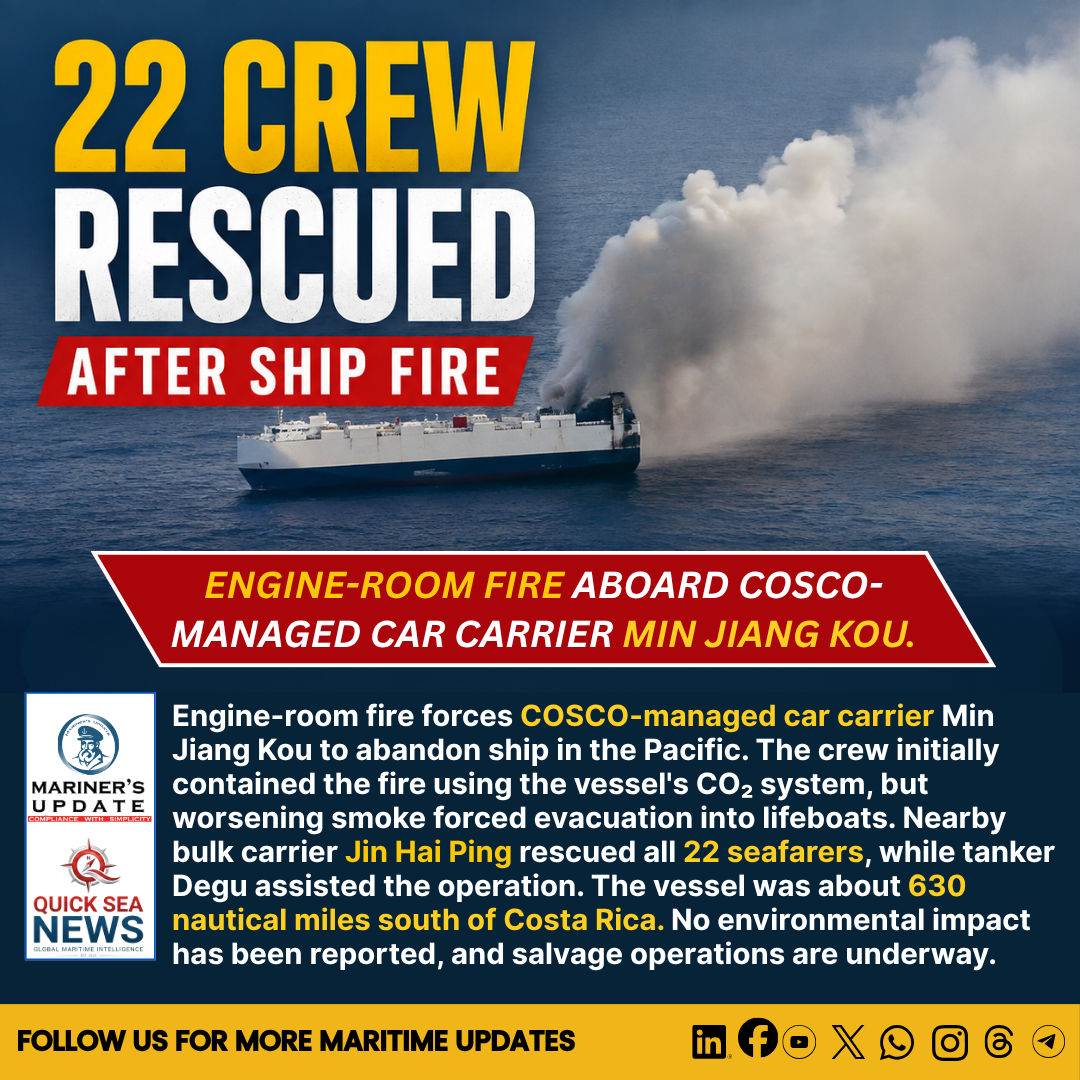
Engine-room fire aboard the vehicle carrier Min Jiang Kou triggers an emergency evacuation in the Pacific, with nearby merchant vessels responding to rescue all 22 crew members.
A major maritime rescue operation unfolded in the Pacific after an engine-room fire aboard the vehicle carrier Min Jiang Kou forced all 22 crew members to abandon the vessel.
The Marshall Islands-flagged car carrier was approximately 630 nautical miles south of Costa Rica when the emergency developed while the vessel was reportedly sailing toward Manta, Ecuador.
According to the U.S. Coast Guard, an Inmarsat distress alert was received at 0109 hrs on 8 August, reporting a fire onboard the vessel.
Fire initially contained
The crew activated the vessel’s fixed carbon dioxide firefighting system after the fire was reported in the engine room. The system initially helped contain the blaze.
However, the situation subsequently deteriorated.
The crew later reported a significant increase in smoke onboard. With conditions worsening, the master ordered the crew to abandon the vessel using the ship’s lifeboats, while remaining onboard himself.
The U.S. Coast Guard then coordinated assistance and issued a request to nearby vessels for immediate support.
Merchant ships respond to distress call
Two merchant vessels responded to the emergency:
- Jin Hai Ping, a 44,500 dwt bulk carrier
- Degu, a 50,000 dwt tanker
Jin Hai Ping proceeded to the lifeboats and successfully recovered all 22 seafarers.
Degu remained in the area to provide additional assistance during the emergency response.
The 22 rescued crew members were subsequently reported safely aboard Jin Hai Ping, which is transporting them to Akita, Japan.
The successful rescue once again demonstrates the critical role merchant ships play in responding to emergencies at sea, particularly when incidents occur far from shore-based rescue infrastructure.
The U.S. Coast Guard highlighted the importance of cooperation between maritime authorities and commercial vessels in ensuring that seafarers in distress receive timely assistance.
Questions surrounding vehicle cargo
The incident also raises an important cargo-safety question because Min Jiang Kou is a large pure car and truck carrier capable of transporting thousands of vehicles.
An industry source has suggested that the vessel may have been carrying Chinese-built electric vehicles, although this has not been publicly confirmed as the cause of the fire.
Electric vehicles introduce additional fire-safety considerations because their lithium-ion batteries can undergo thermal runaway if damaged or subjected to certain electrical or mechanical failures. Such events can generate intense heat and potentially release hazardous gases.
However, there is currently no confirmed evidence that EV cargo caused or contributed to the fire, and the exact cause of the incident remains subject to investigation.
Vessel background
Min Jiang Kou is a relatively new vehicle carrier. Official registry information identifies the vessel as a 2024-built, Marshall Islands-flagged PCTC operated by COSCO Shipping Specialized Carriers and managed by Wallem Ship Management.
The vessel is approximately 200 metres long, has a deadweight of around 19,181 tonnes, and can accommodate approximately 7,500 vehicles across 13 vehicle decks.
It is also equipped with an LNG dual-fuel propulsion system, reflecting the industry’s shift toward lower-emission vehicle carriers.
No environmental impact reported
At this stage, the U.S. Coast Guard has reported no environmental impact from the incident.
Salvage and recovery efforts are also being pursued, with Resolve Marine reportedly involved in plans to address the damaged vessel and support its recovery.
A reminder of the importance of emergency preparedness
The incident highlights several critical aspects of shipboard emergency preparedness: rapid fire detection, effective fixed firefighting systems, clear abandon-ship decision-making, lifeboat readiness, distress communications and cooperation between vessels.
It also underlines the importance of maintaining robust fire-risk controls on vehicle carriers, where large quantities of vehicles can present complex firefighting challenges.
Most importantly, the incident ended with the successful rescue of all 22 seafarers, demonstrating once again that effective distress communication and the willingness of nearby vessels to respond remain fundamental to saving lives at sea.
The cause of the fire, the extent of damage to Min Jiang Kou and the nature of its vehicle cargo will require further investigation and confirmation.