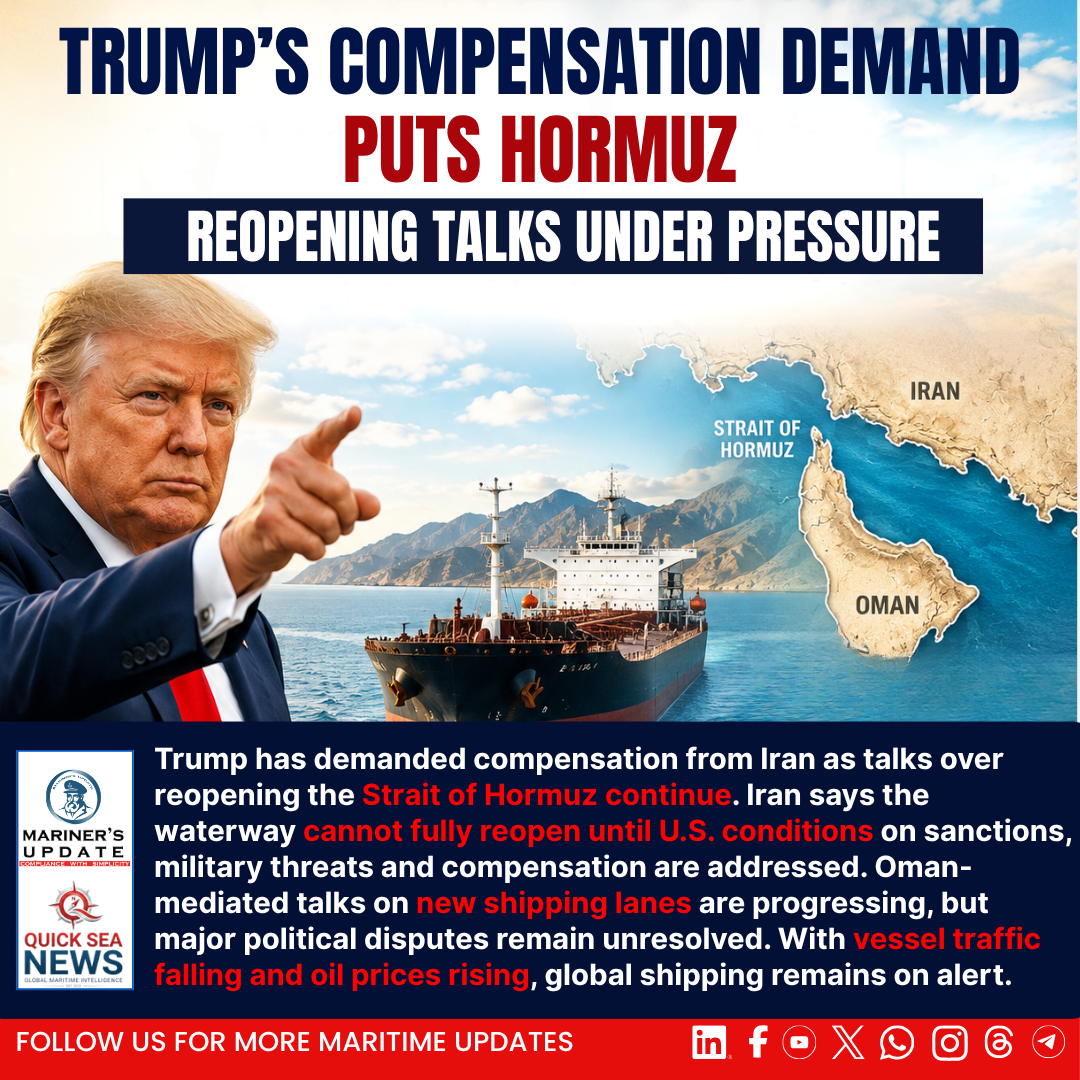
The possibility of restoring normal shipping through the Strait of Hormuz is facing another setback after U.S. President Donald Trump demanded compensation from Iran for deaths and damages that Washington attributes to Tehran.
Trump’s demand comes just as Iran and Oman were working toward an agreement to establish new shipping lanes through the strategic waterway. Iranian officials have indicated that discussions with Oman are progressing, with a route map reportedly agreed and only technical matters remaining. However, Tehran has maintained that the United States must first meet a series of conditions before the Strait can be fully reopened.
Trump’s latest position introduces a significant new point of disagreement. Responding to Iran’s own demand for compensation linked to the recent conflict, Trump said the United States would likewise seek compensation from Iran for people he says were killed or wounded in previous conflicts, attacks and protests.
He also cited the families of the 17 U.S. sailors killed in the USS Cole attack in Yemen in 2000. However, the attack was attributed to al Qaeda rather than Iran, making the demand particularly contentious. Trump further called for Iran to bear responsibility for deaths and damage involving Lebanon, Syria, Yemen and Gaza.
A New Obstacle to Reopening Hormuz
The compensation dispute adds to an already complicated list of conditions surrounding the Strait.
Iran has demanded an end to U.S. sanctions and military threats, along with compensation for damage caused during the conflict. Tehran has also insisted that the reopening of the waterway depends on broader political and security arrangements.
At the same time, Washington has rejected proposals that would give Iran the ability to charge fees for vessels using the Strait. This disagreement over control, access and maritime charges could become one of the most difficult elements of any future agreement.
Iranian Foreign Ministry spokesman Esmaeil Baghaei said discussions with Oman were progressing constructively. The talks have reportedly covered practical maritime matters including safe navigation, environmental protection, maritime services and combating maritime crime.
Why the Shipping Industry Is Watching Closely
The Strait of Hormuz is one of the world’s most important maritime chokepoints, carrying a substantial share of global oil and LNG flows.
The prolonged disruption has already affected tanker movements, energy prices and shipping risk across the Persian Gulf. Recent shipping data showed traffic through the Strait falling to only six vessels on Monday, compared with a 10-day average of around 11 vessels.
Oil markets reacted immediately to the latest escalation in rhetoric. Brent crude rose sharply, trading around $87 per barrel and up 4.6% on the day following Trump’s statement.
For shipowners, operators, charterers and cargo interests, continued uncertainty around Hormuz means that the risk extends beyond crude prices. Vessel routing, war-risk exposure, insurance costs, voyage planning, crew safety and cargo delivery schedules can all be affected if normal navigation does not resume.
The Political Pressure Is Rising
The latest development also comes as Trump faces pressure to bring the conflict to an end. Higher fuel prices are becoming an increasingly important economic concern, while the U.S. administration has so far been unable to secure a lasting arrangement that restores unrestricted commercial navigation through Hormuz.
Iran, meanwhile, appears determined to use control over the waterway as leverage in negotiations.
That creates a difficult situation for both sides. Iran wants sanctions relief, compensation and security guarantees before restoring normal access, while the United States is unlikely to accept arrangements that could give Tehran greater control over international shipping through one of the world’s most important energy corridors.
What It Means for Maritime Trade
The immediate concern for the maritime industry is uncertainty.
Even if Oman and Iran finalise a technical framework for shipping lanes, the waterway may not return quickly to normal commercial operations unless the wider U.S.-Iran dispute is resolved.
Until then, vessels operating in or approaching the Gulf may continue to face heightened security risks, uncertain routing arrangements and potentially higher insurance and operational costs.
For global energy markets, every additional delay in restoring reliable passage through Hormuz keeps pressure on oil and LNG supply chains. For shipping companies, the crisis reinforces the importance of alternative routing plans, voyage risk assessments, updated security guidance and close monitoring of developments in the region.
The key question is no longer simply whether a shipping route can be agreed. It is whether Washington and Tehran can resolve the political conditions that stand between a negotiated route and the full restoration of commercial navigation.