
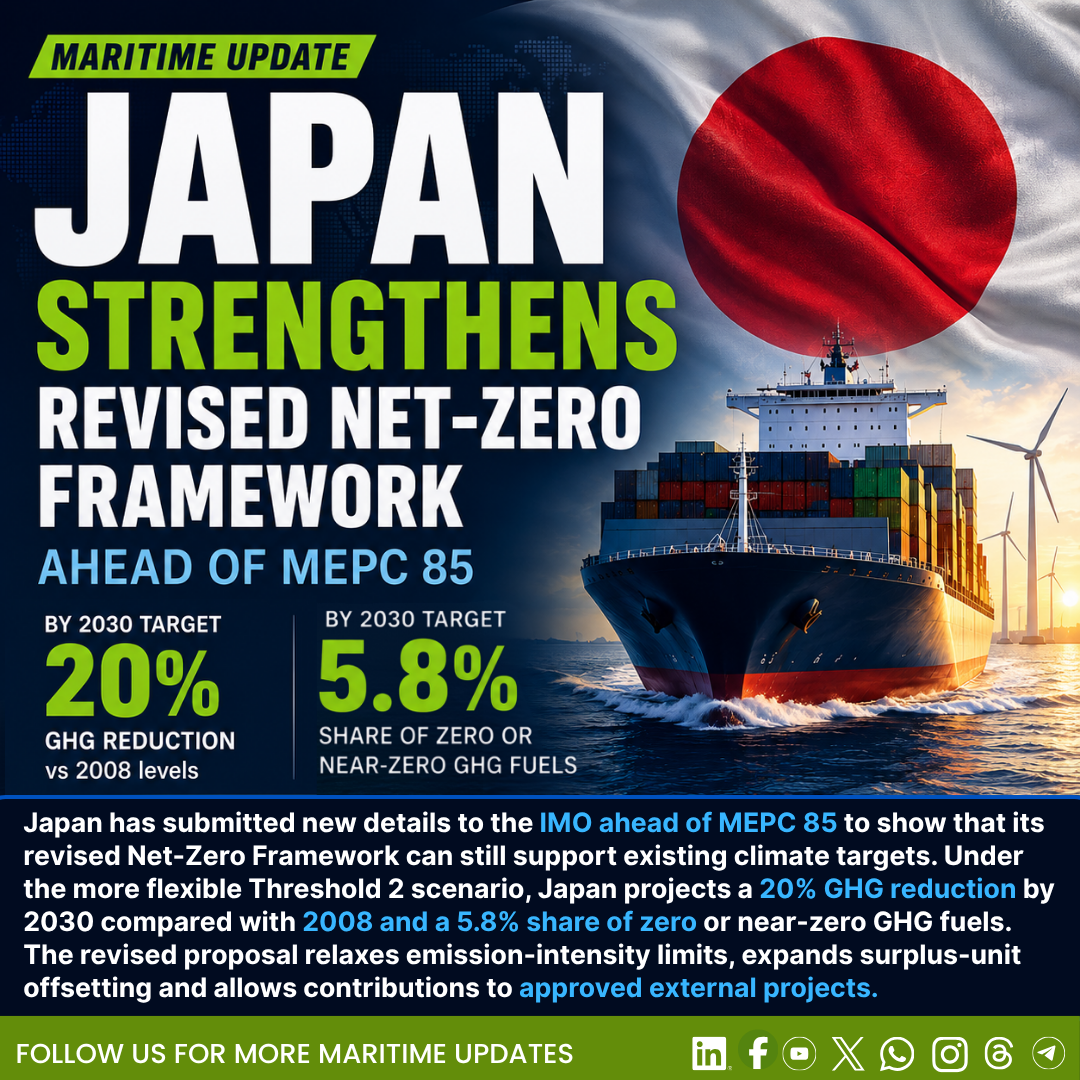
Japan has submitted additional documentation to the International Maritime Organization (IMO) ahead of the 85th session of the Marine Environment Protection Committee (MEPC 85), scheduled for November, providing further details on its revised Net-Zero Framework (NZF) proposal for reducing greenhouse-gas (GHG) emissions from international shipping.
The supplementary document focuses on one of the key questions surrounding Japan’s revised proposal: whether the more flexible regulatory approach can still deliver the targets established under the IMO’s current GHG reduction strategy.
Japan’s calculations indicate that, even under the revised framework, shipping could achieve at least a 20% reduction in GHG emissions from 2008 levels by 2030, while the share of zero or near-zero GHG-intensity (ZNZ) fuels could reach 5.8%. Both figures are within the interim targets established by the current strategy.
Revised NZF Positioned as a Compromise
Japan originally presented its revised NZF proposal during MEPC 84 in April.
Unlike the original proposal, the revised version removes the proposed fund and introduces greater flexibility by relaxing the regulatory limits for ships’ GHG emission intensity.
The proposal also expands the mechanism for using surplus units (SUs). Ships that perform better than the applicable emission-intensity standard can receive surplus units, which can then be used to offset compliance requirements. Charges are applied only to the portion of emissions exceeding the applicable standard.
While offsetting remains the principal route for regulatory compliance, the revised framework would also allow contributions to eligible projects implemented by public or private organisations outside the IMO framework.
Despite these changes, Japan continues to support its original NZF proposal. The revised version is being presented as a compromise option should securing agreement on the original framework prove difficult.
Japan Demonstrates Alignment With IMO GHG Strategy
The latest submission translates the core elements of Japan’s proposed NZF amendments into a more detailed text-based framework and explains how the proposal can remain consistent with the existing IMO GHG reduction strategy.
The current strategy targets net-zero GHG emissions from international shipping around 2050. Its 2030 interim ambitions include:
- A 5–10% share of zero or near-zero GHG-emission fuels
- A 20–30% reduction in GHG emissions compared with 2008 levels
Japan’s Maritime Bureau said discussions with countries supporting the revised proposal had continued since MEPC 84, particularly around the possibility of relaxing threshold values.
One of the concerns raised during those discussions was whether a more flexible threshold system could still deliver the targets under the existing strategy. Japan’s latest submission is intended to demonstrate that the two approaches can be compatible.
Focus on Threshold Value 2
A central element of Japan’s latest analysis is threshold value 2, the more lenient of the two proposed GHG-intensity thresholds.
The NZF draft and Japan’s revised proposal contain two threshold levels:
Threshold 1: More stringent
Threshold 2: More flexible
Japan’s latest calculations assume that the average GHG fuel intensity (GFI) of the global fleet reaches threshold value 2.
Under this scenario, Japan estimates that by 2030 the sector could achieve:
5.8% ZNZ fuel share
20% GHG reduction compared with 2008
These figures would satisfy the lower end of the 2030 interim targets under the existing IMO GHG strategy.
Japan’s Maritime Bureau explained that the 5.8% figure includes low-GFI fuels such as biodiesel.
The calculations also take into account supply estimates for alternative fuels, including ammonia, developed by various research institutions. Japan has used these estimates to construct what it considers a feasible fuel-transition and diffusion scenario.
Cargo Demand Remains a Key Uncertainty
Japan’s estimate of a 20% reduction in GHG emissions by 2030 also incorporates historical trends in maritime cargo movement.
However, the government acknowledges that shipping demand cannot be directly controlled by the regulatory framework.
The Maritime Bureau therefore stressed the importance of closely monitoring market trends, particularly changes in cargo volumes, as these could affect the actual level of emissions reduction achieved.
This highlights an important challenge for the revised NZF: fuel transition and efficiency improvements can be modelled, but changes in global shipping demand can significantly influence total sector emissions.
Governance Rules Proposed for Funded Projects
Japan’s supplementary proposal also provides greater clarity on how projects receiving levy-related contributions would be governed.
The proposed governance structure includes:
- Prior approval by the IMO
- Continuous monitoring after project approval
- Progress verification and confirmation
Japan indicated that more detailed requirements would be established through dedicated guidelines.
Potential projects are expected to focus primarily on alternative-fuel production and technical support.
The framework could also consider existing initiatives involving low-GFI fuel production and projects supporting technological development in developing countries.
This approach is intended to ensure that financial contributions translate into measurable emissions-reduction activities while maintaining oversight and accountability.
Next Steps Toward MEPC 85
The discussion on the NZF is expected to continue through the IMO’s Intersessional Working Group (ISWG) meetings scheduled for September and November.
Japan has now placed its supplementary document into the ongoing discussion and has also submitted it for consideration at MEPC 85.
The objective is to provide governments with more detailed information on how the revised proposal would operate and, importantly, how a more flexible regulatory structure could still support the IMO’s existing pathway toward deep emissions reductions.
The debate ahead of MEPC 85 is therefore likely to focus not only on the level of regulatory flexibility but also on whether the proposed thresholds, alternative-fuel availability, offsetting mechanisms and project governance arrangements can collectively deliver credible emissions reductions.
Japan’s latest submission represents an effort to bridge that gap by showing that regulatory flexibility and the IMO’s climate targets do not necessarily have to be mutually exclusive.