This week’s RISQ Inspection Focus looks at two areas inspectors consistently check onboard: how accurately the Officer Matrix reflects who is actually serving on the vessel, and how well the Master and Navigation Officers can demonstrate their ECDIS familiarisation.
- Q 2.13 – Officer Matrix accuracy, with a 4-step visual flow showing how updates/overlap/verification should work
- Q 2.14 – ECDIS familiarisation, with a 6-box visual grid covering the elements the SMS procedure should ensure get recorded
QUESTION 2.13 – Keeping the Officer Matrix Accurate and Current
An inspector checks whether the officer matrix truly reflects who is on board at the time of inspection – not who was on board last month. If the matrix has not been kept up to date, this is recorded as a finding.
A short allowance is built into the process: if officers have changed within the previous few days, the vessel is expected to have a documented handover in place. When senior officers are transferred between sister ships, this must still be reflected in the matrix – a lack of overlap or parallel sailing is not an excuse to leave a Finding unrecorded.

What the Company and Vessel Are Expected to Maintain:
- A vessel manager keeps up-to-date records of officers and engineers serving on board.
- The inspector should be able to compare the on-board matrix against the crew and seaman books during the inspection.
- Details of Master, Chief Officer, Chief Engineer, Second Engineer and First Officer / Second Engineer are checked against the matrix – any mismatch is recorded as a Finding.
- Random checks are made on the actual certificates held by officers and junior officers.
- A seafarer may sail on a Certificate of Recognition of Application (CRA) and a valid national STCW certificate for up to three months while the STCW Endorsement Certificate is being processed – the inspector will check the validity of any CRA presented.
Why This Matters: A matrix that lags behind reality undermines confidence in every other record on board. Keeping it current, with proper handover documentation, is a simple habit that closes off an entire category of avoidable Findings.
QUESTION 2.14 – ECDIS Familiarisation – Objective Evidence Required
Where ECDIS is fitted, inspectors look for objective evidence that the Master and Navigation Officers have been properly familiarised with the specific equipment installed on board – and that this familiarisation is refreshed every time an officer joins a new vessel.
Generic ECDIS training is not sufficient on its own. The STCW Code sets requirements for approved training, and where the approved training has not been completed, this should be reflected as a limitation on the officer’s certificate and endorsement.
Deck officers holding a valid Certificate of Competency (from 1 January 2017 onward, issued under STCW regulations II/1 and II/2) are required to complete generic ECDIS training, without which the certificate is not considered valid.
Accepted Routes to Equipment-Specific Familiarisation:
- Shore-based manufacturer training followed by installation-specific familiarisation on board.
- Independent training on specific systems, followed by installation-specific familiarisation.
- Computer-Based Training (CBT), followed by installation-specific familiarisation on board.
- Internet / intranet-based e-learning training, followed by installation-specific familiarisation.
- On-board training delivered by a manufacturer’s representative or an appropriately trained crew member / trainer.
- Company-provided familiarisation procedures and manuals.
Regardless of the method used, it is essential that all watchkeeping officers are competent in the use of the on-board ECDIS prior to taking charge of a navigational watch on their own.
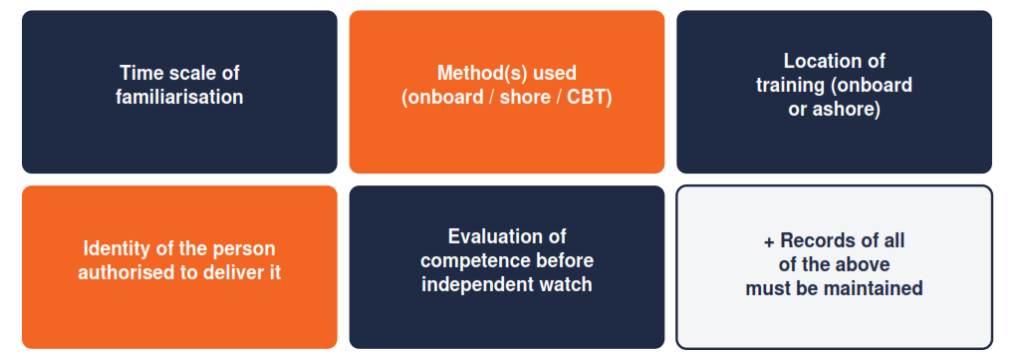
The SMS procedure should ensure the following is recorded: the time scale of familiarisation, the method(s) used, the location of training, the identity of the person authorised to deliver it, the evaluation of competence before independent watch, and records of all of the above being maintained.
No officer should take an independent navigational watch until their ECDIS familiarisation – equipment, timing, method, trainer, and evaluation – has been completed and properly recorded.