
THE ATMOSPHERIC PRESSURE AND TEMPERATURE
1. Pressure of the Atmosphere
The Earth’s atmosphere is held in place by gravity. Although gases are light, they still have weight. The closer we are to the Earth’s surface, the greater the amount of air pressing downward. This creates atmospheric pressure.
At sea level, the average atmospheric pressure is about 1,013.2 hPa. As altitude increases, atmospheric pressure decreases because there is less air above exerting weight. For example, at around 3,000 m (9,850 ft), atmospheric pressure reduces to approximately 670 hPa.
Atmospheric pressure is not limited to a downward force alone. It acts equally in all directions — upwards, downwards, and horizontally.
Key Points
- Air has weight and creates pressure.
- Atmospheric pressure decreases with height.
- Average sea-level pressure: 1,013.2 hPa
- Pressure at 3,000 m: about 670 hPa
- Pressure acts in all directions.
2. Heating of the Troposphere
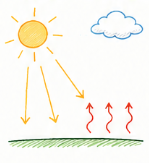
The atmosphere is mostly transparent to the sun’s short-wave radiation and receives very little direct heating from it. Instead, the Earth’s surface absorbs solar energy and becomes warm.
The layer of air in contact with the Earth is heated by this warm surface. Heat then spreads upward through three main processes:
Convection
Warm air rises and carries heat upward.
Turbulence
Mixing of air masses spreads warmth.
Conduction
Direct transfer of heat through molecular contact. This process is relatively slow.
Because of these processes, the temperature of lower atmospheric layers is mainly influenced by the temperature of the Earth’s surface below.
3. Variation of Temperature with Height
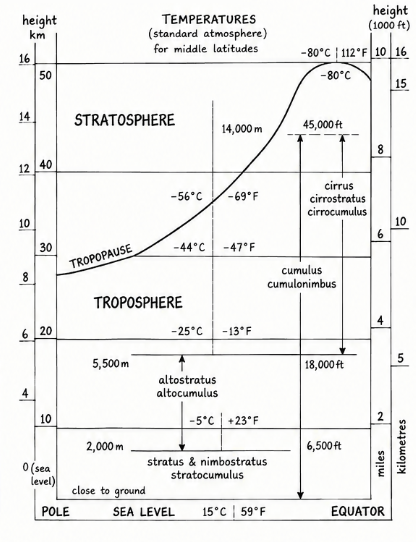
Under normal atmospheric conditions, temperature decreases with increasing height in the troposphere. This occurs because the Earth’s surface is the primary heating source, and its warming effect is strongest near ground level.
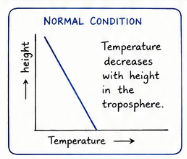
This decrease in temperature continues up to the tropopause, which forms the boundary between the troposphere and the stratosphere. Above the tropopause, temperature patterns behave differently because surface heating and upward air movement have less influence.
The average lapse rate in the troposphere is approximately:
0.6°C per 100 m
or
1°F per 300 ft
However, the actual lapse rate may vary from place to place and from day to day, especially near the surface where weather and local conditions can change rapidly.
Quick Summary
- The Earth heats the air from below.
- Heat moves upward by convection, turbulence, and conduction.
- Temperature normally decreases with altitude in the troposphere.
- Average lapse rate: 0.6°C per 100 m.