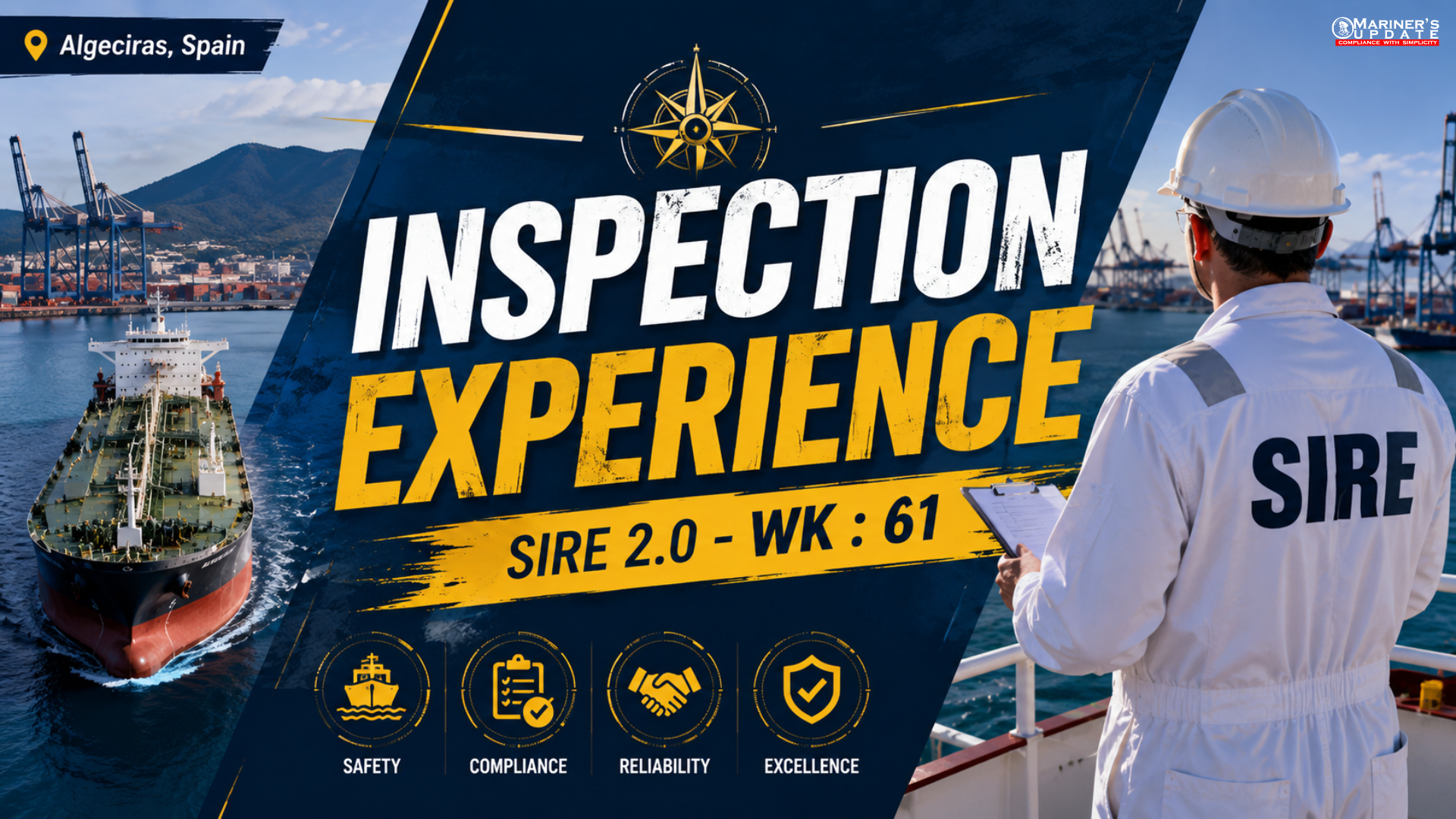
Port: Algeciras, Spain
Inspection Date: June 2026
Inspector: An….
Inspector’s Overall Style
The inspection lasted almost the entire day and was very evidence-driven. The inspector rarely accepted verbal answers alone and almost every discussion ended with requests such as:
- “Show me in your SMS.”
- “Where is the company procedure?”
- “Show me the PMS record.”
- “Show me the manufacturer’s recommendation.”
- “Can you demonstrate it now?”
Bridge, Engine and Cargo departments were all inspected in detail. Random crew interviews were carried out throughout the inspection.
BRIDGE
Inspector reviewed the Master’s Standing Orders and questioned bridge officers on situations requiring the Master to be called. The Night Order Book was checked together with voyage instructions, Master’s voyage approval and passage planning records.
Random verification of Deck Log Book entries was carried out and compared with operational records.
The latest alcohol testing records completed before sailing were verified.
Navigation publication inventory was checked, followed by random verification of publication editions. Particular attention was given to ensuring Bridge Resource Management (BRM) Volume 1 & 2 had replaced obsolete Bridge Team Management publications.
The inspector concentrated heavily on passage planning and ECDIS management.
Documents reviewed included:
- Passage Plan Appraisal Checklist
- Route Check Checklist
- Passage Plan Briefing Record
- Passage Plan Debriefing Record
- UKC Calculation
- Safety Depth Calculation
- Safety Contour Calculation
- ENC Marking Checklist
- Route Check Records
- ECDIS Safety Setting Change Records
Instead of simply confirming that charts were corrected, the inspector requested officers to demonstrate an actual ENC correction. Weekly Notices to Mariners were opened and officers were asked to locate a recently inserted buoy and confirm that the correction was visible on the ECDIS.
Questions were asked regarding Safety Depth, Safety Contour, Guard Zone settings and the basis for selecting each value.
Questions were also asked regarding X-Band and S-Band radar characteristics, Speed Log accuracy testing, BNWAS testing, Radar Magnetron running hours, Navigation Light alarms, Aldis Lamp inspection, Compass lighting arrangements and ETA Book maintenance.
The company procedure for Speed Log accuracy testing was specifically requested together with PMS records and the manufacturer’s acceptable error limits.
CARGO CONTROL ROOM
The Cargo Control Room inspection focused on operational readiness rather than documentation alone.
The inspector reviewed:
- Cargo Watch Takeover Checklist
- Comparison Sheets
- SSSCL
- Cargo Watch Handover procedures
- Duty Officer responsibilities
- Watchkeeping arrangements
- Cargo monitoring records
Cross-questioning was carried out on watchkeeping responsibilities during normal operations and during off-duty periods.
CHIEF ENGINEER’S OFFICE
The following documents were reviewed:
- Monthly Defect Reports
- Critical Equipment Register
- Management of Change Register
- Oil Record Book Part I
- Lubricating Oil Analysis Trend
- Onboard LO Test Records
- Bunkering Documentation
- Engine Power Limitation Documentation
The inspector also questioned the Chief Engineer regarding bunker line pressure testing requirements under company procedures.
ENGINE ROOM
The engine room inspection started from the lowest platform and continued deck by deck.
Bilges were examined carefully for cleanliness, oil traces and housekeeping standards.
The following alarms were demonstrated during the inspection:
- Bilge Alarm
- Main Engine OMD Alarm
- Main Engine Fuel Oil Leakage Alarm
- Auxiliary Engine Fuel Oil Leakage Alarm
- Steering Gear Low Level Alarm
- Engineers Call Alarm
- Incinerator Flame Failure Alarm
- OWS 15 ppm Alarm
The inspector requested operation of both Main Fire Pumps followed by the Emergency Fire Pump.
OWS calibration certificate was verified together with overboard sealing arrangements.
Emergency Bilge Suction arrangements were inspected and the Second Engineer was questioned regarding testing frequency.
ELECTRICAL SYSTEMS
The ETO was interviewed regarding:
- Main Switchboard isolation procedures
- Electrical Permit to Work
- Fire Detection testing
- Smoke Detector testing
- Earth Fault Alarm testing
- Low Insulation Alarm settings for both 220 V and 440 V systems
- Alarm Book entries
Practical explanation of testing procedures was expected rather than theoretical answers.
DECK
The inspector carried out a full walk-around of the main deck.
Routine deck inspections carried out by officers were discussed.
The following records were reviewed:
- Safety Inspection Records
- SSO Inspection Records
- Mooring Quarterly Reports
Visual inspection included:
- Cargo pipelines
- Manifold area
- Hose handling crane
- Mooring stations
- Hydraulic systems
- Deck lighting
- General housekeeping
The inspector expected officers to explain routine deck inspection items together with the corresponding SMS procedures.
LIFEBOATS AND LSA
Questions covered:
- Propeller Shaft Lubrication
- Monthly Inspection requirements
The Third Officer was expected to explain both inspection requirements and maintenance intervals.
ACCOMMODATION
Accommodation inspection included:
- Fire Doors
- Self-closing arrangements
- Escape Routes
- Emergency Lighting
- Fire Control Plans
- Public notices
- General cleanliness
GALLEY
The galley inspection focused on both hygiene and fire safety.
Items checked included:
- Deep Fat Fryer
- Fire Blanket
- Fire Extinguishers
- Emergency fuel shut-off arrangements
- Grease accumulation
- Galley ventilation
- Hygiene standards
- Temperature monitoring records
The Cook was questioned regarding actions to be taken in the event of a galley fire.
HOSPITAL
The inspector briefly inspected:
- Medical Locker
- Expiry Dates
- Oxygen Cylinder
- Stretcher
- Medical Inventory
- Hospital Cleanliness
CREW INTERVIEWS
Random interviews were conducted with both deck and engine ratings.
Topics included:
- Enclosed Space Entry
- Permit to Work
- Working Overside
- Stop Work Authority
- Garbage Segregation
- Oily Rag Disposal
- Fire Drill Duties
- SCBA Low Pressure Alarm
- Familiarisation Training
The inspector preferred ship-specific answers supported by company procedures.
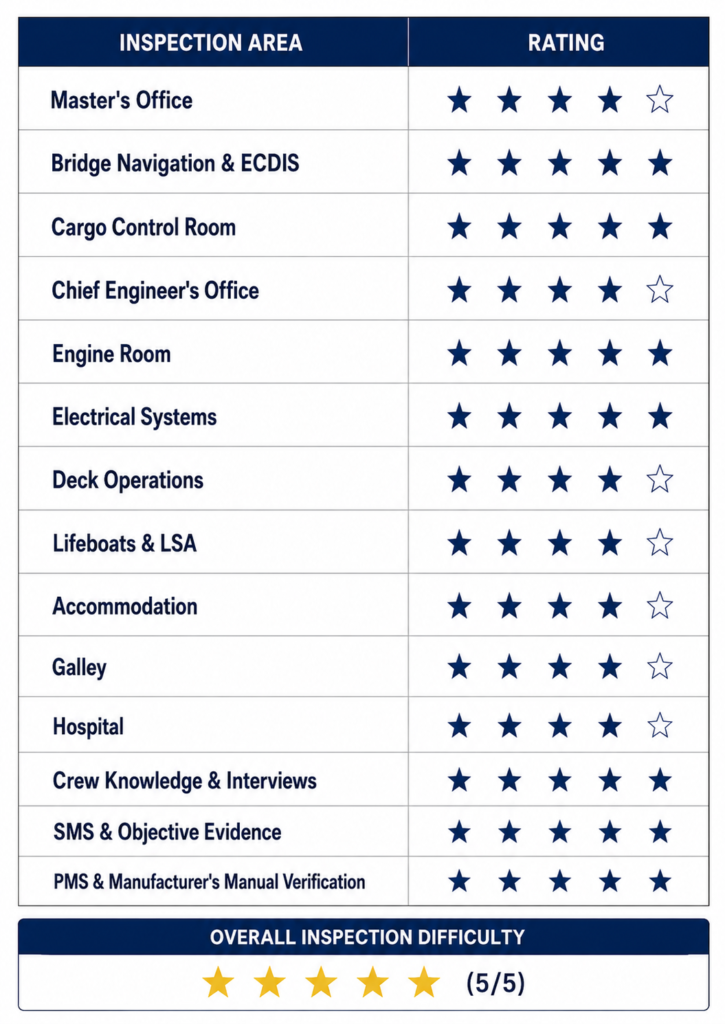
INSPECTION DIFFICULTY RATING