This week’s focus draws on a recent RightShip Ship Inspection Program (RISQ) report for a bulk carrier in the dry cargo trade.
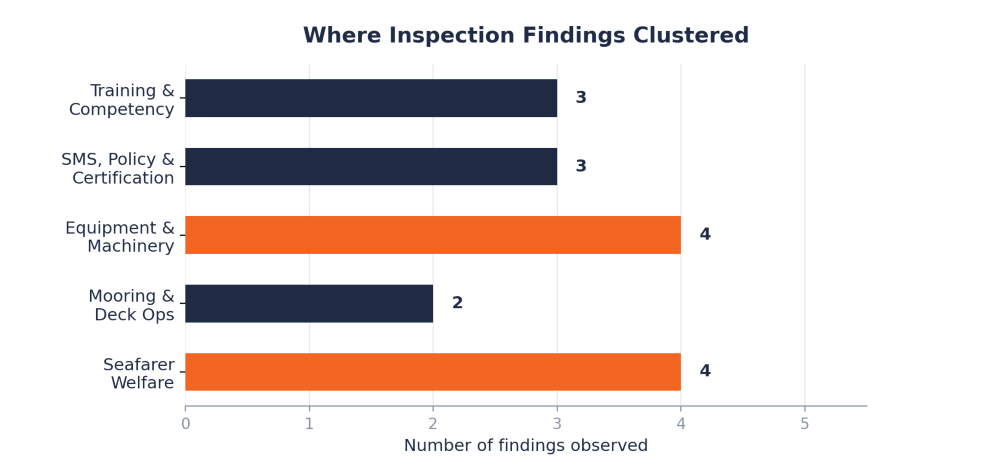
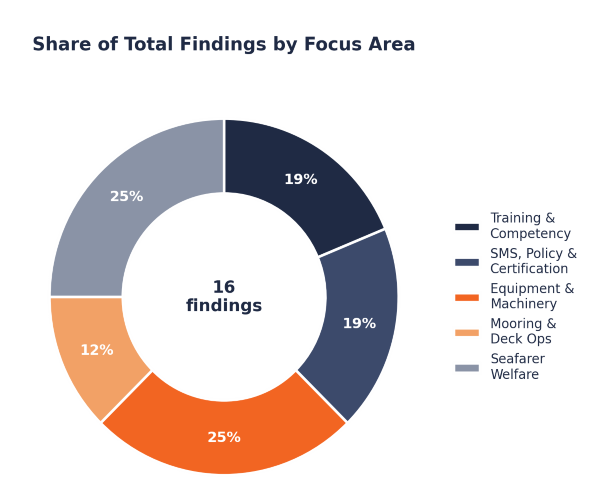
The Findings at a Glance – The inspection recorded sixteen non-conformities. We’ve grouped them into five recurring focus areas that consistently surface across RISQ inspections fleet-wide: Training & Competency (3), SMS/Policy & Certification (3), Equipment & Machinery (4), Mooring & Deck Ops (2), and Seafarer Welfare (4).
1. Training & Competency Gaps The largest recurring theme involved personnel who had not completed formal, documented training for specific shipboard tasks — rather than a lack of general competence. Examples included cargo teams without formal instruction on handling hazardous solid bulk cargoes, and senior officers without manufacturer-based training on hatch cover inspection, maintenance, and emergency operation. In each case, the underlying skill may well have existed onboard — what was missing was the paper trail proving it.
Takeaway: Maintain a live training matrix for every certification an inspector could ask about, and keep manufacturer or class-recognised certificates readily accessible onboard — not just completion records in a shore-based file.
2. Safety Management System & Certification Gaps Several findings pointed to SMS procedures that hadn’t kept pace with current requirements: a drug-testing policy that didn’t extend unannounced external testing to bulk carriers, missing evidence that engine and boiler modifications had been assessed against low-sulphur fuel compliance, and a cyber-security management system that had not been formally evaluated and certified by class.
Takeaway: SMS policies should be reviewed against the vessel’s actual type and trade — a generic fleet-wide policy can quietly fall short of vessel-specific regulatory requirements.
3. Equipment & Machinery Maintenance Technical findings included navigation equipment operating beyond its manufacturer-rated service life, oxy-acetylene welding equipment without an annual competent-person inspection and pressure test, a UMS-certified engine room that was never actually run in unattended mode, and a mast stay secured with an improvised covering rather than the specified fitting.
Takeaway: Planned maintenance systems should track manufacturer-specified service intervals as strictly as running hours — and certified operating modes should be exercised in practice, not just held on paper.
4. Mooring & Deck Operations Two findings centred on mooring safety: mooring lines with a Line Design Break Force exceeding the guideline threshold relative to the ship’s design Minimum Breaking Load, and a winch brake rendering test being set against the wrong reference value — the rope’s MBL rather than the ship design MBL specified by the manufacturer.
Takeaway: Mooring equipment selection and winch brake settings should be checked directly against class mooring guidelines, not assumed from familiarity with equipment used on similar vessels.
5. Seafarer Welfare & Human Element The final cluster concerned crew welfare: wages for spot-checked ratings and officers falling below the applicable ILO minimum wage scale, no free internet or email access for the crew, and an absence of both a documented mental health policy and structured training for key personnel in recognising mental health concerns onboard.
Takeaway: Welfare compliance is increasingly assessed with the same rigour as technical compliance. Wage scales, connectivity provisions, and mental health policies are documentable items — and should be reviewed on the same cycle as any other certificate.
A Closer Look: All 16 Non-Conformities from this Inspection
Q1: Have officers and ratings responsible for cargo handling on ships carrying dangerous and hazardous substances in solid form in bulk, undergone formal training? (V)
Response: No
Non-Conformity: Officers and ratings responsible for the carriage and care of dangerous and hazardous substances in solid form in bulk, including Material Hazardous Only in Bulk (MHB), have not received appropriate formal training to comply with the STCW Convention and Code’s 2010 Manila Amendments.
Q2: Has an SMS policy and procedure been established to enforce the STCW Convention and Code requirements for the purpose of preventing drug and alcohol abuse? (V & M)
Response: No
Non-Conformity: Company’s SMS policy does not require unannounced drug testing by an external agency, for bulk carrier. This testing is required for tankers only.
Q3: Is navigation equipment in good order? (V)
Response: No
Non-Conformity: S-Band Radar magnetron transmission time was 5745 hours. Manufacturer (JRC) required replacement interval is 4000 hours.
Q4: Is welding and gas burning equipment in good order and properly stored? (V & M)
Response: No
Non-Conformity: Regular inspection, thorough examination, and testing of all components to ensure the oxy/acetylene equipment in use on board is in a safe operational condition was not undertaken at least annually by a competent engineer from the manufacturer, including pressure testing of on-board piping systems.
Q5: Can the vessel safely comply with the requirements of Emission Control Areas (ECAs) and other local requirements regarding use of very-low or ultra-low sulphur fuels in the main engine, auxiliary engines and boilers? (M)
Response: No
Non-Conformity: Evidence of an evaluation and/or a statement of fact from a classification society confirming whether modifications to the vessel’s installed equipment (main and auxiliary engines and boilers) are required, was not carried onboard.
Q6: Is a procedure in place for the safe operation of hatch covers, and is the Master/Chief Officer appropriately trained in hatch cover inspection and maintenance? (V)
Response: No
Non-Conformity: Master and Chief Officer have not attended any formal hatch cover inspection and maintenance training (shore-based and/or onboard) course by a manufacturer’s representative.
Q7: Are officers familiar with emergency hatch cover operation arrangements, and is there evidence of effective training of personnel available on board? (V)
Response: No
Non-Conformity: Evidence of effective training of personnel in emergency hatch cover operation was not found on board. The manufacturer’s instructions for the maintenance and testing of the emergency portable pump unit were not incorporated in the PMS.
Q8: Do mooring lines and mooring tails comply with industry guidelines and are they in good order? (V & M)
Response: No
Non-Conformity: Line Design Break Force (LDBF) of the mooring lines fitted to the vessel was 84.5 tons, exceeding the guideline limit of 100–105% of the ship design MBL of 67.8 tons.
Q9: Is there a procedure for testing the winch brake rendering setting, and is it being tested regularly? (V & M)
Response: No
Non-Conformity: The vessel manager’s brake rendering test procedure requires setting the brake at 60% of the rope MBL, rather than 60% of the ship design MBL.
Q10: Are cyber security policies and procedures being incorporated in the safety management system, and was the cyber security management system evaluated and certified by Class? (V)
Response: No
Non-Conformity: Cyber security certification covering operational, technical and physical requirements had not been evaluated and certified by Class.
Q11: If the vessel has been certified for periodically unattended machinery space operation (UMS), is the machinery space being operated in that mode? (V)
Response: No
Non-Conformity: Vessel is certified for UMS; however, machinery spaces are always kept manned at sea.
Q12: Are the mast heads and their fittings, including wire stays, flood lights, deck lights, emergency lights, and hold lights (if installed), in good working order? (V)
Response: No
Non-Conformity: One main mast wire stay with sheathed plastic was used to secure the mast head; the other three stays were renewed and free of any covering.
Q13: Do the Seafarer Employment Agreements (SEA) comply with the requirements of MLC 2006, and do the crew salaries meet or exceed the current ILO Minimum Wage Scale? (V & M)
Response: No
Non-Conformity: A randomly checked seafarer’s basic wage was below the ILO minimum recommended basic wage scale applicable from 1 Jan 2021. Example 1: Deck Rating monthly basic ~92 USD vs. ILO basic scale of 641 USD for the rank. Example 2: Chief Engineer monthly basic ~381 USD vs. ILO basic scale of 1963 USD.
Q14: Are the ship’s staff provided with adequate recreation facilities on board the ship? (V)
Response: No
Non-Conformity: Crew were not provided with free internet access and free email communication facilities.
Q15: Is the vessel provided with adequate policies on mental health and mental disorders? (V)
Response: No
Non-Conformity: Vessel was not provided with adequate policies on mental health and mental disorders.
Q16: Has the company provided training for on-board key personnel in recognising signs of mental health problems? (V)
Response: No
Non-Conformity: No training was provided for on-board key personnel in recognising signs of mental health problems.