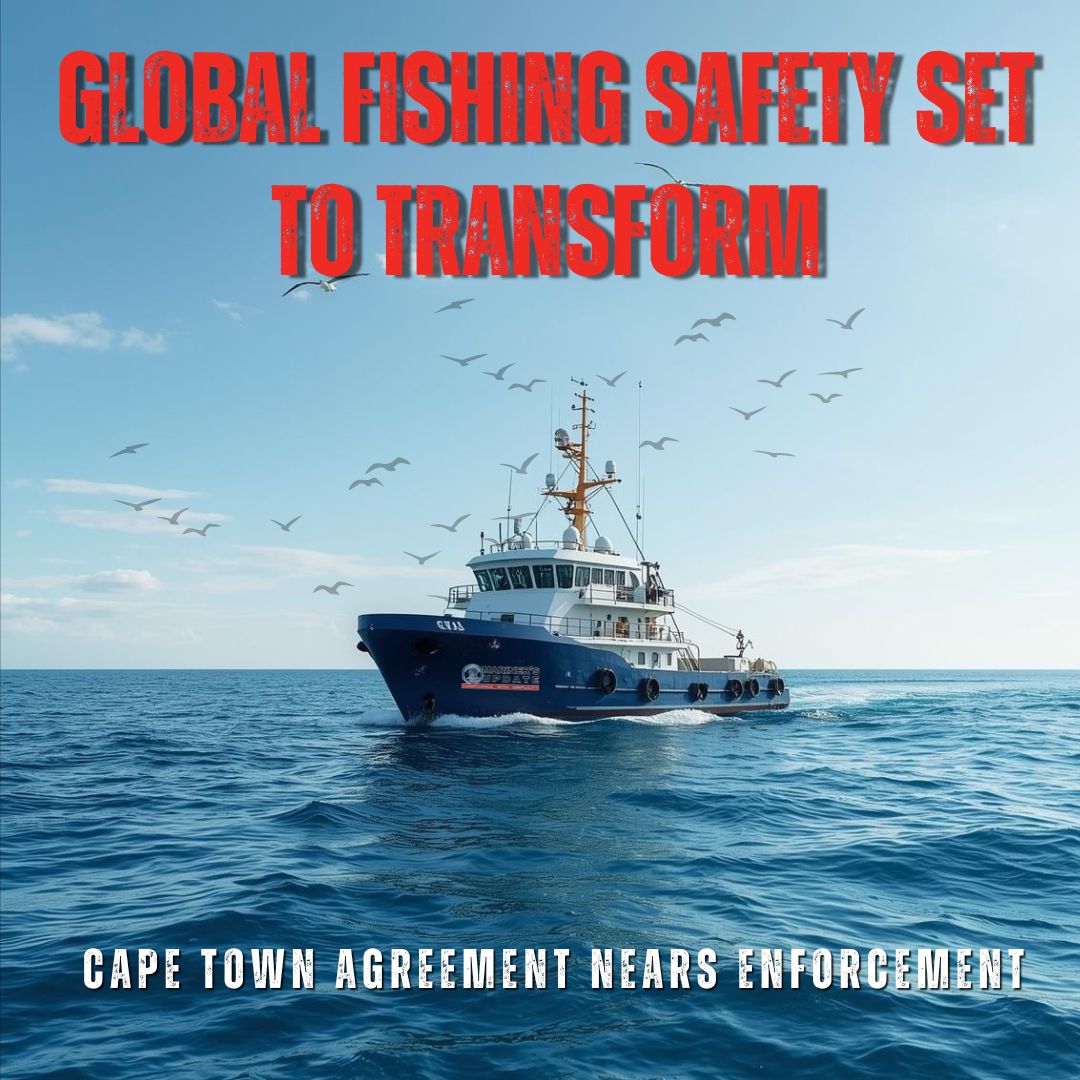
The long-awaited 2012 Cape Town Agreement, developed under the International Maritime Organization, is finally approaching implementation, marking a major step toward safer seas for fishing vessels worldwide.
This landmark framework introduces the first legally binding international safety standards specifically for fishing vessels. It lays down comprehensive rules covering vessel design, construction, equipment, and operational safety. Key areas include stability, seaworthiness, communication systems, and life-saving appliances.
Beyond safety, the Agreement carries a broader mission. It strengthens efforts to tackle Illegal, Unreported and Unregulated (IUU) fishing and addresses serious concerns such as forced labour within the fishing industry.
The regulations apply primarily to fishing vessels measuring 24 meters and above, or their equivalent in gross tonnage. Administrations have the flexibility to use tonnage as a benchmark, with the following equivalencies:
- 300 GT ≈ 24 meters
- 950 GT ≈ 45 meters
- 2,000 GT ≈ 60 meters
- 3,000 GT ≈ 75 meters
While many of the technical standards are aimed at newly built vessels, certain provisions extend to existing fleets as well. However, exemptions may be granted by States for vessels operating exclusively within their own Exclusive Economic Zones (EEZs).
After years of deliberation and gradual adoption, the Agreement has now secured the required ratifications and is set to enter into force on 24 February 2027. Once active, it will enable port State inspections, helping enforce compliance and creating a more uniform global safety environment.
Stakeholders seeking further clarity are encouraged to reach out to relevant maritime safety or loss prevention departments.