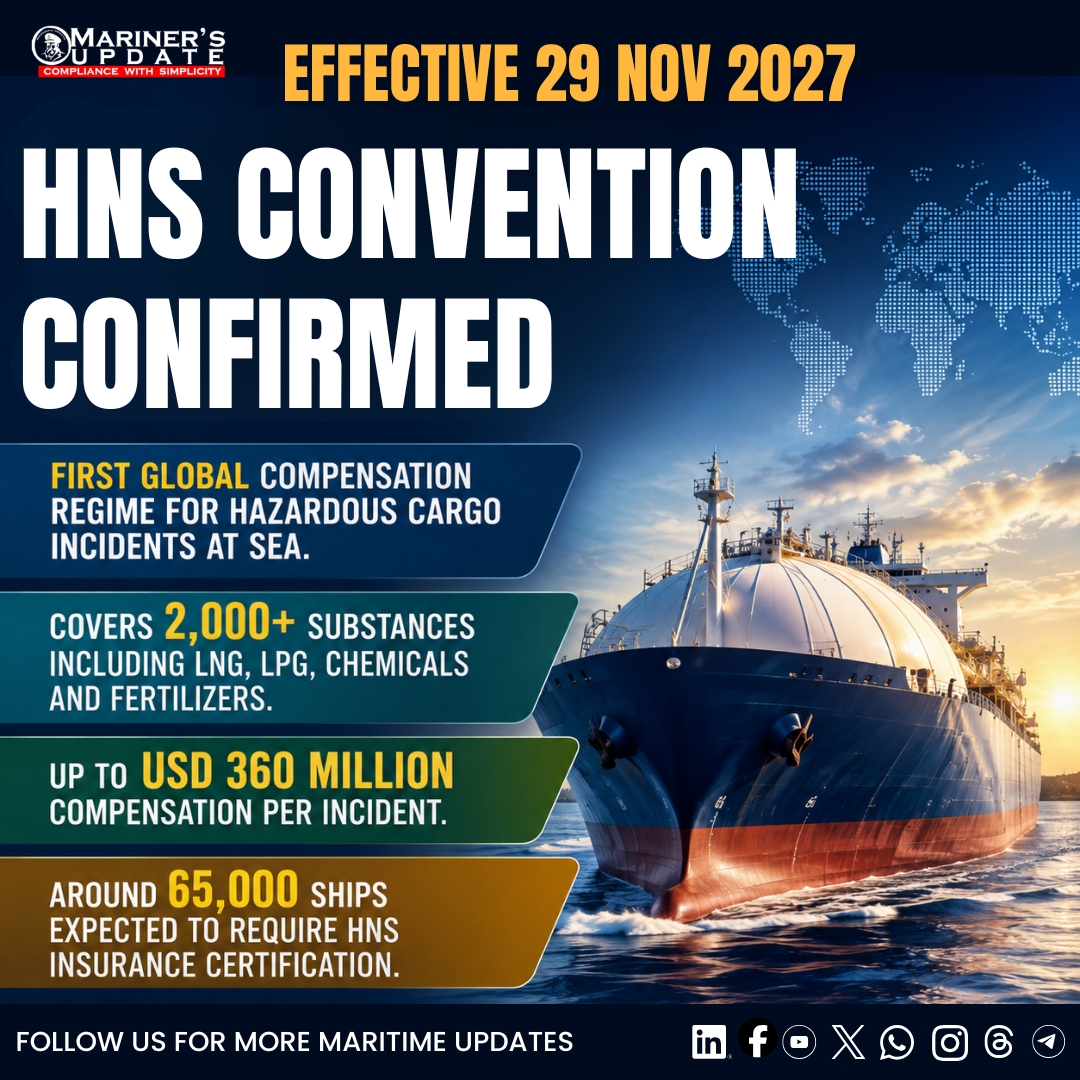
The maritime industry has reached a historic milestone with the confirmation that the International Convention on Liability and Compensation for Damage in Connection with the Carriage of Hazardous and Noxious Substances by Sea (2010 HNS Convention) will officially enter into force on 29 November 2027.
This long-awaited development closes one of the most significant gaps in the international maritime liability and compensation framework and establishes the first global compensation regime specifically designed for accidents involving hazardous and noxious substances (HNS) carried by sea.
Why This Matters
While international conventions already provide compensation mechanisms for oil pollution and shipwreck-related incidents, accidents involving thousands of hazardous chemical cargoes have lacked a dedicated international compensation system.
As global trade increasingly relies on the transportation of chemicals, fertilizers, acids, LNG, LPG, alcohols and other hazardous cargoes, the need for a comprehensive compensation regime has become more critical than ever.
The HNS Convention now provides a structured framework ensuring that victims of hazardous cargo incidents receive fair and timely compensation while offering legal certainty to shipowners, cargo interests, governments and insurers.
Conditions Successfully Met
The conditions required for the Convention’s entry into force were officially fulfilled on 29 May 2026.
Under the Convention, the following requirements had to be satisfied:
• At least 12 States must ratify the Convention.
• Four of those States must each possess not less than 2 million gross tonnage.
• Contributing cargo receipts reported by contracting States must exceed 40 million tonnes during the preceding calendar year.
These requirements have now been achieved following the submission of cargo reports for 2025 by all Contracting States.
The recent ratifications by Belgium, Germany, the Kingdom of the Netherlands and Sweden played a crucial role in reaching the required threshold.
IMO Welcomes Historic Achievement
IMO Secretary-General Arsenio Dominguez described the achievement as a major breakthrough for international shipping.
According to the IMO, the Convention closes an important gap in the global liability and compensation regime and ensures that those affected by hazardous cargo incidents involving ships can access fair and timely compensation.
The treaty also provides legal certainty for governments, insurers and industry stakeholders involved in the transport of dangerous cargoes.
What Cargoes Are Covered?
The Convention applies to more than 2,000 hazardous and noxious substances transported by sea, including:
• Chemicals
• Acids
• Fertilizers
• Petroleum products
• Alcohols
• Liquefied Natural Gas (LNG)
• Liquefied Petroleum Gas (LPG)
• Other hazardous bulk and packaged cargoes
The Convention covers:
✓ Loss of life
✓ Personal injury
✓ Property damage
✓ Economic losses
✓ Environmental damage
✓ Pollution clean-up costs
This significantly expands protection beyond traditional oil pollution incidents.
How the Compensation System Works
The Convention operates on the internationally recognized “Polluter Pays” principle.
First Tier – Shipowner Liability
Shipowners will be held strictly liable for damages resulting from HNS incidents.
Owners must maintain valid insurance or financial security certified by their Flag Administration.
Second Tier – HNS Fund
When compensation exceeds the shipowner’s liability limits, additional compensation will be available through a dedicated HNS Fund.
The Fund will be financed by receivers of HNS cargo in Contracting States and will only collect contributions when compensation is required following an incident.
Compensation Limits
The total compensation available under the Convention is capped at:
250 Million Special Drawing Rights (SDR)
Equivalent to approximately:
USD 360 Million per incident
This provides a significant financial safety net for victims, coastal communities and governments affected by major hazardous cargo accidents.
Impact on the Shipping Industry
Industry estimates suggest that approximately 65,000 ships worldwide will require HNS insurance certificates or equivalent financial security documentation once the Convention enters into force.
Shipowners, operators, charterers, cargo interests, insurers and maritime administrations should begin preparations well ahead of November 2027.
The implementation phase is already underway, with the IOPC Funds Secretariat and IMO Secretariat working together to establish a fully operational HNS Fund and supporting administrative framework.
HNS Fund Headquarters
To support implementation, Member States have approved the co-location of the HNS Fund headquarters with the IOPC Funds Secretariat in London.
The HNS Fund will also share the same Director, ensuring consistency and efficiency during the establishment phase.
Contracting States
As of 29 May 2026, the 12 Contracting States are:
Belgium, Canada, Denmark, Estonia, France, Germany, the Kingdom of the Netherlands, Norway, Slovakia, South Africa, Sweden and Türkiye.
Mariners Update Takeaway
The entry into force of the 2010 HNS Convention represents one of the most significant developments in maritime liability legislation in recent decades.
For shipowners, operators and cargo stakeholders, the message is clear: preparation must begin now.
With increasing volumes of LNG, LPG, chemicals and alternative fuels moving across the world’s oceans, the Convention provides a modern compensation framework designed to protect victims, strengthen accountability and enhance confidence in the global shipping system.
29 November 2027 will mark the beginning of a new era in hazardous cargo liability and compensation.