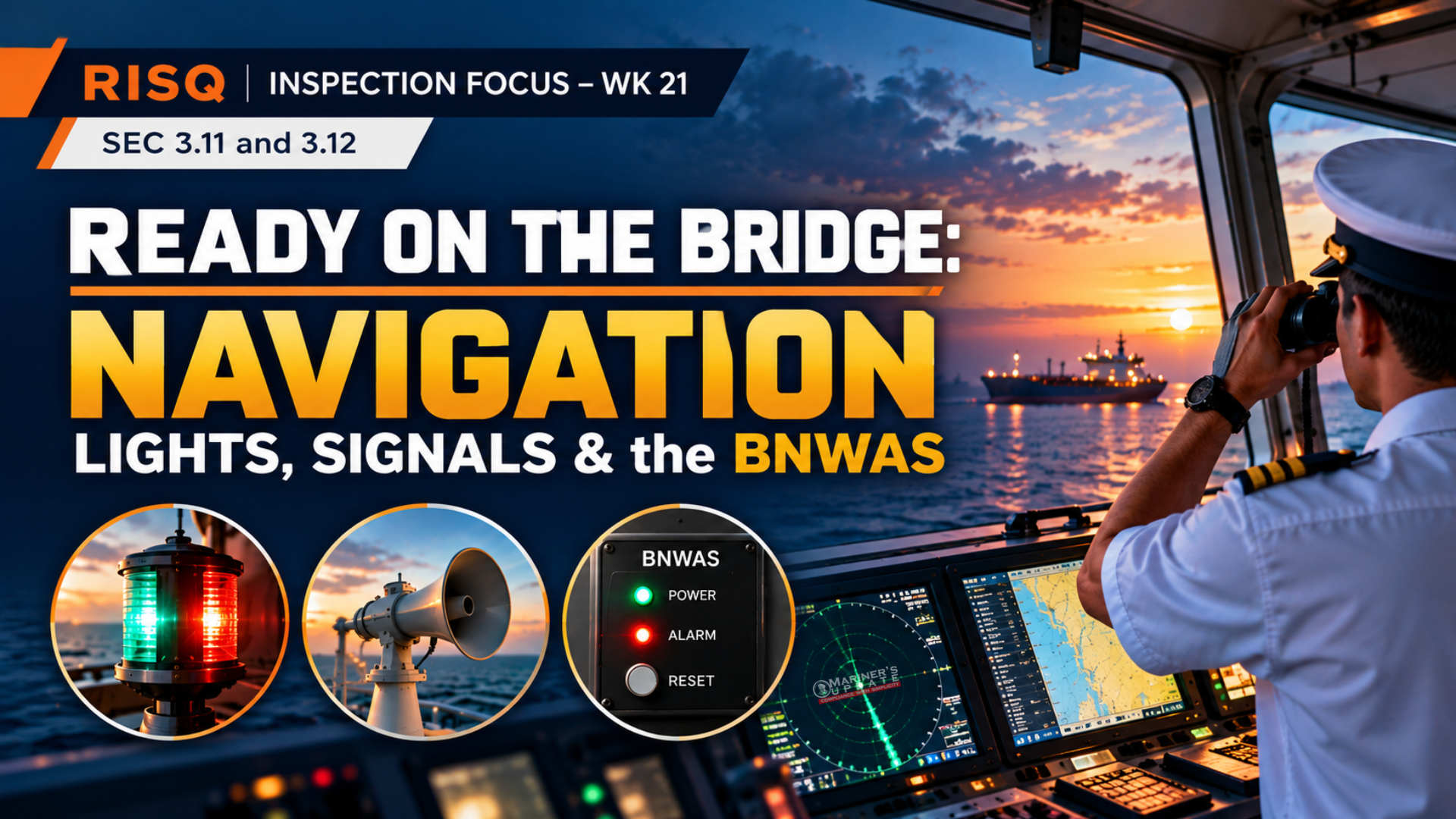
Two checkpoints that keep the ship visible and the watch alert
A vessel is only as safe as its ability to be seen, to signal and to keep the watch alert. Checkpoints 3.11 and 3.12 look at exactly that: whether lights and signalling gear are ready the moment they are needed, and whether the Bridge Navigational Watch Alarm System (BNWAS) is understood, operated and tested the way the company procedure says.
────────────────────────
3.11 – LIGHTS, SHAPES & SIGNALLING EQUIPMENT Is it working, and is it ready right now?
Navigation lights, emergency navigation lights, shapes and signalling equipment tell other vessels who we are and what we are doing. If any of them fail, the risk of a misunderstanding at sea rises quickly. That is why the Officer of the Watch (OOW) carries the responsibility of making sure this equipment is in working order and ready for immediate use.
What good looks like on board:
- The OOW takes ownership of the condition and readiness of navigation lights, emergency navigation lights and signalling equipment.
- The condition of lights, flags and shapes is checked at regular intervals, not only before departure.
- Sound signalling equipment is checked daily and kept in an operational condition.
- A procedure for testing the navigation light failure alarm is posted on the bridge, so any officer on watch can carry out the test correctly.
- The signalling lamp is supported by 3 spare bulbs and a portable battery pack, so it can still be used if the normal supply or a bulb fails.
Readiness at a glance:
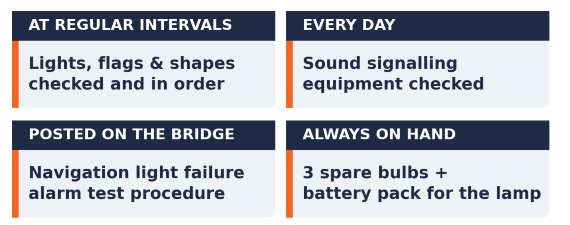
- At regular intervals: lights, flags and shapes checked and in order
- Every day: sound signalling equipment checked
- Posted on the bridge: navigation light failure alarm test procedure
- Always on hand: 3 spare bulbs and a battery pack for the signalling lamp
Why it matters: Signalling equipment is rarely needed, but when it is needed there is no time to find a spare bulb or work out how a test is done. Regular checks, a visible procedure and the right spares turn a possible failure into a routine fix.
────────────────────────
3.12 – BNWAS FAMILIARITY & RECORDS A silent system only works if everyone knows how it works.
The Bridge Navigational Watch Alarm System monitors the alertness of the bridge watch and raises an alarm if there is no response. Navigation officers should be familiar with the company procedure for its use, and records should be available to show that it was operated while the ship was underway and at anchor, and that it was tested in line with the procedure.
Operate it every time:
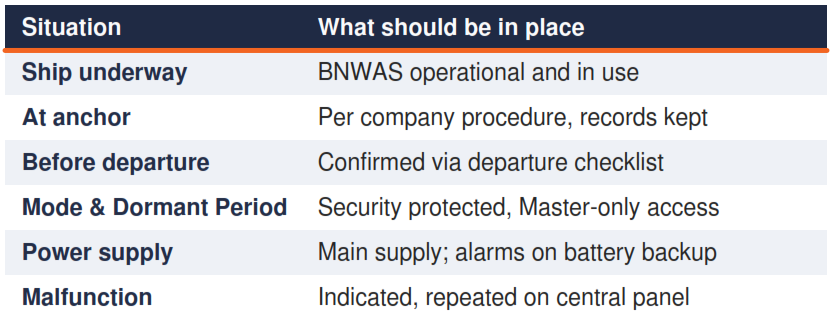
- The BNWAS must be operational whenever the ship is underway.
- It should also be used when the ship is at anchor.
- The operating modes (automatic, manual, on and off) and the steps for correct use should be written into the company navigation procedure.
- Its operation should be part of the departure checklist, so it is confirmed every time the ship sails.
- If a key is supplied with the system, it should be kept by the Master.
How the alarm escalates:
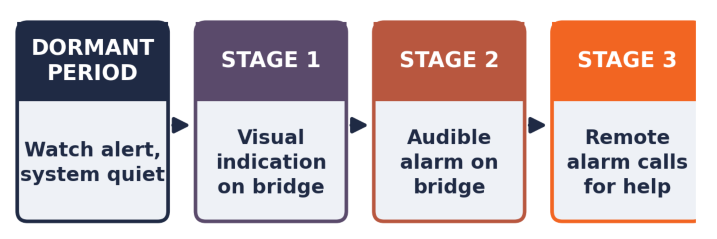
- Dormant Period – the watch is alert and the system stays quiet.
- Stage 1 – a visual indication on the bridge.
- Stage 2 – an audible alarm on the bridge.
- Stage 3 – a remote alarm that calls for help.
If there is no response, the alarm escalates. A reset restarts the cycle.
Protect the settings:
- Selecting the operational mode and the length of the Dormant Period should be security protected.
- Access to these controls should be restricted to the Master only, so the system cannot be weakened or switched off by mistake or by choice.
Protect the power:
- The BNWAS should be powered from the ship’s main power supply.
- The malfunction indication, and all elements of the Emergency Call facility where fitted, should be powered from a battery-maintained supply, so the warnings still work if the main supply is lost.
Know when it is not working:
- If a malfunction or a power supply failure is detected, it must be clearly indicated.
- Where a central alarm panel is fitted, the indication should be repeated there, so the fault is seen by the right people.
What the company procedure should cover:
The vessel manager should establish procedures that set out:
- When the BNWAS must be operational
- Who is responsible for activating it
- Safeguards against unauthorised deactivation
- The actions to take if a Stage 2 or Stage 3 alarm is triggered
- The periodic tests and checks needed to confirm the system keeps working properly
────────────────────────
BNWAS READINESS CHECKLIST
────────────────────────
Working lights, ready signals and a properly operated BNWAS are everyday habits, not paperwork. Test the gear, follow the procedure and keep the records, so that when the bridge is tested, the evidence is already there.