Red Sea Attack and Strait of Hormuz Restrictions Signal Rising Maritime Risk
Maritime security concerns are intensifying across the Red Sea and Arabian Gulf, with a tanker coming under attack west of Yanbu, Saudi Arabia, while commercial traffic through the Strait of Hormuz has fallen to a fraction of its normal level. At the same time, Iran is moving to formalise its control measures over Hormuz, while regional authorities are increasing scrutiny of vessels operating under Iranian transit arrangements.
Tanker Attacked West of Yanbu
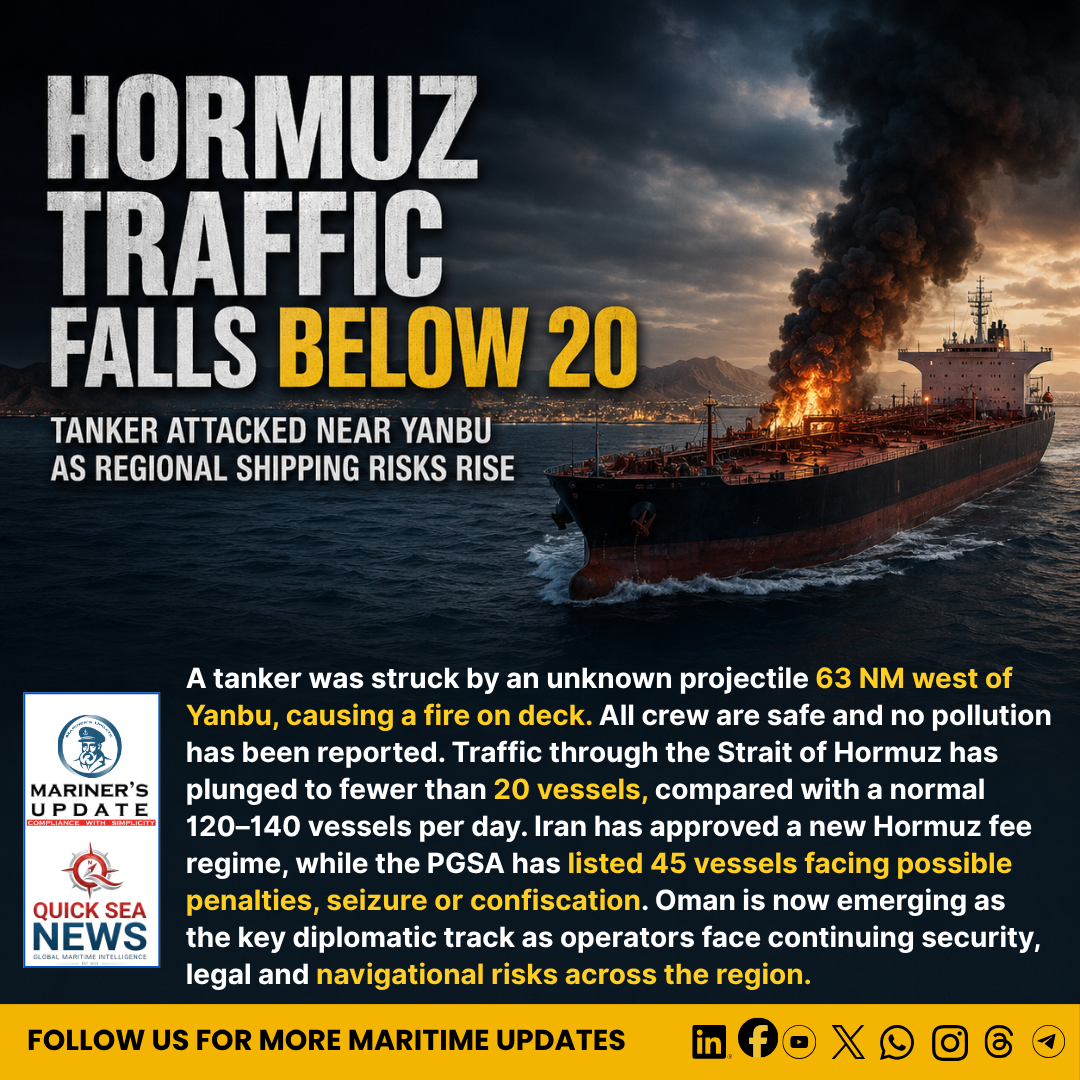
The United Kingdom Maritime Trade Operations (UKMTO) reported that a tanker was attacked at approximately 0637 UTC while sailing around 63 nautical miles west of Yanbu, Saudi Arabia.
The vessel was reportedly struck by an unidentified projectile, triggering a fire on the main deck. All crew members are reported safe, and there has been no reported environmental impact from the incident.
Ships operating in the surrounding area have been advised to exercise extreme caution. Vessels within 100 nautical miles of the incident area are advised to review and maintain the protective measures contained in BMP Maritime Security (BMP MS).
The current threat assessment remains SEVERE for Saudi-affiliated vessels, while EUNAVFOR Aspides continues to assess the threat to Israeli-linked vessels as HIGH.
The incident highlights that the security risk is not confined to the immediate Strait of Hormuz area and continues to affect commercial shipping routes across the wider Red Sea and Gulf region.
Hormuz Traffic Falls to Less Than 20 Vessels
Commercial traffic through the Strait of Hormuz has dropped dramatically.
According to Pole Star Global data, fewer than 20 vessels transited the Strait during the weekend, compared with a pre-conflict daily norm of approximately 120–140 vessels.
Although no new confirmed attacks on merchant ships were identified during the latest reporting period, the extremely low traffic volume demonstrates the continuing reluctance of operators to use the strategically important waterway.
The transit threat assessment remains SEVERE. NAVWARN 01/2026 remains in force, while the unresolved mine threat within the IMO Traffic Separation Scheme continues to be an important consideration for vessels planning a passage.
Iran Moves to Formalise Hormuz Fee Regime
Iran is also strengthening its legal position concerning navigation through the Strait.
On 23 August, Iran’s parliamentary commission approved a formal fee regime covering authorised vessels using the Strait. The proposed charges include navigation, environmental protection, fuel, insurance and other associated services.
Payments may be required in Iranian rial or another currency selected by Iran.
The development is significant because it places recent enforcement measures on a more formal legislative footing. It follows a statement from Iran’s Supreme National Security Council Secretary, who said the Strait remains closed and would not reopen until the United States changes its behaviour.
The current assessment is therefore that enforcement activity is more likely to continue than rapidly de-escalate.
Persian Gulf Strait Authority Publishes 45-Vessel List
The Persian Gulf Strait Authority (PGSA) has separately announced that vessels considered to be in violation of Iranian transit arrangements could face fines, seizure or confiscation.
The authority has published a list containing 45 vessels, which cargo owners and operators are being advised to check before entering into new chartering arrangements.
The warning also extends to ship-to-ship (STS) transfers and transshipment activities. A vessel conducting an STS operation or transshipment involving a listed vessel could itself be added to the list.
Operators should also be alert to vessel identity changes. VADIN, previously known as LILA VADINAR, appears on the list under the same IMO number.
This makes due diligence particularly important before fixing vessels, arranging STS operations or conducting cargo movements connected with the region.
Oman Emerges as the Key Diplomatic Track
Diplomatic developments could become important over the next 24–48 hours.
Oman’s Foreign Minister is reportedly travelling to Tehran for discussions concerning shipping arrangements in the Strait, with talks expected around Tuesday, 25 August.
Oman’s engagement is currently one of the key diplomatic developments to monitor.
Separately, Iraq has proposed the creation of a joint security council involving Iran, Iraq and Saudi Arabia to address what it described as a “crisis of confidence” between Tehran and Riyadh.
There is currently no confirmed information indicating that US-Iran talks are ongoing or formally scheduled.
Port Operations Remain Uneven
Port operations across the region continue, but restrictions remain in place at several locations.
In Bahrain, BAPCO remains suspended, while APM Terminals is operating on a restricted 0600–1800-hour schedule.
Kuwait’s Shuaiba and Shuwaikh ports continue to operate under ISPS Security Level 2.
Ports in the UAE, Saudi Arabia, Qatar and Oman remain operational. However, vessels calling at Mina Al Fahal should ensure that a functioning Doppler log is available because GPS interference continues to affect navigation reliability.
Operators should also avoid relying solely on older regional status information. With no ISS update since 3 August, terminal and port conditions should be verified directly with local agents before arrival.
What Operators Should Do Now
The current security environment requires operators to make voyage decisions using the latest available information rather than relying on normal routing assumptions.
Ships should not transit the Strait of Hormuz without current guidance from relevant authorities, including NAVCENT NCAGS, UKMTO, insurers and flag administrations.
Iran’s new fee regime should be treated as an active enforcement framework, while the PGSA’s published vessel list should be checked before fixing or arranging cargo movements involving the region.
Where operationally and commercially feasible, routing around the Cape of Good Hope remains strongly recommended for vessels seeking to avoid the current Hormuz risk.
For vessels operating through the Red Sea and Gulf of Aden, BMP Maritime Security measures should remain fully implemented. All relevant transits should also be registered with UKMTO, MSCIO and EUNAVFOR Aspides.
The Bigger Maritime Picture
The combination of a new tanker attack near Yanbu, historically low Hormuz traffic, Iran’s formalisation of transit fees, the PGSA vessel restrictions and continuing navigational threats creates a highly uncertain operating environment for commercial shipping.
For shipowners, charterers, masters and cargo interests, the priority is no longer simply selecting the shortest or most economical route. Security assessments, sanctions and legal exposure, insurance requirements, port restrictions, navigational hazards and the latest government guidance must all be considered before a vessel enters the region.
With diplomatic efforts now developing through Oman and other regional channels, the situation could change quickly. Until there is clear evidence of sustained de-escalation, operators should continue to treat the Red Sea and Strait of Hormuz as high-risk operating environments and maintain robust voyage-specific risk assessments.