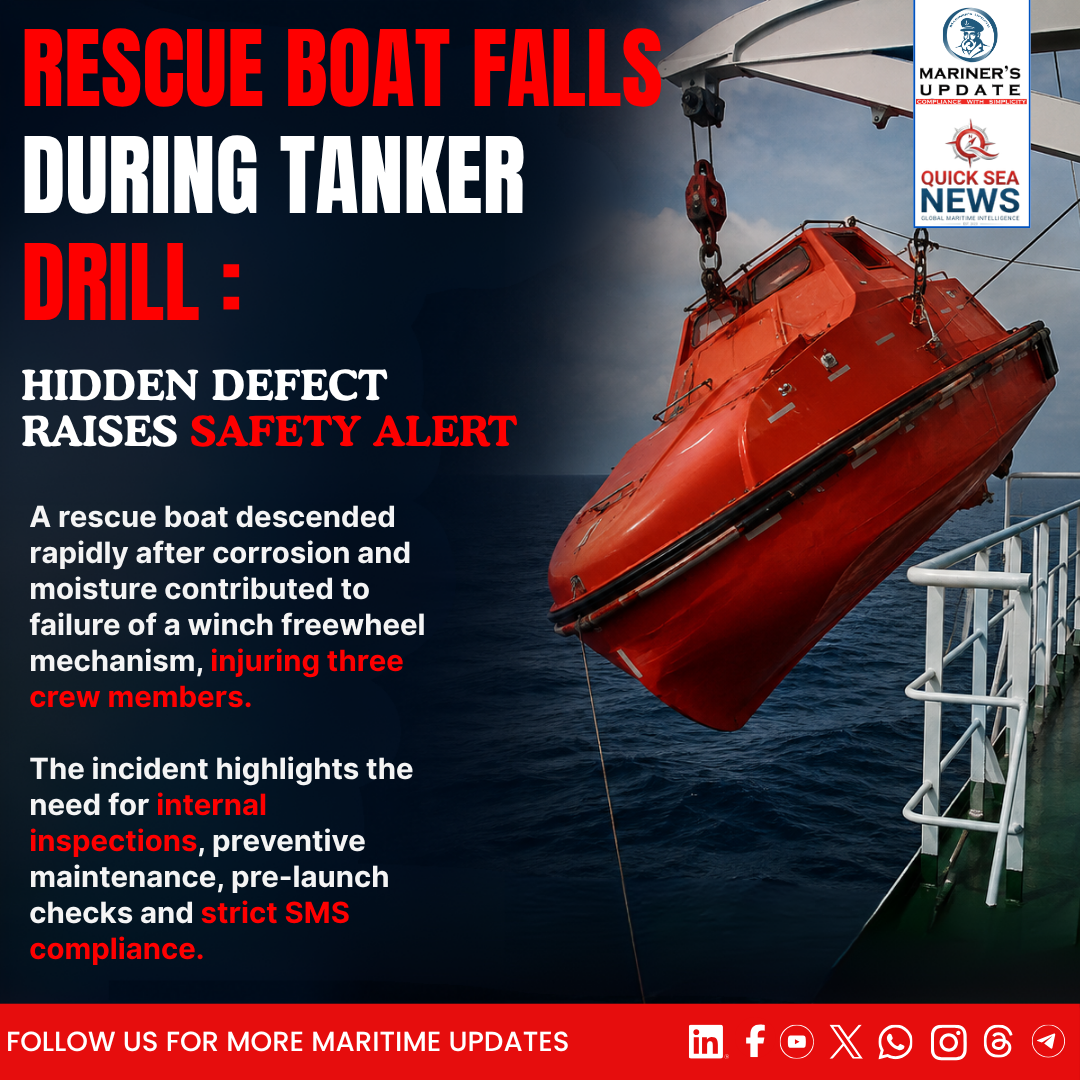
A rescue boat launching drill on board a tanker has highlighted a serious and often overlooked safety risk: critical defects can remain hidden inside launching appliances even when equipment appears satisfactory during routine inspections.
The Federal Bureau of Maritime Casualty Investigation (BSU) published its investigation report and press release on 23 July 2026 following an uncontrolled rescue boat fall during a drill. The accident occurred when the rescue boat descended rapidly because of a hidden technical defect in the launching appliance’s winch-unit freewheel module (one-way clutch). Corrosive ambient air and moisture inside the winch contributed to deterioration of the internal mechanism. The sudden fall resulted in injuries to three crew members.
Following its investigation, BSU issued safety recommendations to the German Association for Shipbuilding and Marine Technology (VSM) so that the technical findings could be communicated to member manufacturing companies.
Why This Accident Matters
Rescue boat launching drills are essential for maintaining crew readiness and ensuring that emergency equipment can be deployed when lives are at risk. However, these operations also involve significant fall-from-height and mechanical failure hazards.
The incident demonstrates that relying only on external visual checks, routine greasing or annual inspections may not always reveal deterioration inside critical machinery. Components such as the freewheel mechanism, braking system, bearings and seals may develop corrosion, seizure or other defects that are not immediately visible from outside.
The accident also reinforces the importance of following the vessel’s Safety Management System (SMS) without shortcuts. Pre-launch inspections and operational verification procedures are designed specifically to identify unsafe conditions before crew members are exposed to the equipment.
Key Preventive Measures for Tankers
1. Carry out thorough internal inspections and planned maintenance
Visual inspection alone may not identify corrosion, seizure or deterioration inside the winch. Launching appliances should therefore undergo periodic open-up inspections in accordance with the manufacturer’s instructions, with particular attention to internal freewheel and braking mechanisms.
2. Recognise hidden equipment risks
Equipment that has successfully passed an annual inspection can still contain defects within internal components. Critical parts such as seals and bearings should be replaced according to manufacturer-recommended service intervals, taking into account the vessel’s operating environment and exposure to corrosive conditions.
3. Never assume machinery will function correctly
Pre-inspection and operational verification procedures specified in the SMS must be completed before a rescue boat is lowered with personnel on board. The possibility of an unseen machinery failure should always be considered.
4. Conduct a proper risk assessment before drills
Before starting a rescue boat launching operation, the crew should assess potential failure scenarios, including uncontrolled lowering or failure of the winch and braking systems. These risks should be discussed during Toolbox Meetings so that everyone involved understands the hazards and control measures.
5. Share lessons learned onboard
Incidents involving hidden technical defects should be discussed during Shipboard Safety Committee meetings and safety briefings. Sharing such cases can improve crew awareness and encourage closer attention to machinery conditions that may not be apparent during routine checks.
Key Takeaway
The BSU investigation is a strong reminder that passing an inspection does not necessarily mean that critical equipment is free from hidden defects. For rescue boat launching systems, preventive maintenance, internal inspections, strict SMS compliance, operational testing and effective risk assessment must work together.
A rescue boat drill is intended to prepare the crew for an emergency—not create another emergency. Every launching operation should therefore begin with the assumption that equipment failure is possible and that human life must be protected accordingly.