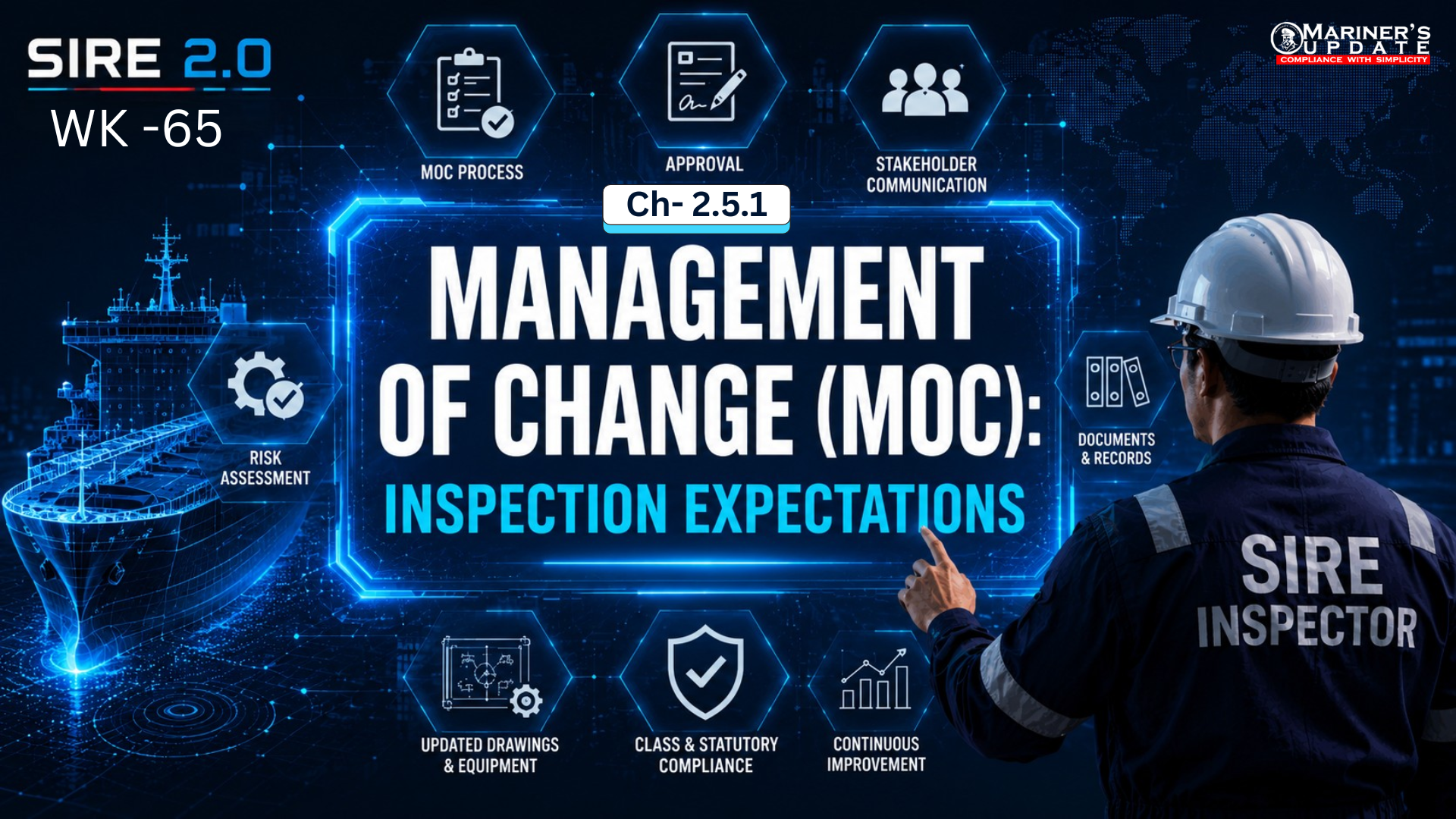
Chapter 2.5.1
Had the company Management of Change procedure been effectively implemented for changes affecting structure, machinery and equipment governed by Classification Society rules or statutory survey?
Applies to: Oil Tanker | Chemical Tanker | LNG | LPG
Potential Ground for Negative Observation (OBS)
- There was no company MOC procedure covering changes affecting class and/or flag regulated structure, machinery and equipment.
- The accompanying senior officer was unfamiliar with the company MOC process, as it applied to changes falling within the scope of this question, to structure, machinery and equipment onboard the vessel.
- Changes falling within the scope of this question to vessel structure, machinery or equipment, regulated by class and/or flag, had been conducted within the previous twelve months but had not been declared on the pre-inspection questionnaire.
- Changes to vessel structure, fittings or equipment, within the scope of this question, had been conducted within the previous twelve months but there was no approved MOC request form and supporting documentation onboard.
Checklist for You
- Are all senior officers familiar with the company MOC process for changes to vessel’s structure, machinery and equipment onboard the vessel?
- Is there approved MOC request form and supporting documentation for any changes to vessel’s structure, machinery or equipment which have been conducted within the previous twelve months?
- Are supporting documents such as risk assessments, training plans, updated drawings lists etc. as identified within each MOC request form available?
Guidelines
Human
- Senior Officers must be familiar with the MOC process.
PROCESS
1. Have a Clear MOC Process
- List what needs MOC approval and what doesn’t.
- Document every change request in a set format.
2. Follow an Approval System
- Get changes approved by management before starting.
- Notify all stakeholders about approved changes.
3. Keep Supporting Documents Ready
- Include all related papers like drawings, manuals, and checklists.
- Confirm updates to these documents are completed.
4. Maintain Records Properly
- Index all changes onboard and file them in a database.
5. Declare Changes Before Inspection
- Report all recent changes in the PIQ (Pre-Inspection Questionnaire).
6. Inspector’s Review
- Inspectors will check the MOC register/database for changes made in the last 12 months.
- They will verify that changes onboard match the MOC process and PIQ entries.
HARDWARE
The Inspector will also note any obviously defective structure, machinery or equipment not covered by any defect report. In addition, defects caused by an incident, or in instances where defects had caused an incident, would be noted to see if an investigation had taken place.
Reference
TMSA KPI 7.1.1 requires that there is a documented procedure for management of change.
The procedure addresses both permanent and temporary changes onboard and ashore. These may include:
- Installation of new equipment and modification of existing equipment.
IMO: ISM Code/10.1
IACS Information Paper: Classification societies – what, why and how?
Section B1 – The effectiveness of classification depends upon the shipbuilder, during construction, and the shipowner, once the vessel enters service, cooperating with the Class Society in an open and transparent manner on all issues which may affect its class status.