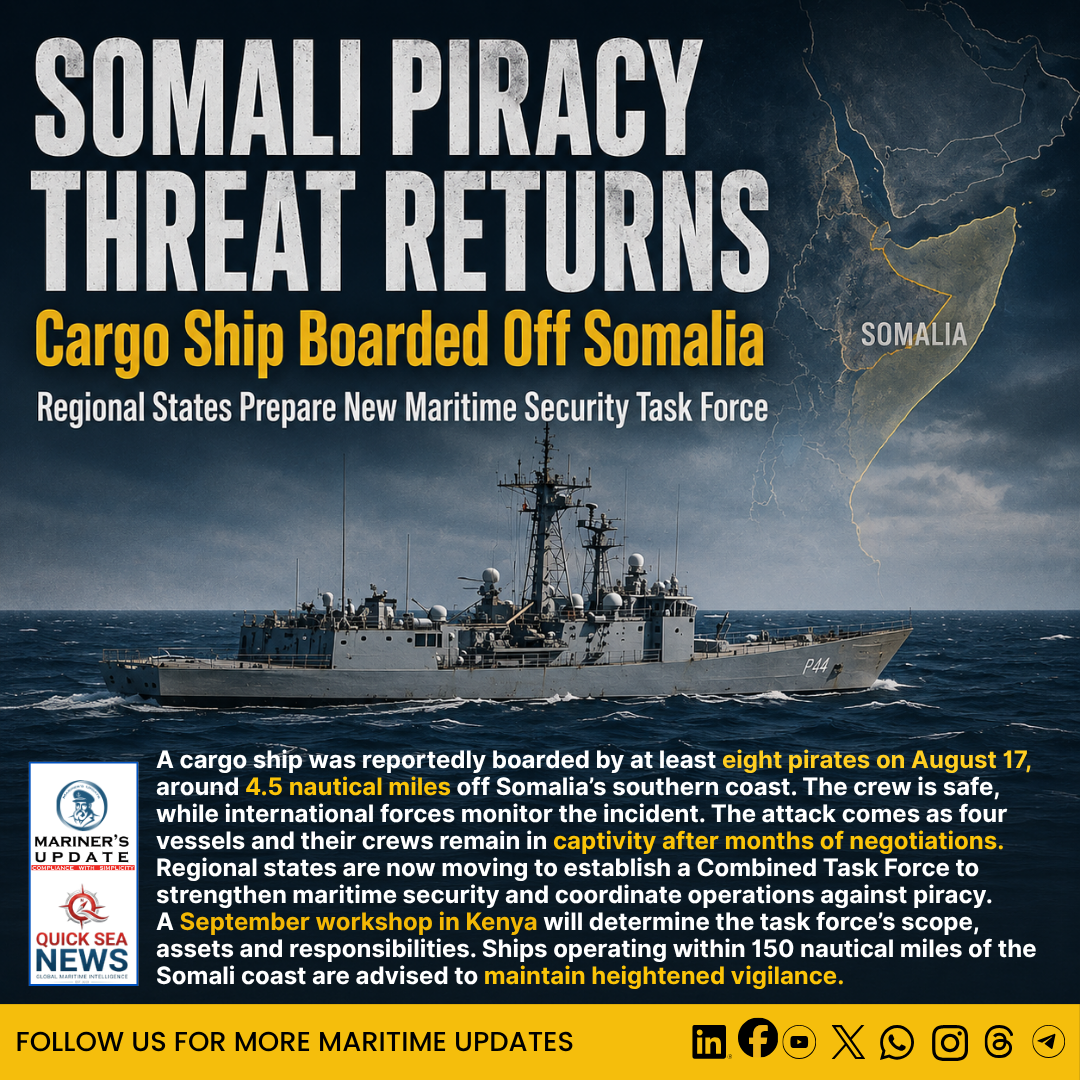
A fresh piracy incident off the Somali coast has raised renewed concerns over maritime security in the region, as regional states prepare to establish a new coordinated security task force to counter piracy and other illicit activities at sea.
According to reports, an unnamed cargo vessel was boarded on Monday, August 17, approximately 4.5 nautical miles south of Maraya, along Somalia’s southern coastline. The vessel’s security officer reported that at least eight pirates boarded the ship and took control of the vessel. The crew is reported to be safe.
The incident is being investigated and monitored by EUNAVFOR Operation ATALANTA. Since the reported boarding occurred within Somalia’s territorial waters, international forces are coordinating their response with the relevant Somali authorities.
Maritime security company Vanguard Tech has identified the vessel involved as the Lutuf, a 1,400-dwt Cameroon-registered general cargo vessel built in 1995. The ship was reportedly sailing from Turkey to Dar es Salaam, Tanzania.
Piracy Incident Comes Amid Ongoing Hostage Crisis
The latest boarding comes against the backdrop of a wider piracy and hostage situation in the region. Four vessels and their crews have reportedly remained in captivity for around four months, despite continued international diplomatic efforts aimed at securing their release.
One of the most significant cases involves the tanker Honour, which has 17 crew members aboard, including 10 Pakistani nationals who have been held since April 21.
Pakistan has highlighted the risks associated with any direct law-enforcement operation to free the crew because of the vessel’s highly explosive cargo.
Pakistan’s Deputy Prime Minister and Foreign Minister Ishaq Dar has reportedly instructed officials to intensify diplomatic engagement with Somali authorities, international organizations and other partners in an effort to secure the sailors’ release.
Egypt has also reportedly directed its diplomats to pursue efforts to free its nationals. However, negotiations are being complicated by reported divisions and infighting among the pirate groups involved.
The Palau-flagged MT Honour 25 is among the four vessels reportedly being held. According to the Djibouti Code of Conduct initiative, seafarers aboard the Honour, Sward, Eureka and Asna remain in captivity.
The organization has again called for the immediate and unconditional release of all seafarers being held hostage.
Regional States Prepare a Combined Maritime Task Force
The resurgence of piracy has also prompted renewed action through the Djibouti Code of Conduct, an initiative established in 2009 to combat piracy and armed robbery against ships in the western Indian Ocean and Gulf of Aden region.
Since 2017, its mandate has expanded beyond piracy to cover a broader range of maritime crimes, including:
- Illegal, unreported and unregulated fishing
- Arms and drug trafficking
- Illegal wildlife trade
- Crude oil theft
- Human trafficking and smuggling
- Illegal dumping of toxic waste
A total of 22 states are participating in the initiative, while 19 states have endorsed its expanded mandate.
Despite significant progress in reducing piracy over the years, the organization says that the underlying conditions allowing piracy to emerge have not been completely eliminated.
Following the recent resurgence in pirate activity, member states began discussing new security initiatives in July. They have now agreed to establish a Combined Task Force designed to coordinate maritime operations and strengthen existing international security efforts in the region.
The initiative is expected to follow the regional security approach previously used successfully in the Gulf of Guinea.
Task Force Structure Still Under Discussion
The exact structure of the proposed task force has not yet been finalized.
Participating states will need to determine:
- The geographical area of operation
- Required maritime assets
- Number and type of vessels or other assets to be contributed
- Operational responsibilities
- Command and coordination arrangements
- Resource requirements
- The task force’s relationship with existing regional and international maritime security mechanisms
These issues will be discussed at a dedicated workshop scheduled to take place in Kenya from September 7 to 9.
The outcome of those discussions could determine how quickly the new regional mechanism becomes operational and how effectively it can complement existing international patrols.
Ships Advised to Maintain Heightened Vigilance
International maritime patrols in the region are continuing, but the latest incident demonstrates that the piracy threat has not disappeared completely.
Vessels operating off Somalia are being advised to maintain heightened vigilance, particularly within 150 nautical miles of the Somali coastline between Mogadishu and Hafun.
For shipowners, operators, masters and crews, the incident serves as another reminder that previously reduced piracy risks can re-emerge rapidly when regional security conditions deteriorate.
The planned Combined Task Force represents an attempt by regional states to strengthen coordination and close security gaps before the renewed activity develops into a wider threat to commercial shipping and seafarer safety.