Every RightShip inspection tells a story about how well a vessel is really run — not just what’s written in the manuals, but how consistently the crew lives up to it day to day. This week, we take a closer look at what inspectors focus on, where the majority of findings actually come from, and why some ships consistently walk away with a clean report while others struggle. The takeaway is simple: preparation is not a one-time event before an inspection, it’s a habit built into daily operations.
WHY RIGHTSHIP INSPECTIONS MATTER
RightShip’s RISQ inspections go well beyond flag and class requirements. Where statutory surveys check whether a vessel meets the minimum legal standard, RISQ digs deeper into whether the safety management system is actually functioning as intended on board — not just documented, but practiced.
- Assess the vessel’s real operational condition and safety performance, based on how well the SMS is implemented in daily work, not just how well it reads on paper.
- Cover regulations, industry requirements, and best practices that often exceed flag and class minimums, meaning a ship can pass a statutory survey and still pick up RISQ findings.
- Provide ship managers with critical, actionable information they can use to close gaps across the crew, the vessel, and the wider fleet — turning an inspection into a genuine improvement tool rather than a one-off pass/fail event.
- Strengthen the transparency and accuracy of vetting recommendations, which charterers and stakeholders increasingly rely on when deciding which vessels to fix.
The payoff for ship managers is tangible: a reduced risk of incidents, detentions, and delays; a stronger signal of safety and reliability to charterers; and better market appeal and resilience for the vessel and the fleet as a whole. In a competitive chartering market, a clean inspection history is increasingly a commercial advantage, not just a compliance checkbox.
THE TRIPLE-P FOCUS: PROCESS, PEOPLE, PLANT
Every RISQ finding, no matter how it’s worded on the report, traces back to one of three root causes — a gap in Process, a gap in People, or a gap in Plant. Looking at a full year of inspection data (July 2023 to July 2024, covering 63,000 total findings) makes it very clear where the industry as a whole is struggling.
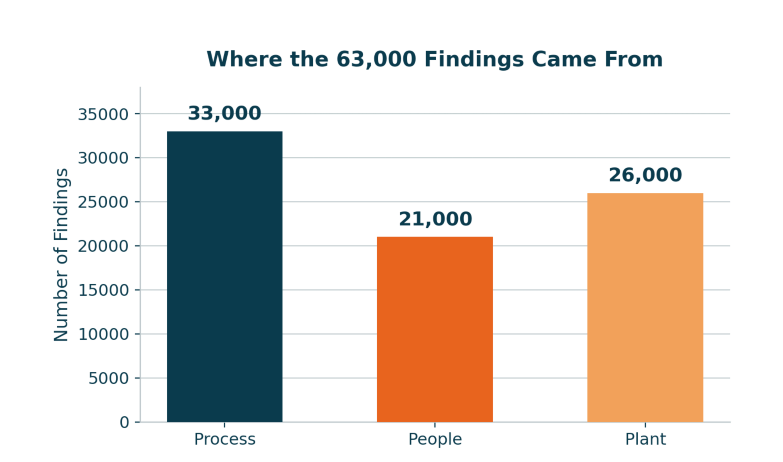
Process — over half of all findings (about 33,000)
Procedures exist to ensure compliance with the ISM Code and to standardize how crew handle training, emergency response, maintenance, and cargo operations across different ships and different crews. When procedures are missing, outdated, or simply not aligned with what RISQ expects, findings pile up. Most of these gaps trace back to an SMS that hasn’t been properly benchmarked against the RISQ Guide to Inspection — meaning the fix often isn’t about writing new procedures from scratch, but about reviewing and integrating what RISQ specifically expects into the existing SMS. Left unaddressed, this raises real questions about consistency of compliance across the wider dry bulk sector, not just on an individual vessel.
People — nearly a third of all findings (about 21,000)
Even the best-written procedures fail if the people executing them haven’t been properly selected, trained, or familiarised. This is where the human element of safety shows up most clearly in the data. Common issues include incomplete or rushed enclosed space entry training (in some cases finished in as little as 14 minutes, which is nowhere near sufficient for something this high-risk) and general unfamiliarity with emergency and mooring procedures. The impact isn’t just a paperwork finding — it’s a real increase in safety risk and non-compliance on board. The solution is straightforward in principle: ship managers need to integrate RISQ training and familiarisation requirements directly into how crew are onboarded and refreshed, not treat it as a one-off induction exercise.
Plant — the largest single share of findings (about 26,000)
Proper maintenance of equipment, machinery, and instruments is what keeps a vessel safe, efficient, and reliable — and it’s also where the largest share of findings originates. Poor maintenance doesn’t just cause paperwork issues; it leads to unexpected breakdowns, increased off-hire time, and genuine safety risk for the crew. The most common failures involve not following the maker’s own recommendations — gyro compasses, hatch covers, and mooring fittings are recurring offenders. The fix is to make sure RISQ maintenance guidance is built directly into the ship’s Planned Maintenance System (PMS), and that manufacturer recommendations are followed as a matter of routine, not just before an inspection is due.
WHERE THE HIGH-RISK FINDINGS CLUSTER
Not all findings carry equal weight. A missing signature on a form and a poorly serviced lifeboat davit are both “findings,” but they represent very different levels of risk. High-risk findings specifically point to a real gap in how safely a ship is being run — and when you look across thousands of inspections, the same handful of issues keeps resurfacing:
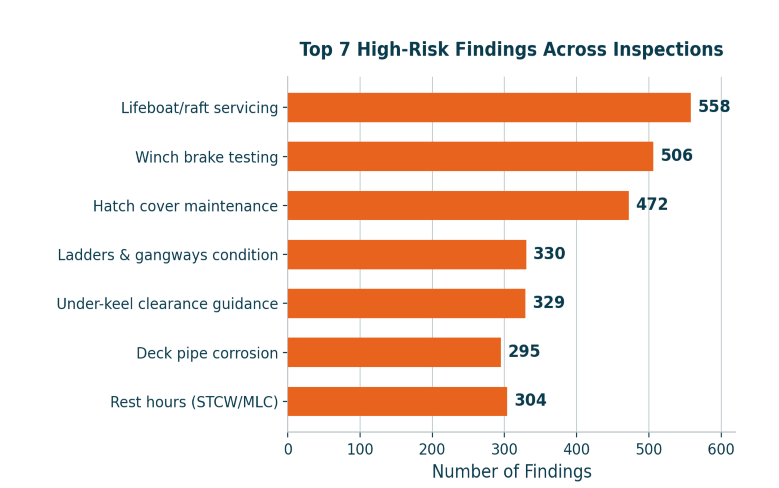
- Lifeboat/rescue boat servicing and launching arrangements — 558 findings
- Winch brake testing procedures for mooring operations — 506 findings
- Hatch cover and lifting appliance maintenance — 472 findings
- Condition of accommodation ladders and gangways — 330 findings
- Under-keel and air draft clearance guidance — 329 findings
- Crew rest hours compliance (STCW/MLC requirements) — 304 findings
- Corrosion and condition of deck pipework — 295 findings
Lifeboat and rescue boat servicing tops the list by a clear margin, followed closely by winch brake testing and hatch cover maintenance. What’s striking is that every single one of these is genuinely preventable — none of them require new technology or major investment, just consistent routine checks, proper documentation, and crew who are actually familiar with the correct procedure rather than just aware that one exists on paper.
UNDERSTANDING SEVERITY LEVELS
RightShip classifies every finding into one of three severity bands, and understanding the difference helps ship managers prioritize corrective action where it matters most:
- Low severity — findings with minimal or no immediate impact or threat to the safety of the vessel, crew, cargo, environment, or operations. These pose a minor risk and don’t meaningfully interrupt day-to-day operations, but they’re still worth closing out to keep the overall record clean.
- Medium severity — findings that present a potential impact or threat to safety. These often reflect weaknesses in processes, procedures, or shipboard practices that, if left unaddressed, could escalate into a significant failure affecting both the ship’s safe operation and the company’s reputation. Corrective action is genuinely necessary here to prevent further escalation, not just a box-ticking exercise.
- High severity — findings that represent an immediate threat to the safety of the vessel, crew, environment, or operations. These indicate a real, systemic lapse in how effectively the safety management system is being implemented, and they demand immediate corrective action from ship management. Left unresolved, high-severity findings can escalate into serious incidents, detentions, or legal consequences.
2024 INSPECTION SNAPSHOT
The scale of RightShip’s inspection program in 2024 gives a useful sense of just how widely this framework is applied across the global fleet:

- 3,308 inspections completed across the year
- 2,615 vessels covered, spanning over 735 Document of Compliance (DOC) holders
- 763 ports visited
- 93 countries involved
A few patterns stand out in the numbers. Ninety-three percent of inspections were marked acceptable, and of those, 60 percent received a 9- or 12-month validity — a strong signal that most of the industry is genuinely engaging with the process rather than scraping through. Two-thirds of inspections took place post-discharge specifically to minimise disruption for crew who are already managing other operational demands during port calls. Perhaps most interesting: age is not the deciding factor in outcomes. Looking at the most recent six months of data, vessels under 10 years old still only averaged a 95 percent acceptance rate, while vessels aged 10 to 14 years averaged 89 percent and vessels over 14 years averaged 91 percent. In other words, a newer ship is not automatically a better-prepared ship — genuine preparation matters more than age on the certificate.
GETTING YOUR SHIP INSPECTION-READY
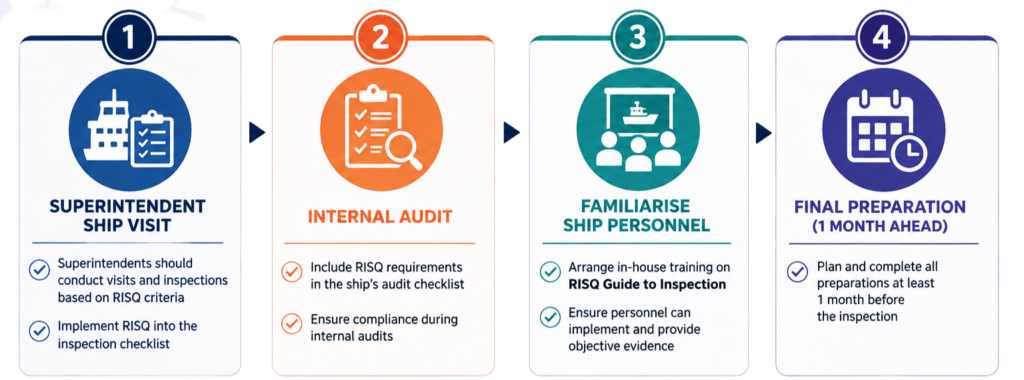
RightShip’s own guidance breaks preparation down into four clear, sequential stages that ship managers can build into their existing routines rather than treating as a separate, standalone exercise:
Step 1 — Superintendent ship visit.
Superintendents should conduct visits and inspections specifically benchmarked against RISQ criteria, and RISQ should be formally built into the vessel’s own inspection checklist — not treated as a separate external standard.
Step 2 — Internal audit.
RISQ requirements should be folded directly into the ship’s existing internal audit checklist, so compliance is verified from within the organisation well before an external inspector ever steps aboard.
Step 3 — Familiarise the crew.
Arrange proper in-house training on the RISQ Guide to Inspection, going beyond simple awareness so that crew can genuinely implement the requirements and provide objective evidence when asked — the same evidence an inspector will be looking for.
Step 4 — Final preparation.
In the month leading up to the scheduled inspection, run a final readiness check across all three areas — Process, People, and Plant — to catch and close out any last gaps before the inspector arrives.
The data backs up the value of this discipline: ship managers who undertake proper gap assessments against RISQ, prepare deliberately, and plan ahead consistently achieve better outcomes and genuinely perform better over time. Out of the full 2024 inspection pool, 362 vessels came through with 10 or fewer findings in total — proof that a low-finding inspection is entirely achievable with the right groundwork, not just a matter of luck.
2025 TIMELINE TO WATCH
A few important dates are coming up this year that ship managers and owners should have on their radar when planning inspections and fleet compliance:
- Early booking window: Vessels built after 1 October 2011 that complete their inspection during the early booking window can benefit from a reduced booking cost of $1,000 — a straightforward incentive to plan ahead rather than book at the last minute.
- 1 July 2025: RightShip’s vetting criteria will be updated to require an acceptable inspection for vessels aged 13 years and older, subject to charterer requirements — meaning older vessels in this age bracket will need to ensure their inspection status is current well ahead of this date.
- 1 October 2025: Phase 1 of the RightShip Inspection SS2/5 hybrid rule will be updated to apply to vessels aged 13 years and older, extending the scope of vessels affected by the hybrid inspection framework.
Ship managers with vessels approaching these age thresholds should treat this timeline as a planning trigger now, rather than waiting until closer to the deadline when booking slots and preparation time become harder to secure.