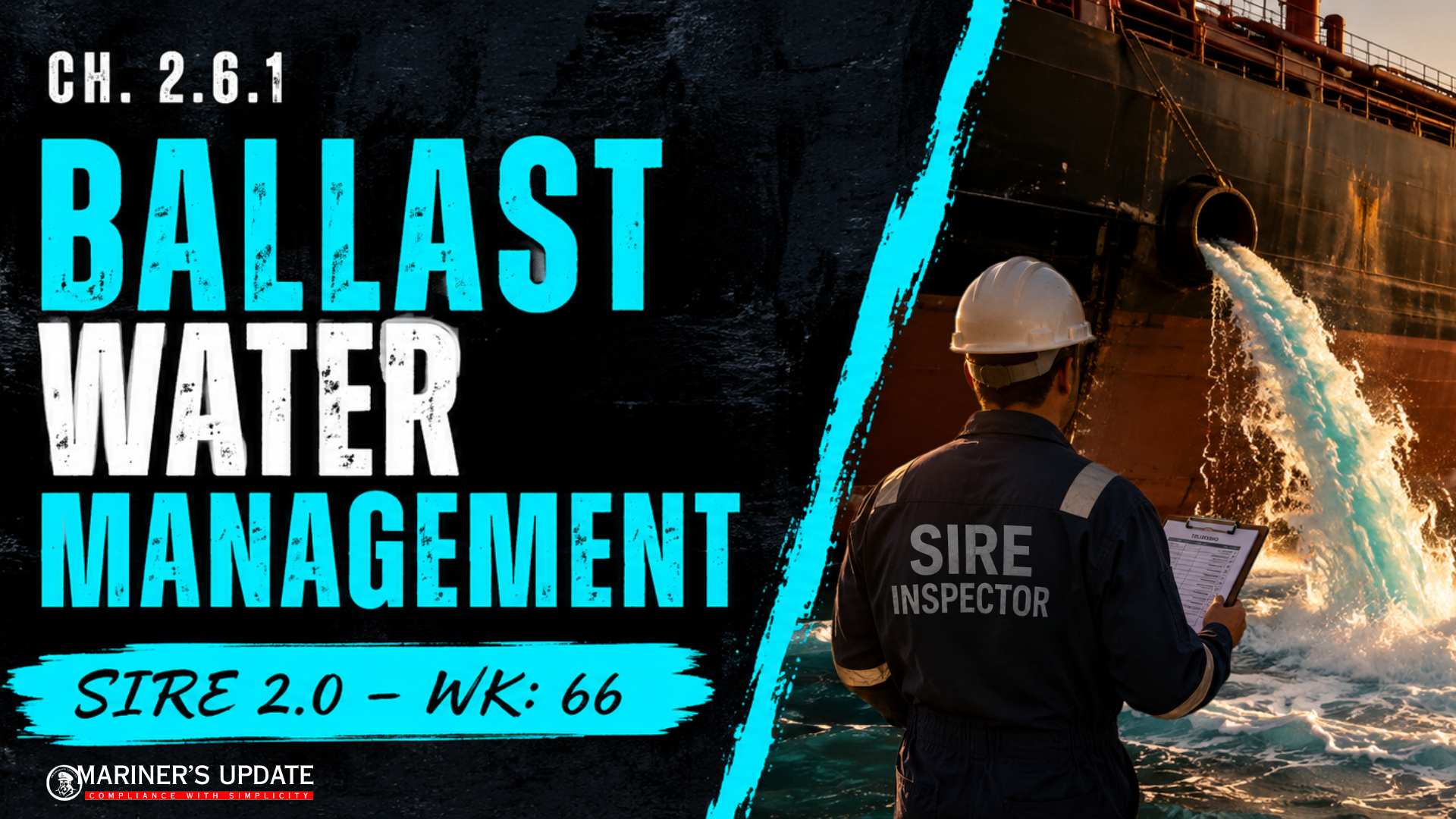
Chapter 2.6.1
Were the Master, deck officers and engineer officers familiar with the vessel’s Ballast Water Management Plan and were records available to demonstrate that ballast handling had been conducted in accordance with the plan?
Applies to: Oil Tanker | Chemical Tanker | LNG | LPG
Potential Ground for Negative Observation (OBS)
• The vessel did not have a Ballast Water Management Plan or a valid Ballast Water Management Certificate.
• The Ballast Water Management Plan was not approved by the Flag Sate or recognised organisation such as a class society.
• The Ballast Water Management Plan was not ship-specific.
• The officer designated in the Ballast Water Management Plan to be in charge of ensuring that the plan was properly implemented was not familiar with its contents.
• The Ballast Water Management Plan was not written in the working language of the ship.
• The accompanying deck or engineering officer was unfamiliar with the Ballast Water Management Plan, or the entries required to be made in the ballast water record book.
• The Ballast Water Record Book had not been maintained in accordance with company procedures.
• Where ballast water exchange had taken place there was no plan showing the sequential exchange of ballast which included the longitudinal stress at each stage of the operation.
• The ballast water treatment plant was reported to be defective in any respect.
• Where ballast operations had not been completed in accordance with the Ballast Water Management Plan due to defect or accident to the ballast water treatment plant there was no evidence that the Flag and / or Port State Authorities had been notified.
• Where Flag or Port State Authorities had imposed conditions on the vessel due to the failure of the ballast water treatment plant, the vessel had not complied with the conditions imposed.
• There was evidence that the ballast water treatment plant had been bypassed in contravention to the Ballast Water Management Plan.
Checklist for You
- Is Ship specific Ballast Water Management Plan along with a copy of valid Ballast Water Management Certificate available onboard?
- Is Ballast Water Management Plan approved by the Flag Sate or classification society?
- Is Ballast Water Management Plan written in the working language of the ship?
- Is Ballast Water Record Book maintained in accordance with company procedures?
- Where ballast water exchange had taken place is there a plan showing the sequential exchange of ballast including the longitudinal stress at each stage of the operation?
- Where ballast operations had not been completed in accordance with the Ballast Water Management Plan due to defect or accident to the ballast water treatment plant is there a evidence that the Flag and Port State Authorities had been notified?
- Where Flag or Port State Authorities had imposed conditions on the vessel due to the failure of the ballast water treatment plant, has vessel complied with the conditions imposed?
- Is there any instance that the ballast water treatment plant had been bypassed in contravention to the Ballast Water Management Plan and not reported to relevant authorities?
- Is the officer designated in the Ballast Water Management Plan to be in charge of ensuring that the plan was properly implemented familiar with its contents?
- Are all deck and engineering officers familiar with the Ballast Water Management Plan, and the entries required to be made in the ballast water record book?
- Is ballast water treatment plant free of any defect or alarm?
Guidelines
Human
Designated officer & Accompanying officer must be familiar with the BWMP & Entries required to be made in the BWRB
PROCESS
1. Ship-Specific BWMP
- The BWMP must be tailored for your ship and written in the ship’s working language.
2. Familiarity with Responsibilities
Crew members with BWMP duties must know:
- Safety procedures for ballast water management.
- Steps to follow BWMC rules and extra practices.
- How to handle sediment disposal at sea or onshore.
- Rules for loading, discharging, and exchanging ballast water.
- How to properly record ballast operations.
- What to do if the ballast water treatment system fails.
3. Inspector’s Review
Inspectors will:
- Check the BWMP and ensure the crew understands it.
- Verify the main ballast water management method in use.
- Inspect the ballast water record book for recent operations.
4. Record Accuracy
Keep proper records of ballast water exchanges, including:
- Plans and stress assessments during exchanges.
- Draught and trim at each stage of the operation.
5. Non-Compliance Documentation
If ballast operations deviate from the BWMP due to system failure:
- Record communications with Flag and Port State Authorities.
- Document conditions set by these authorities and ensure compliance.
Keep your BWMP updated, and train the crew to follow and document all ballast-related operations accurately.
HARDWARE
The inspector will sight BWTS plant, check for functional and their evidence of bypass which contravenes with the BWMP.
Reference
TMSA KPI 6.2.3 requires that comprehensive procedures cover all aspects of ballast handling operations. These procedures may include:
• Ballast water exchange. • Ballast water treatment.
IMO: ISM Code/7.
IMO: Ballast Water Management Convention and BWMS Code/Regulation B-1
IMO Resolution MEPC.252(67) – Guidelines for port state control under the BWM Convention.
IMO Resolution MEPC.288(71) – 2017 Guidelines for ballast water exchange.
OCIMF/ICS: International Safety Guide for Oil Tankers and Terminals. Sixth Edition.