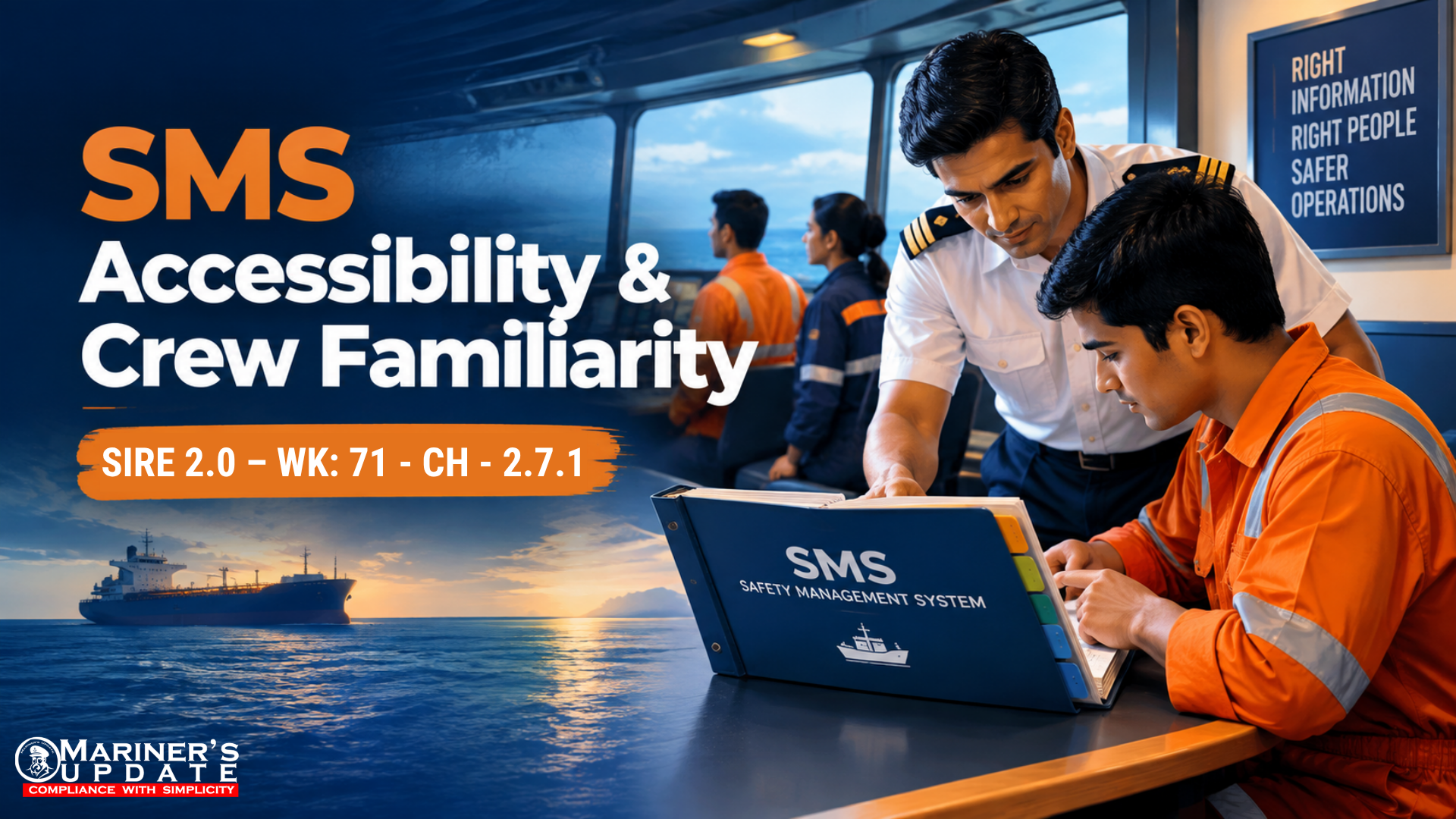
Ch 2.7.1 — SMS Accessibility & Crew Familiarity
Was the relevant content of the SMS manuals easily accessible to all personnel on board in a working language(s) understood by them?
Applies to: Oil Tanker | Chemical Tanker | LNG | LPG
Potential Ground for Negative Observation (OBS)
• The SMS manuals were not ‘user friendly’ and ship staff found it difficult and/or time consuming to navigate to the appropriate information.
• A significant proportion of the content of the SMS manuals was not relevant to the ship e.g. described procedures for general cargo ships, container ships or bulk carriers.
• Manuals were in hard-copy format but there were insufficient copies at appropriate locations.
• Manuals were only available in electronic format, but not all personnel had ready access to a work-station and/or adequate training in accessing the SMS.
• The operator’s navigation procedures and instructions were not available on the bridge.
• The operator’s navigation procedures and instructions were available on the bridge in electronic format only, but a back-up independent means of power supply to the work-station was not provided.
• All or some of the copies of the SMS manuals had not been updated with the latest changes.
• Obsolete documentation, such as procedures or checklists which had been revised and superseded, were in use on board.
• There was no procedure to ensure that changes to the SMS were promptly brought to the attention of the appropriate on- board personnel and understood.
• There was no evidence that changes to the SMS had been promptly brought to the attention of the appropriate on-board personnel and understood.
• An interviewed rating was not familiar with the process to access the sections of the SMS relevant to their role.
• An interviewed rating was not able to understand the sections of the SMS manuals relevant to their role onboard in the language(s) in which they were provided.
Checklist for You
1. Where Manuals were only available in electronic format, do all personnel had ready access to a work-station and adequate training given in accessing the SMS?
2. Are all officers and ratings familiar with the process to access the sections of the SMS relevant to their role?
3. Are all ratings able to understand the sections of the SMS manuals relevant to their role onboard in the language(s) in which they were provided?
4. Are SMS manuals ‘user friendly’ and ship staff is able to navigate to the appropriate information easily?
5. Are SMS manual contents relevant to the ship?
6. Where navigation procedures and instructions were available on the bridge in electronic format only, is there a backup independent means of power supply to the work-station provided?
7. Are all the copies of the SMS manuals been updated with the latest changes?
8. Is there any obsolete documentation, such as procedures or checklists which had been revised and superseded, used on board?
9. Are there procedures and evidence which show that changes to the SMS are promptly brought to the attention of the appropriate on-board personnel and understood?
Guidelines
HUMAN
Role-Based Knowledge
Crew, including Ratings, must:
Know how to access SMS sections relevant to their duties.
Understand SMS manuals provided in the language(s) they read.
Easy Access to SMS
Ensure all crew can quickly find SMS content they need.
Navigation procedures and instructions must be readily available on the bridge, in electronic or hard copy format.
Regularly train and test the crew on SMS procedures to ensure familiarity and compliance.
PROCESS
1. Ship-Specific SMS
- Ensure the SMS is relevant to your ship type.
2. Document Management
- Changes to the SMS must be reviewed and approved by authorized personnel.
- Remove outdated documents promptly.
- Inform onboard personnel about updates without delay.
3. User-Friendly Manuals
- SMS manuals must be easy to navigate and time-efficient for the crew to use.
4. Accessibility of Hard-Copy Manuals
- Provide enough copies in key locations onboard.
- Ensure all copies are updated to the latest version.
5. If Electronic Manuals available:
Relevant personnel must:
- Have easy access to workstations.
- Be trained to use electronic SMS systems.
- Ensure bridge workstations have a backup power source if SMS is in electronic format only.
Regularly review and update the SMS to ensure compliance, accessibility, and ease of use for all crew members.
Reference
TMSA KPI 1A.1.4 requires that procedures and instructions are easily accessible to personnel and available at appropriate locations. Sufficient electronic or hard copies of procedures and instructions are easily accessible to all personnel, including contractors, at appropriate locations which may include:
• Onboard vessels.
IMO: ISM Code/6.6 ,11.1, 11.2, 11.3