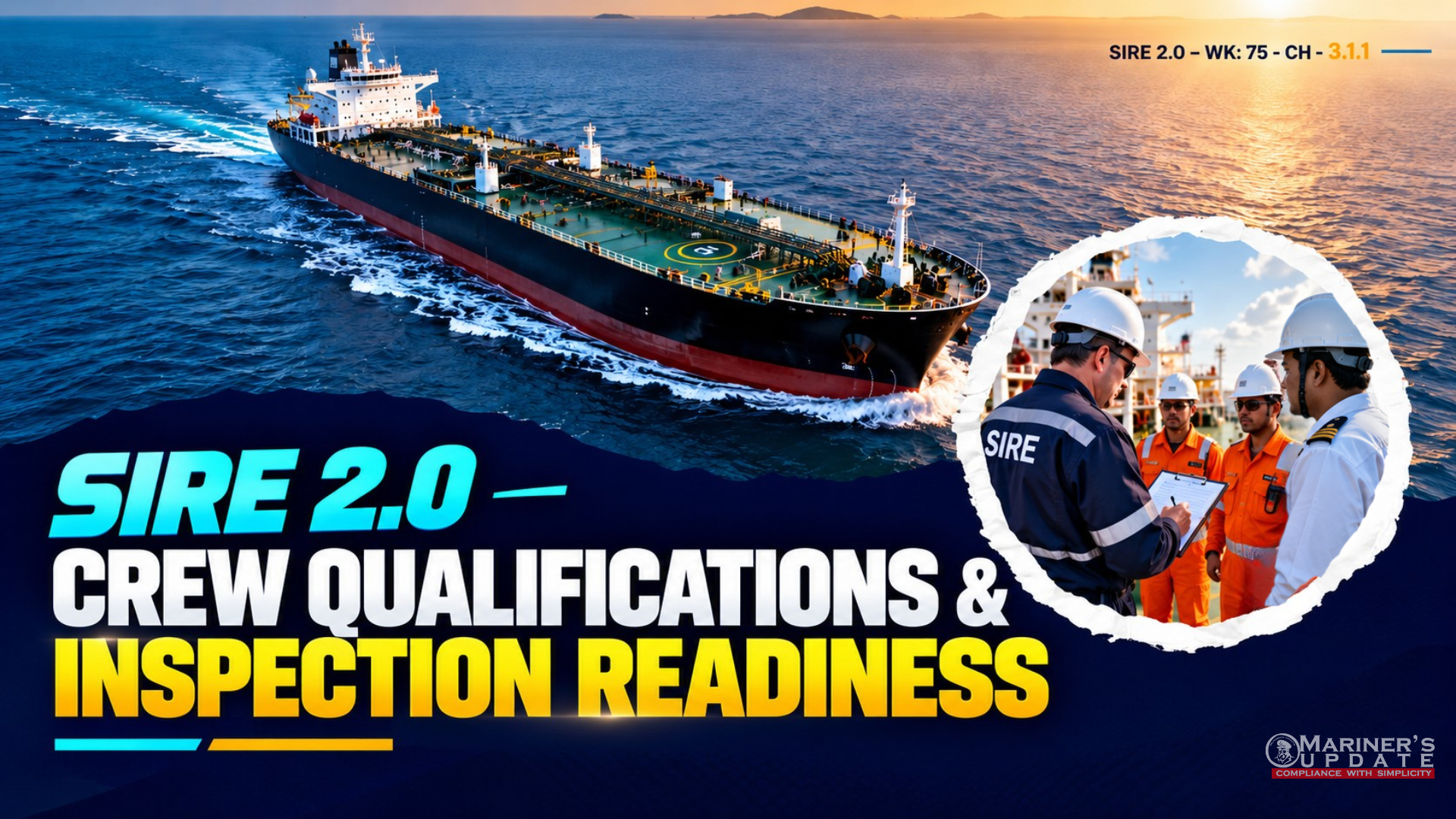
SIRE 2.0 – Ch 3.1.1
Officer & Rating Qualifications, Experience and English Language Capabilities
Applies to: Oil Tanker | Chemical Tanker | LNG | LPG
Ch 3.1.1
Were the officers and ratings suitably qualified to serve onboard the vessel and did the officer matrix posted on the OCIMF website accurately reflect the qualifications, experience and English language capabilities of the officers onboard at the time of the inspection?
Potential Ground for Negative Observation (OBS)
• The officer matrix had not been updated to reflect the officers who were on board at the time of the inspection (an allowance will be made for any officer that had changed within the previous four days).
• The accompanying senior officer was unfamiliar with the maintenance of officer and rating certification records onboard.
• The details contained in the officer matrix were inaccurate in terms of:
o National Certificate of Competency (CoC).
o National Certificate in advanced or basic training for oil, gas or chemical service.
o Flag endorsements of CoC or training for oil, gas or chemical service.
o National radio operator license or flag endorsement.
o The sea service in rank.
• An officer’s CoC or Flag Endorsement included a limitation that would prevent them from performing their duties on the inspected vessel.
• A senior officer, junior deck officer or cargo/gas engineer did not hold a certificate in advanced training for oil, chemical or liquified gas tanker operations as applicable to the vessel type.
• A rating, including the pumpman, with immediate responsibility for loading, discharging, care in transit, handling of cargo tank cleaning or other cargo-related operations on oil, chemical or liquified gas tankers did not hold a certificate in advanced training for tanker operations as applicable to the vessel type.
• The sea time in rank for any officer whose records were sampled was found to be inaccurate or records were not available to verify sea time in rank. (verification checks will only cover up to thirty-six months sea service onboard).
• The flag endorsement for any individual officer did not reflect the details of the national CoC on which they were based.
• There was a concern with the standard of English language comprehension or spoken English with an officer who was recorded as having a “good” standard of English within the published officer matrix.
Checklist for You
1. Is the crew matrix uploaded in OCIMF accurate and free of errors?
2. Is there supporting RA if senior officers have been changed without adequate stagger?
3. Is the crew matrix shared with vessel regularly for accuracy checks?
4. Is there consolidated sea service record for each officer to demonstrate qualification, experience?
5. Are the required certificates for each individual available and presented in a standard order with an index indicating which certificates were mandatory for the role on board?
6. Do all senior officers and junior deck officers hold a certificate in advanced training for oil/chemical as applicable?
7. Are the officers adequately experienced for the type and class of vessel?
Guidelines
PROCESS
1. Crew Matrix Upload
- Upload the updated crew matrix to the OCIMF website no more than four days before the inspection.
2. Inspector Verification
- The Inspector will check the accuracy of the matrix by randomly selecting:
- Certificates of competency, endorsements, and sea service records (up to 36 months) will be verified.
3. Training Certificates
- Senior Officers, Junior Deck Officers, and Cargo/Gas Engineers must hold advanced training certificates for oil, chemical, or liquefied gas tanker operations (based on vessel type).
- Junior Engineer Officers must hold basic training certificates for oil, chemical, or liquefied gas tanker operations.
- Pumpman and Ratings supervising cargo operations must also hold advanced training certificates as applicable.
4. Operator Responsibilities
- Ensure all crew have statutory and company-required certifications and course completion certificates for their roles.
- Present certifications in a standard order with an index for mandatory certificates.
- Maintain a consolidated record of sea service for all Officers.
- Verify that sea time in rank is accurate and records are available.
- Ensure Flag endorsements reflect the details of national CoCs.
5.Definition of Immediate Responsibility
- Includes watchkeeping Officers (e.g., 2nd, 3rd, 4th Officers, and Cargo/Gas Engineers) and any Ratings supervising cargo operations (e.g., pumpman).
Keep crew documentation organized, updated, and indexed for easy verification by the Inspector. Regularly review training and certification compliance to avoid last-minute issues.
HUMAN
1. Certification Records
- The Senior Officer accompanying the Inspector must be familiar with certification records of Officers and Ratings.
- Certification for Deck Ratings involved in cargo or equipment duties must include basic training for oil, chemical, or liquefied gas tanker operations (based on vessel type).
2. English Proficiency
- The Inspector will assess the English comprehension and speaking skills of the Master, Chief Engineer, and other Officers.
- If communication issues are found, the Inspector will document the level of English proficiency in the Officer matrix against the individual’s rank.
Ensure all Officers and Ratings have valid certifications for their roles and provide regular English language training to improve onboard communication.
Reference
TMSA KPI 3.2.3
TMSA KPI 3.2.3 requires that the company verifies that vessel personnel quality requirements are consistently met. Irrespective of whether this function is performed internally or by a manning agency, verification may include:
• Certification and experience.
• Compliance with manning procedures and legislative requirements.
IMO: ISM Code
6.2 The Company should ensure that each ship is:
- manned with qualified, certificated and medically fit seafarers in accordance with national and international requirements; and
- appropriately manned in order to encompass all aspects of maintaining safe operations on board.
IMO: STCW Code
Part A
Chapter II – Standards regarding the Master and deck department.
Chapter III – Standards regarding the engine department.
Chapter IV – Standards regarding radio operators.
Chapter V – Standards regarding special training requirements for personnel on certain types of ships:
Section A-V/1-1 – Mandatory minimum requirements for the training and qualifications of masters, officers and ratings on oil and chemical tankers.
Section A-V/1-2 – Mandatory minimum requirements for the training and qualifications of masters, officers and ratings on liquified gas tankers.
Part B
Chapter V – Guidance regarding special training requirements for personnel on certain types of ship.
Section B-V/1 – Guidance regarding the training and qualifications of tanker personnel.